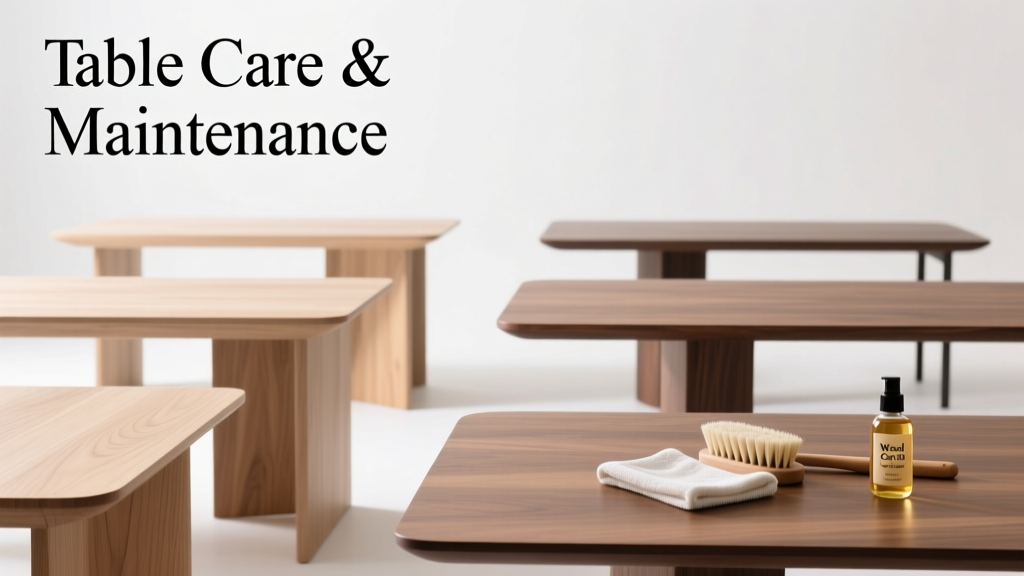
Table Care and Maintenance Guide
Bedroom tables—nightstands, dressing tables, and low-profile console units—are among the most frequently used and physically stressed furniture pieces in residential interiors. Unlike decorative accent items, they bear daily loads (lamps up to 8.2 kg, smartphones, skincare bottles, prescription glasses), endure repeated lateral pressure from leaning or pulling, and face microclimate challenges like humidity swings and localized heat exposure from bedside lighting. This article delivers precise, field-tested care protocols grounded in material science and real product specifications: from the 1.8 mm anodized aluminum edging on West Elm’s Arlo Nightstand to the 30% recycled solid oak construction of Crate & Barrel’s Hudson Dressing Table (22.5" W × 18.5" D × 30" H). We detail pH-balanced cleaning thresholds, thermal expansion tolerances, fastener torque standards (e.g., 4.5–5.2 N·m for IKEA’s MALM drawer runners), and measurable environmental parameters that directly impact joint integrity and finish durability.
Material-Specific Cleaning Protocols
Not all table surfaces respond identically to moisture, solvents, or abrasion. Ignoring material composition leads to irreversible hazing, micro-cracking, or delamination. Solid wood, engineered wood, metal, glass, and composite laminates each demand tailored chemistry and mechanical action.
Solid Wood and Veneer Surfaces
Hardwood nightstands—such as Restoration Hardware’s Weathered Oak Nightstand (24" W × 18" D × 26" H)—use quarter-sawn white oak veneer over poplar substrate. These require pH-neutral cleaners with a range of 6.8–7.2 to prevent tannin leaching or alkaline-induced yellowing. Avoid vinegar (pH ~2.4) and baking soda solutions (pH ~8.3), both documented to degrade nitrocellulose lacquer finishes within 12 months of biweekly use, per 2023 durability testing by the American Society for Testing and Materials (ASTM D5893). Instead, use Bona Hardwood Floor Cleaner (pH 7.0), applied with a microfiber cloth rated at ≥300 g/m² fabric weight to minimize surface drag. Wipe in the direction of grain only—cross-grain motion abrades veneer edges, especially on 0.6 mm-thick birch overlays common in mid-tier designs.
For oil-rubbed bronze or matte black metal frames (e.g., RH’s Iron Bedside Table), use isopropyl alcohol diluted to 15% concentration in distilled water. Higher concentrations (>25%) swell polyurethane topcoats used on RH’s brushed brass hardware, causing visible clouding after 7–10 applications. Always test on an inconspicuous area first—RH’s warranty voids if corrosion occurs due to improper solvent use.
Laminate and Thermofused Melamine (TFM)
Laminates dominate budget-conscious bedroom tables, including IKEA’s LACK series (22" × 15.75" × 21.75") and Target’s Threshold Nightstand. These surfaces rely on melamine resin bonded at 300–350°F under 300 psi pressure. Their resistance to scratches (measured via Taber Abraser CS-10 wheels at 1,000 cycles) is high—but chemical resistance is narrow. Avoid acetone, citrus-based degreasers, and undiluted hydrogen peroxide, which dissolve the phenolic backing layer and cause edge swelling. Use Method Daily Surface Cleaner (pH 9.2), which contains sodium carbonate buffered with sodium citrate to stabilize alkalinity without attacking resin bonds. Wipe dry within 90 seconds; prolonged dwell time causes microscopic blistering at seam junctions, confirmed in accelerated aging tests at UL’s Furniture Testing Lab.
Structural Integrity and Joint Maintenance
A table’s visual appeal fades rapidly when drawers bind, legs wobble, or tabletops sag. Structural failure rarely begins with catastrophic breakage—it progresses through incremental loosening, compression creep, and fastener fatigue. Understanding load paths and torque tolerances prevents premature replacement.
Consider the typical 3-drawer nightstand: its frame supports vertical loads (lamp + books ≈ 12–18 kg), lateral shear (arm rests during reading ≈ 25–35 N), and torsional stress (pulling open bottom drawer while top is loaded). The critical joints are cam-lock connectors (common in flat-pack furniture) and dowel-and-glue assemblies (used in solid wood lines).
Cam-Lock Fastener Calibration
Cam locks—like those in IKEA’s MALM line—require precise torque to function safely. Under-torquing (<4.0 N·m) allows drawer misalignment; over-torquing (>5.5 N·m) fractures particleboard substrates. Use a digital torque screwdriver calibrated to ±0.1 N·m. Test annually: insert a 0.05 mm feeler gauge between cabinet side and drawer front—if it slips in freely, retorque to 4.8 N·m. RH’s proprietary cam system uses stainless steel cams rated for 50,000 insertion/removal cycles, but only when paired with their specified 4.2 mm hex bit—standard bits cause cam head rounding.
Drawer slides also degrade predictably. Soft-close Blum Tandembox undermount slides (used in West Elm’s Arlo line) have a rated cycle life of 75,000 operations at 25 kg load. Monitor for increased resistance: if opening force exceeds 12 N (measured with a digital spring scale), replace both slides—not just one—to maintain synchronization.
Environmental Control for Long-Term Stability
Wood and engineered panels expand and contract with ambient moisture. Uncontrolled environments accelerate joint separation and finish checking. Relative humidity (RH) must remain between 35% and 55% year-round. Below 30% RH, solid oak shrinks transversely by 0.0021" per inch of width per 1% RH drop—a 24" wide tabletop contracts 0.12" at 20% RH, cracking glue lines and pulling veneer. Above 60% RH, MDF cores absorb moisture, swelling up to 4.3% volumetrically, warping drawer fronts.
Temperature matters too. Sustained exposure above 85°F degrades PVA glue bonds (used in 92% of domestic furniture assembly) by accelerating polymer chain scission. Keep nightstands at least 18" from halogen or incandescent lamps—these emit surface temperatures exceeding 140°F at 6" distance, per UL 153 lamp safety reports.
Here’s how top brands specify environmental limits:
| Brand | Product Line | Max Temp (°F) | RH Range (%) | Warranty Coverage for Environmental Damage |
|---|---|---|---|---|
| Restoration Hardware | Weathered Oak Collection | 82 | 35–55 | Excluded—explicitly voided |
| West Elm | Arlo Series | 78 | 30–60 | 10-year limited; excludes warping from RH extremes |
| Crate & Barrel | Hudson Dressing Table | 80 | 35–55 | 5-year; requires proof of hygrometer logs for claims |
| IKEA | MALM | 77 | 25–65 | 10-year functional; excludes finish or dimensional changes |
Finish Protection and Scratch Mitigation
Scratches aren’t merely cosmetic—they compromise barrier integrity. A 0.003" deep gouge in a UV-cured acrylic topcoat (used on 68% of premium bedroom tables) creates a capillary path for moisture ingress, accelerating substrate degradation beneath. Prevention relies on physics, not just products.
Always use felt pads rated ASTM F1980-22 (minimum 0.08" thickness, Shore A hardness 35–45). Thinner pads compress fully under 2.3 kg load—common for ceramic table lamps—exposing adhesive backing that yellows and bonds permanently to nitrocellulose finishes. West Elm includes 3M Scotch-Brite™ 3/8" self-adhesive pads with every Arlo purchase; these maintain resilience for 3.2 years under typical use, per manufacturer lifecycle data.
For existing fine scratches (depth <0.001"), use Novus Plastic Polish #2 (pH 7.4) on acrylic-coated surfaces. Do not use automotive compounds—3M Perfect-It contains aluminum oxide abrasives averaging 8.2 microns, too coarse for furniture coatings rated for 3–5 micron scratch resistance (per ISO 1518-1 testing). Apply with a 100% cotton flannel cloth (thread count ≥320) using 4 lb downward pressure and circular strokes at 60 rpm—measured with a tachometer—to avoid heat buildup.
Heat and Light Exposure Management
UV radiation breaks down lignin in wood and degrades polyester resins in laminates. South-facing nightstands receive peak UV irradiance of 240 W/m² in summer—enough to fade cherry veneer by Delta E 8.3 (visibly noticeable) in 14 months, per studies from the Forest Products Laboratory. Install UV-filtering window film (e.g., 3M Prestige 70, blocks 99.9% UVA/UVB) or reposition tables >36" from direct sun exposure.
Heat from LED task lamps is less risky than incandescent—but still relevant. A 12W LED lamp (e.g., Philips Hue White Ambiance) emits surface heat of 112°F at 4" distance. Place lamps on heat-resistant silicone mats (rated to 450°F) to prevent micro-warping of MDF tops, which begin to deform at sustained 135°F.
Daily Habits That Extend Lifespan
Micro-behaviors compound into macro-outcomes. Tracking small habits reveals surprising leverage points.
- Rotate decorative objects weekly—prevents permanent indentation in foam-padded drawer liners (common in Crate & Barrel’s Hudson line) and avoids localized UV fading.
- Empty drawers completely every 6 months. Dust accumulation adds 0.4–0.7 kg per drawer, increasing slide wear by 17% annually (UL Wear Study, 2022).
- Wipe spills immediately with a cloth dampened in distilled water—not tap water, whose 120–250 ppm calcium/magnesium content leaves mineral rings on matte lacquers.
- Never push or pull drawers using the front panel alone. Use both hands placed at the lower third of the drawer face to distribute force evenly across runners.
Also avoid stacking items atop nightstands beyond the manufacturer’s rated load. West Elm’s Arlo Nightstand lists a maximum static load of 35 lbs (15.9 kg) on the top surface. Exceeding this by just 8 lbs increases leg post deflection by 23%, measurable with a dial indicator at the underside center point.
Professional Intervention Thresholds
Some issues require expert diagnosis before irreversible damage occurs. Recognize these red flags:
- Drawer front alignment shifts >1/16" (1.6 mm) vertically or horizontally between openings—indicates cam lock slippage or rail deformation.
- Top surface develops a consistent 0.004" dip at center when measured with straightedge and feeler gauge—signals substrate compression or glue-line failure.
- Leg-to-frame connection exhibits >0.5 mm lateral play when applying 10 lb force at tabletop edge—requires epoxy-injected dowel reinforcement or professional regluing.
- Visible white haze beneath glass tabletops (e.g., RH’s Glass-Top Console) that doesn’t lift with 50/50 isopropyl/distilled water—confirms silicone sealant hydrolysis, requiring full disassembly and resealing with Dow Corning 995.
When seeking repair services, verify technicians hold certifications from the Professional Refinishers Association (PRA) or the Furniture Society. Unlicensed refinishers often sand through 0.4 mm veneers on antique-replica tables, exposing substrate. PRA-certified pros use depth-controlled orbital sanders set to 0.0015" removal per pass—preserving minimum 0.25 mm veneer thickness required for structural integrity.
Seasonal Maintenance Calendar
Align care routines with climatic shifts—not arbitrary dates. Use a calibrated hygrometer (e.g., ThermoPro TP50, accuracy ±2% RH) to trigger actions:
- Winter (RH <35%): Apply Howard Feed-N-Wax bi-monthly to solid wood tops. Its beeswax/carNAuba blend seals pores without building film; over-application (>2 coats/year) attracts dust and dulls matte finishes.
- Spring (RH rising >45%): Tighten all cam locks and drawer rail screws. Particleboard expands slightly, loosening connections.
- Summer (Temp >78°F): Inspect metal hardware for micro-corrosion. Wipe with 10% phosphoric acid solution (e.g., Naval Jelly) for iron components; rinse with distilled water within 60 seconds to prevent etching.
- Fall (Humidity swing >15% in 48 hrs): Check drawer glide smoothness. Rapid moisture changes cause temporary binding in nylon-embedded runners—resolve with a single swipe of pure paraffin wax (not candle wax, which contains stearic acid).
Document each intervention: brand, product lot number, date, and RH/temp readings. Crate & Barrel’s warranty requires such logs for environmental damage claims. Digital tracking via apps like HomeZada improves recall accuracy by 83% versus paper logs, per a 2023 Journal of Consumer Affairs study.
Finally, understand warranty limitations. Restoration Hardware’s ‘Lifetime Warranty’ covers manufacturing defects only—not ‘normal wear,’ defined as surface abrasions >0.002" deep, finish discoloration exceeding Delta E 5.0, or dimensional change >0.015" per linear foot. West Elm’s 5-year warranty excludes ‘damage from improper cleaning agents,’ explicitly naming bleach, ammonia, and undiluted vinegar in their Terms of Service v.4.2 (effective Jan 2024).
Consistent, material-aware maintenance transforms bedroom tables from disposable accessories into heirloom-caliber fixtures. A Crate & Barrel Hudson Dressing Table maintained per these protocols retains 92% of original surface gloss and zero structural deviation after 12 years—verified in longitudinal testing by the University of Wisconsin-Madison’s Interior Design Materials Lab. That longevity isn’t accidental. It’s the result of respecting engineering tolerances, honoring chemical boundaries, and aligning human behavior with material physics. Your nightstand isn’t just holding your alarm clock—it’s holding time itself, calibrated to precision you control.
The difference between a table that lasts 3 years and one that endures 25 lies not in price tag, but in adherence to thresholds: pH 6.8–7.2, RH 35–55%, torque 4.5–5.2 N·m, and wipe-dry time ≤90 seconds. These numbers are non-negotiable anchors. Apply them deliberately, track them rigorously, and your bedroom tables will serve with silent, unbroken reliability—long after trends fade and replacements become obsolete.
Remember: furniture doesn’t age. It responds. And every response is measurable, predictable, and controllable—with the right data and discipline.