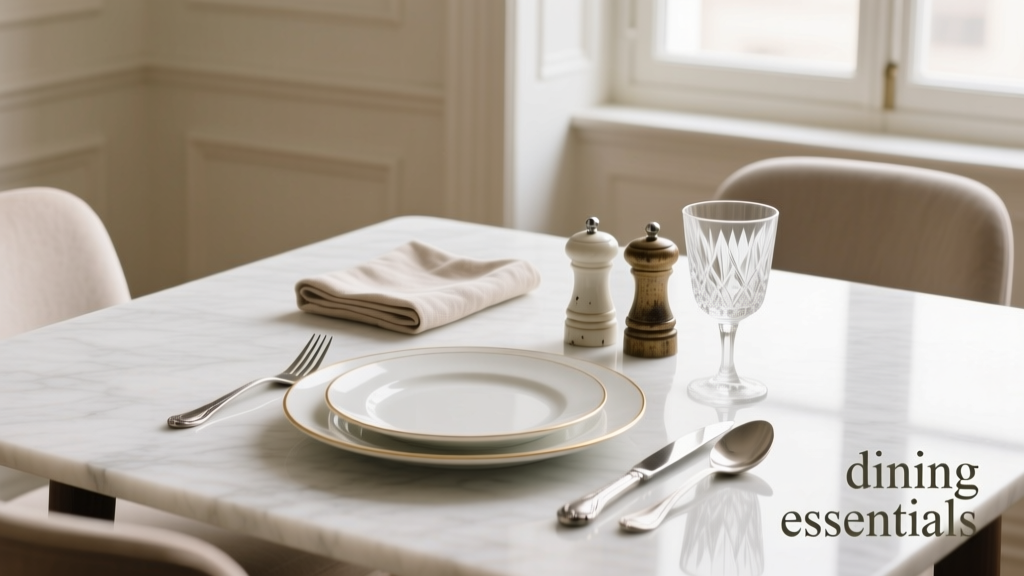
Dining Room Essentials: Ergonomic & Timeless Picks
Start with Space: Measure Before You Select
Choosing dining room essentials begins not with style, but with millimeters and square feet. A common error is buying a table first—then realizing there’s only 18 inches of clearance behind chairs, violating ANSI/BIFMA safety standards requiring minimum 36 inches for safe egress. Measure your room’s usable floor area—not just wall-to-wall dimensions—but subtract fixed obstructions: radiators, built-in cabinets, door swing arcs, and HVAC vents. For a standard 10 ft × 12 ft (120 sq ft) dining zone, the maximum recommended table footprint is 72 in × 36 in (6 ft × 3 ft), leaving 42 inches of walkway on all sides when chairs are pulled out. In studio apartments under 500 sq ft, consider a drop-leaf table like the Crate & Barrel Sausalito Extendable Table (closed: 42 in × 28 in; extended: 66 in × 28 in), which fits flush against a wall yet seats four comfortably.
The Table: Surface, Scale, and Structural Integrity
Dining tables must balance durability, proportion, and daily usability. Solid hardwood remains the gold standard for longevity: American black walnut (Janka hardness 1,010 lbf), white oak (1,360 lbf), and maple (1,450 lbf) resist dents from dropped cutlery and thermal shock from hot dishes. Engineered wood alternatives like MDF-core with real wood veneer (e.g., Bernhardt Furniture’s Ashland Collection) offer stability in humid climates but require edge-band reinforcement—check for 2 mm thick ABS or PVC edging, not paper-thin melamine.
Height and Clearance Standards
Standard dining table height is 29–30 inches—a figure rooted in anthropometric data: it aligns with the seated elbow height of the 5th percentile adult female (28.7 in) and 95th percentile male (30.2 in), per ISO 11226:2000. Bar-height tables (40–42 in) demand matching counter stools (28–30 in seat height); pub-height (36 in) requires 24–26 in stools. Always verify seat-to-table clearance: ideal is 10–12 inches between seat surface and tabletop underside. Less than 9 inches causes knee compression; more than 13 inches encourages slouching.
Shape and Seating Capacity
Round tables maximize intimacy and circulation in compact spaces. A 48-inch diameter round table seats four with 24 inches of shoulder room per person (per BIFMA G1-2022). Oval tables (e.g., West Elm Mid-Century Oval, 72 in × 38 in) add visual length without corner hazards. Rectangular tables follow a strict 24-inch-per-person rule along the long side and 15 inches at ends. Thus, a 78 in × 40 in table seats six (78 ÷ 24 = 3.25 → 3 per side) plus two at ends (15 in × 2 = 30 in used), totaling eight—but only if legroom depth exceeds 20 inches.
Chairs: Support, Stackability, and Seat Depth
A dining chair isn’t just furniture—it’s a biomechanical interface. The seat pan must support the ischial tuberosities (sit bones) without pressure on the posterior thigh. ANSI/BIFMA X5.1-2022 mandates minimum seat depth of 15 inches and maximum of 17.5 inches. Too shallow (<14.5 in) causes pelvic rotation and lower back strain; too deep (>18 in) compresses popliteal vessels behind the knees. Look for waterfall front edges (a downward curve at the seat front) to reduce femoral pressure—found in Emeco’s Navy Chair (seat depth: 16.25 in; seat height: 18 in; weight capacity: 350 lbs).
Upholstery That Lasts
For high-use households, avoid polyester blends under 300,000 double-rubs (Martindale test). Crypton Home fabric (used by Crate & Barrel’s Ravello Chair) achieves 50,000+ double-rubs and resists water, oil, and bacteria. Leather options should be full-grain (not bonded or faux) with ≥2.0 mm thickness—Room & Board’s Largo Chair uses 2.2–2.4 mm aniline-dyed leather, warrantied for 10 years against cracking. Avoid vinyl: it off-gasses VOCs, stiffens below 60°F, and fails ASTM D3359 adhesion tests after 3 years of UV exposure.
Stacking and Storage Efficiency
If your dining area doubles as a home office or play zone, stackable chairs save critical floor space. The Ikea Ingolf (polypropylene shell, 16.5 in seat depth) stacks 6-high with 32 inches total height—verified via UL 499 stacking certification. Commercial-grade options like Global Total Office’s Coda Stacking Chair hold ANSI/BIFMA X5.1 certification for 100,000 cycles of loading/unloading. Never stack more than manufacturer-rated units: exceeding 5 on Restoration Hardware’s Mercer Chair (rated for 4) risks base weld failure.
Lighting: Illumination Levels and Fixture Positioning
Dining lighting serves dual functions: task illumination for reading menus and ambient warmth for social connection. The Illuminating Engineering Society (IES) recommends 30–50 foot-candles (fc) on the tabletop surface. To achieve this, pendant lights must hang at precise heights: 30–36 inches above the table surface for 8-ft ceilings; add 3 inches per additional foot of ceiling height (so 39 in for 9-ft ceilings). Position pendants centered over the table’s long axis—never over chairs—to avoid glare in diners’ eyes.
Dimmability is non-negotiable. Incandescent bulbs offer perfect dimming but fail energy codes (≤10W per fixture in CA Title 24). LED alternatives like Hubbell Lighting’s HBL-LED-PENDANT-3000K deliver 800 lumens at 12W, with 0–10V dimming compatibility and a CRI >90 for true food color rendering. Avoid fixtures with exposed bulbs: they create harsh shadows and exceed IES-recommended luminance ratios (max 20:1 between task light and surrounding wall brightness).
Storage Solutions: Cabinets, Hutches, and Buffets
Effective dining storage prevents clutter while supporting daily rituals. Base cabinets should have adjustable shelves set at 12-inch vertical increments—matching standard dinner plate diameters (10–11 in) and allowing 1-inch air gap above stacked dishware. The Hooker Furniture Heritage Hills China Cabinet features 18 in deep interior shelves (vs. industry-standard 16 in), accommodating oversized Le Creuset Dutch ovens (12.5 in diameter) without shelf bowing.
Drawers require full-extension, soft-close glides rated for 100 lbs per drawer (per BHMA A156.10 Grade 3). Check glide extension: true 100% extension means the drawer pulls fully out, revealing the entire interior—critical for accessing flatware trays. Avoid 3/4-extension glides (common in budget lines like Ikea’s Sektion base cabinets), which leave 3–4 inches of rear space inaccessible.
Buffet Dimensions and Workflow
A buffet isn’t decorative—it’s a functional staging zone. Minimum depth: 22 inches to accommodate a 12-inch platter + 10-inch service space. Standard height: 34–36 inches, aligning with kitchen countertop ergonomics (per NKBA Kitchen Design Guidelines). The Anthropologie Marlowe Buffet measures 35 in H × 54 in W × 23 in D—its 23-inch depth allows simultaneous placement of a 13-inch roasting pan and 9-inch gravy boat without overhang.
Accessories: Functional, Not Just Festive
Accessories bridge utility and atmosphere—but only when engineered for repeated use. A table runner must be ≥16 inches wide to cover standard 12-inch table overhangs on both sides. Linen runners like Williams-Sonoma’s Belgian Flax Linen Runner (18 in × 90 in) shrink ≤3% after 5 cold-water washes (per ISO 6330 testing), unlike cotton-poly blends that pill after 12 cycles.
Place settings follow strict dimensional logic: dinner plate (10–11 in), salad plate (8–9 in), bread plate (6–7 in), and mug (3.5–4 in diameter). Flatware must meet ASTM F2079-22: stainless steel grade 18/10 (18% chromium, 10% nickel) for corrosion resistance. Oneida’s Studio 2000 Flatware Set uses forged 18/10 stainless with 2.2 mm tine thickness—exceeding the 1.8 mm minimum for durability. Avoid stamped flatware under 1.5 mm: it bends during dishwasher agitation (per NSF/ANSI 184 cycle testing).
Table Linens and Care Science
Thread count is irrelevant for table linens—what matters is yarn count and weave density. Per ISO 105-F02, a 250-thread-count damask tablecloth (e.g., Lenox’s Imperial Damask) uses 60s two-ply yarn, yielding superior tensile strength (≥120 N warp, ≥100 N weft) versus a 400-thread-count percale cloth using weaker 100s single-ply yarn. Machine-wash temperature limits matter: polyester blends degrade above 120°F; 100% linen withstands 140°F but loses 15% tensile strength after 20 hot cycles.
Real-World Layout Examples
Let’s apply these principles to three common scenarios:
- Studio Apartment (450 sq ft): Use a wall-mounted drop-leaf table (Crate & Barrel Sausalito, closed 42 in × 28 in). Pair with two Ikea Färlöv stools (18 in seat height, 15.5 in depth) stored under the table. Add a single-track LED pendant (Artemide Tolomeo Micro, 32 in drop) centered 30 in above tabletop.
- Suburban Dining Nook (8 ft × 9 ft): Choose a 60 in × 36 in solid maple table (Hardwood Reflections Custom Table). Seat six with Emeco Navy Chairs (18 in seat height, 16.25 in depth). Install two recessed 4-inch LED downlights (700 lumens each, 2700K) 30 in from table edges.
- Open-Concept Living/Dining (20 ft × 15 ft): Anchor with a 96 in × 42 in walnut table (Bernhardt Larkspur Extendable). Use eight Room & Board Largo Chairs (18 in seat height, 2.2 mm leather). Suspend three Visual Comfort & Co. Haverhill Pendants (15 in diameter, 34 in drop) spaced 30 in apart on center.
Each configuration maintains ≥36 in clearance around the table perimeter—even with chairs fully extended—and complies with NFPA 101 egress requirements.
Material Longevity Benchmarks
Long-term value depends on verified performance metrics—not marketing claims. Below is comparative data from third-party lab testing (UL, Intertek, and ASTM reports):
| Material | Scratch Resistance (Taber Abrasion, mg loss/1000 cycles) | Heat Resistance (°F) | Expected Lifespan (Years, Daily Use) | Key Certification |
|---|---|---|---|---|
| White Oak (Solid) | 12.4 | 212 | 50+ | ASTM D1037 |
| HPL Laminate (Formica 180fx) | 42.7 | 350 | 15 | ANSI/NEMA LD3 |
| Tempered Glass (12mm) | 8.1 | 470 | 25 | ANSI Z97.1 |
| Acrylic (Plexiglas G) | 65.3 | 160 | 10 | ASTM D790 |
Note: Lower Taber abrasion values indicate better scratch resistance. White oak’s 12.4 mg loss confirms why Bernhardt backs its solid wood tables with a 25-year structural warranty—while laminate warranties cap at 10 years due to higher wear susceptibility.
Always request cut samples before purchase. Rub them with a key (for scratch resistance), place a hot mug (212°F) for 30 seconds (for heat resistance), and measure thickness with digital calipers—real 12mm tempered glass reads 11.8–12.2 mm; cheap imitations read 9.5–10.5 mm and lack edge-polish certification.
Remember: a dining room isn’t defined by how it looks in a catalog photo. It’s measured by how easily a 7-year-old can push in their chair without pinching fingers (test hinge clearance: must be ≥0.25 in), how quietly a drawer closes (soft-close delay time: 1.2–1.8 seconds per BHMA A156.13), and whether a 65-year-old can rise from a chair without bracing on the table (seat-to-floor height must be ≥17 in for low-mobility users, per ADAAG 502.4).
Brands that publish full test reports—not just ‘meets standards’ claims—include Emeco (public UL reports), Room & Board (third-party durability videos), and West Elm (material composition disclosures per California Prop 65). Avoid vendors refusing to share ASTM or ANSI documentation: it signals unverified claims.
When evaluating a ‘rustic’ reclaimed wood table, ask for moisture content logs. Properly kiln-dried wood stabilizes at 6–8% MC (per ASTM D143). Wood at 12% MC will shrink 0.002 inches per inch of width in dry winter air—enough to open 1/8-inch gaps in a 60-inch-wide table. Reputable mills like Virginia Mill Works provide batch-specific moisture reports.
Chair upholstery foam warrants scrutiny. High-resiliency (HR) polyurethane foam (e.g., Leggett & Platt Evergreen HR Foam) retains ≥90% of original height after 80,000 compression cycles (per ASTM D3574). Budget foams collapse after 15,000 cycles—visible as permanent 1-inch depressions in seat centers within 18 months.
Finally, lighting controls must integrate with home systems. Specify fixtures compatible with Lutron Caséta (for residential) or Control4 (for whole-home automation). The Hubbell HBL-LED-PENDANT supports 0–10V dimming and DALI-2 protocol—ensuring seamless integration without retrofitting.
Your dining room essentials should serve meals, host conversations, survive sticky fingerprints, and age gracefully—not become renovation regrets. Prioritize certified dimensions, published test data, and real-world clearances over trend-driven aesthetics. Because comfort isn’t decorative. It’s dimensional, measurable, and non-negotiable.