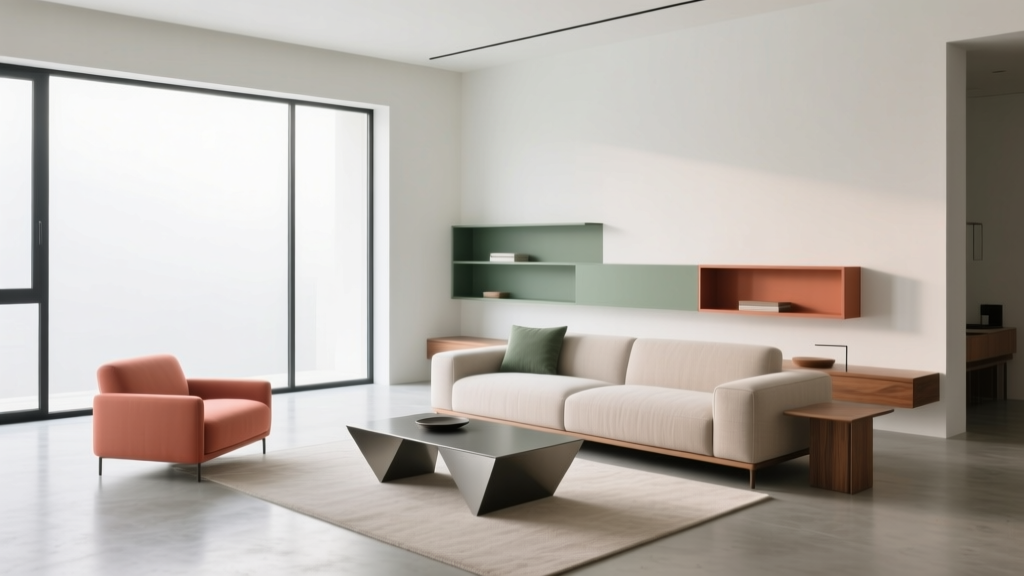
Living Room Lighting Layers: Ambient, Task & Accent
Why Lighting Layers Transform Your Living Room
Your living room isn’t just a space—it’s the emotional and functional heart of your home. In 2026, interior design prioritizes human-centric lighting: dynamic, layered, and responsive to both activity and mood. Relying solely on a single overhead fixture creates flat, uninviting light—and often causes eye strain or glare. Instead, experts at FurnishCuration.com recommend building three intentional lighting layers: ambient (general illumination), task (focused functionality), and accent (visual storytelling). When balanced correctly, these layers enhance comfort, highlight architecture and décor, and support circadian health.
Ambient Lighting: The Foundation Layer
Ambient lighting provides uniform, shadow-minimized illumination across the entire room. Think of it as the ‘base coat’—soft, even, and non-distracting.
Best Fixtures & Placement
- Recessed downlights: Use 4–6” LED gimbal trims spaced 4–5 ft apart in a grid pattern. For an 18' × 12' living room, aim for 8–10 fixtures (centered over seating zones, not walls).
- Flush-mount or semi-flush ceiling fixtures: Ideal for low ceilings (<8 ft). Choose models with diffused glass or fabric shades—avoid exposed bulbs. Optimal mounting height: 7.5–8 ft above floor.
- Track lighting: Highly adjustable; use matte-black tracks with dimmable 2700K–3000K LED heads (CRI ≥90) for consistent warmth and color fidelity.
Key specs for 2026: All ambient sources should be dimmable, with a correlated color temperature (CCT) between 2700K–3000K and a Color Rendering Index (CRI) of 90+ to render skin tones and textiles authentically. Avoid cool-white (4000K+) LEDs—they feel clinical and suppress melatonin after sunset.
Task Lighting: Precision Where You Need It
Task lighting supports focused activities: reading, crafting, gaming, or working remotely. Unlike ambient light, it must be brighter, directional, and glare-free.
Strategic Placement & Dimensions
- Reading lamps: Place floor or table lamps beside primary seating. Lampshade bottom should sit 40–42" above floor (for seated eye level). Use adjustable-arm designs (e.g., brass swing-arm or ceramic tripod) with 400–500 lumens output and a 36° beam angle.
- Console or bar lighting: Under-cabinet LED strips (2700K, 12V, 120–150 lm/ft) mounted 2–3" above surface edge provide spill-free illumination without casting shadows.
- Gaming/workstations: Position a dedicated desk lamp (e.g., LED task light with gooseneck or articulated arm) so light falls from the non-dominant side—reducing screen glare and hand shadows. Ideal brightness: 500–700 lumens at the work surface.
Material note: Matte-finish metal (brushed nickel, aged brass) or ceramic bases dissipate heat better than plastic and age gracefully. Avoid glossy plastics—they yellow by 2026 and reflect harsh highlights.
Accent Lighting: The Design Statement
Accent lighting adds drama, depth, and intentionality. It draws attention to art, architectural features, textures, or curated objects—making your space feel curated, not cluttered.
Effective Techniques & Specs
- Wall washing: Install recessed or track lights 12–18" from the wall, angled at 30°, to evenly illuminate large artwork or textured plaster. Use narrow-spot (12°) or flood (40°) beams depending on piece width (e.g., 12° for a 24" painting; 40° for a 60" gallery wall).
- Highlighting shelves: Use low-voltage LED puck lights (3W, 2700K) spaced every 12–16" along shelf edges. Mount flush or recessed to avoid visible hardware—ideal for floating oak or blackened steel shelving.
- Floor uplighting: Place slim, IP20-rated uplights (e.g., aluminum cylinder or linen-wrapped column) behind tall plants or sculptural vases. Height: 16–20" tall; beam spread: 60° for soft diffusion.
For 2026, smart integration is essential: choose accent fixtures compatible with Matter-over-Thread protocols (not just Bluetooth or proprietary hubs) for reliable, whole-home automation. Pair with occupancy sensors in rarely used corners to reduce energy waste without sacrificing ambiance.
Putting It All Together: A Real-World Example
Imagine a 20' × 15' open-plan living room with a sectional sofa, built-in bookshelves, and a 72" abstract painting above the fireplace.
- Ambient: Nine 5" recessed LEDs (3000K, 800 lm each, dimmable via Lutron Caséta) spaced in a 3×3 grid—centered over the rug, avoiding direct placement over seating.
- Task: Two adjustable floor lamps (42" height, 450 lm, warm-dim LEDs) flanking the sofa’s ends; under-shelf lighting (24V tape, 140 lm/ft) on the bookcase’s top two tiers.
- Accent: Two 12° track heads aimed at the painting (mounted 16" from wall); three recessed wall washers (30° beam) highlighting the stone fireplace surround; one uplight nestled behind a fiddle-leaf fig in the corner.
Control tip: Group layers into scenes (“Relax,” “Entertain,” “Focus”) using a unified smart hub. In “Relax” mode (evenings), ambient dims to 30%, task lights soften to 40%, and accent stays at 100%—preserving visual interest while lowering overall intensity.
Common Mistakes to Avoid in 2026
- Over-relying on smart bulbs alone: While convenient, screw-in smart bulbs lack precise beam control and thermal management—use them only for secondary ambient roles (e.g., table lamps), never as primary ambient or accent sources.
- Ignoring vertical light: 70% of poorly lit living rooms suffer from flat, horizontal-only lighting. Always incorporate at least one upward-facing (uplight) or downward-facing (pendant, sconce) source to create dimension.
- Mismatched color temperatures: Mixing 2700K ambient with 4000K task lamps creates visual dissonance. Stick to a 200K tolerance across all layers (e.g., 2700K–2900K throughout).
- Skipping maintenance planning: Dust buildup on recessed baffles or fabric shades reduces output by up to 30% in 12 months. Choose fixtures with tool-free access or washable diffusers—especially critical for high-humidity climates.
Final Thought: Light Is Furniture, Too
In 2026, lighting isn’t an afterthought—it’s foundational furniture. Like a well-proportioned sofa or thoughtfully scaled rug, each layer must be selected for scale, material integrity, and human behavior. Start with ambient (coverage), refine with task (function), then elevate with accent (personality). When layered intentionally, your living room doesn’t just look beautiful—it feels intuitively right, night after night.