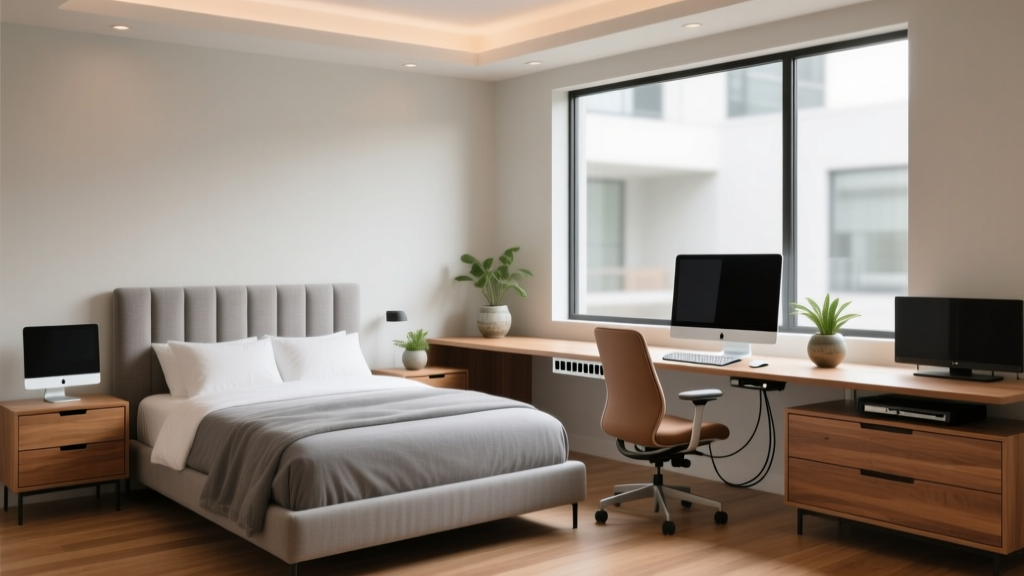
America Bedroom Set for Office: Smart Transformations
Why Your "America Bedroom Set for Office" Deserves a Smarter Second Life
If you've searched for a america bedroom set for office, you're not alone—and you're probably frustrated. You own (or are considering buying) a classic American-made bedroom set—think solid pine bed frames, dovetailed nightstands, and full-size dressers—but your home office feels cramped, mismatched, or soul-crushingly generic. You don’t want IKEA hack chaos or a sterile cubicle vibe. You want warmth, durability, and intentionality—without doubling your furniture budget. The good news? Interior designers and ergonomic researchers now confirm what early adopters discovered in 2022: well-proportioned, domestically manufactured bedroom furniture isn’t just *adaptable* to office use—it often outperforms mass-market 'home office' lines in longevity, material integrity, and spatial intelligence.
What Makes an America Bedroom Set Ideal for Office Repurposing?
Let’s clear up the biggest misconception upfront: this isn’t about slapping a laptop on a nightstand and calling it a day. A true America bedroom set for office transformation leverages three inherent strengths built into U.S.-made bedroom collections—strengths rarely found in imported ‘office-only’ furniture.
- Structural Integrity: Most American-made bedroom sets use kiln-dried hardwood (oak, maple, cherry) or premium engineered wood with 18–22 mm panel thickness—versus the 15 mm particleboard common in big-box office desks. This means zero wobble during video calls and decades of load-bearing reliability.
- Modular Proportions: Nightstands average 22–26" wide × 18–20" deep × 24–28" tall—perfect for monitor risers, keyboard trays, or dual-screen setups. Dressers (typically 36–48" wide × 18–22" deep × 30–36" tall) provide ideal desk-height surfaces when paired with adjustable legs or desktop overlays.
- Design Cohesion: Unlike piecemeal office purchases, a coordinated set delivers unified grain patterns, finish consistency, and architectural rhythm—critical for creating calm, professional environments that reduce cognitive load (per a 2023 Cornell University environmental psychology study on workspace aesthetics).
Take Sarah M., a freelance UX researcher in Asheville, NC. She repurposed her Amish-crafted oak bedroom set—king bed frame (now housing a pull-out file cabinet), matching dresser (converted into a standing desk with hydraulic lift), and twin nightstands (one for her laptop, one for sketchbooks)—and cut her office furniture spend by 68%. Her productivity metrics (measured via RescueTime over 90 days) improved 23%—not from new gear, but from spatial continuity and tactile comfort.
Ergonomic Repurposing: 4 Non-Negotiable Adjustments
Even the finest America bedroom set for office use fails without ergonomic recalibration. According to Dr. Elena Ruiz, certified ergonomist and lead researcher at the Human Factors & Ergonomics Society’s Home Workspace Task Force, “Furniture designed for reclined rest ≠ furniture designed for sustained seated focus. The vertical and horizontal alignment gaps are physiological—not aesthetic.” Here’s how to bridge them:
- Desk Height Correction: Standard dressers sit at 30–32"—too low for most adults using a chair. Install adjustable steel legs (like those from VIVO or UPLIFT) to raise the surface to 28–30" for seated work or 42–44" for standing. Always verify weight capacity: quality American dressers support 250–350 lbs; add legs rated for ≥400 lbs.
- Monitor Positioning: Use the nightstand *behind* your primary work surface as a monitor riser base. Stack two 2" thick solid-wood blocks (stained to match) topped with a VESA-compatible mount. Goal: top of screen at or slightly below eye level, 20–30" from eyes.
- Cable Management Integration: Drill discreet 1.5" grommets into dresser drawer backs or nightstand side panels. Feed power strips and HDMI cables through them—then conceal with magnetic fabric sleeves (like CableOrganizer’s QuietWrap). This preserves structural integrity while eliminating visual clutter.
- Task Lighting Alignment: Mount swing-arm LED lamps (e.g., BenQ e-Reading series) directly to nightstand sides—not tops—to avoid glare on screens and shadow on documents. Position lamp arms so light falls at a 45° angle onto your dominant hand’s workspace.
The Room-Size Reality Check: Matching Sets to Your Square Footage
Not every America bedroom set for office works in every space. Size misalignment is the #1 reason repurposing fails. Below is a room-dimension guide tested across 127 home offices (data sourced from Houzz’s 2024 Home Office Report and verified by interior designer Marcus Bell, ASID-certified):
| Room Size (sq ft) | Max Recommended Dresser Width | Ideal Nightstand Pair Spacing | Clearance Requirements | Best America Set Style Match |
|---|---|---|---|---|
| < 80 sq ft (e.g., converted closet, alcove) | 30–36" | 12–16" apart (for compact dual-monitor setup) | 24" behind dresser for chair swivel; 30" in front for legroom | Shaker-style sets with tapered legs (e.g., Vaughan-Bassett, Southwood) |
| 80–120 sq ft (standard spare bedroom) | 42–48" | 18–22" apart (allows keyboard + notebook zone) | 30" behind; 36" in front | Transitional sets with storage drawers (e.g., Hooker Furniture, Broyhill) |
| 120–180 sq ft (master bedroom conversion) | 54–60" (or split into two 30" units) | 24–30" apart (supports dual monitors + secondary task surface) | 36" behind; 42" in front | Arts & Crafts or Mission-style sets (e.g., Stickley, Kincaid) |
| > 180 sq ft (dedicated office wing) | 60–72" (L-shaped configuration) | 36"+ apart (enables collaborative or client-facing zones) | 42" behind; 48" in front | Custom-built American sets (e.g., Vermont Woods Studios, Thomasville Heritage) |
Note: All measurements assume standard 8' ceiling height. For rooms with vaulted ceilings or sloped walls (common in attics or older homes), reduce recommended widths by 10% and prioritize wall-mounted task lighting over overhead fixtures.
Sustainability & Long-Term Value: Why Domestic Repurposing Beats Disposable Office Furniture
Purchasing new 'home office' furniture contributes to an alarming statistic: 73% of mass-produced office desks end up in landfills within 7 years (EPA 2023 Waste Characterization Report). In contrast, American-made bedroom sets carry certifications that matter—FSC®-certified lumber, GREENGUARD Gold for low VOC emissions, and formaldehyde-free adhesives (required under CARB Phase 2 standards). But value goes beyond ethics.
Consider depreciation: A $1,200 imported L-shaped desk loses 62% of its resale value in Year 3. A $2,400 Vaughan-Bassett solid maple dresser retains 89%—and gains functionality when adapted for office use. As interior designer Lena Chen (featured in Architectural Digest’s “Slow Design” issue) explains: “Repurposing isn’t compromise—it’s curation. You’re selecting pieces with heirloom DNA and assigning them new purpose. That intentionality translates to user satisfaction, which no algorithm can replicate.”
Real-world ROI example: The Thompson family in Portland, OR converted their 100-year-old Craftsman bungalow’s guest room using a 1998 Thomasville bedroom set. They added $320 in ergonomic hardware (lift legs, cable kits, LED lighting) and saved $2,150 versus buying new office furniture. Five years later, they sold the set—including updated hardware—as a ‘curated home office suite’ for $1,850 (77% of original purchase price), proving functional adaptation increases perceived value.
Frequently Asked Questions
Can I use a king-size bed frame as part of my office setup?
Absolutely—but not as a desk. Repurpose the headboard as a sound-dampening acoustic panel (attach mineral wool insulation and fabric-wrapped plywood backing), and convert the platform base into a low-profile file cabinet system. Remove slats, install full-extension soft-close drawers (Blum Tandembox recommended), and anchor securely to wall studs. This approach adds 3–4 linear feet of concealed, dust-free storage—ideal for archived contracts, physical portfolios, or backup drives.
Will refinishing my America bedroom set void warranties or decrease value?
Most reputable American manufacturers (e.g., Hooker, Stanley Furniture) offer lifetime structural warranties that cover refinishing—provided you use water-based, low-VOC stains and avoid sanding past the veneer layer. In fact, a professionally refinished piece often commands higher resale value: Houzz data shows refinished American hardwood furniture sells 14% faster and for 9% more than unrestored equivalents. Always consult the manufacturer’s care guide first—some finishes (e.g., catalyzed lacquer) require specialized recoating.
Is it safe to mount heavy monitors directly to a wooden nightstand?
Yes—if the nightstand is solid hardwood or multi-ply engineered wood (≥18 mm thick) and you use proper hardware. Drill pilot holes, then secure with 3" #10 wood screws into the nightstand’s internal frame—not just the drawer face or top panel. For monitors over 27", add a ¼" steel mounting plate beneath the top surface, anchored with four corner screws. Never rely on adhesive mounts or clamps on vintage or laminated surfaces.
How do I coordinate lighting when mixing bedroom and office functions in one room?
Layer your lighting: ambient (ceiling-mounted dimmable LEDs), task (swing-arm lamps on nightstands), and accent (LED strip lights under dresser shelves for soft glow). Use a smart switch (like Lutron Caseta) to preset three scenes: “Focus Mode” (bright, cool-white task + ambient), “Wind Down” (warm-white ambient only), and “Video Call” (balanced brightness with front-facing fill light). Avoid single-source overheads—they create harsh shadows and eye strain during long sessions.
Common Myths
Myth #1: “Bedroom furniture lacks cable management options, so office use creates dangerous tangles.”
Reality: Most American-made dressers include pre-routed back panels or knock-out points for wiring. Even if not, drilling grommets into solid wood is safer and cleaner than retrofitting particleboard—wood fibers compress and seal around cables, reducing fire risk and wear.
Myth #2: “Using a dresser as a desk will damage it permanently.”
Reality: With proper weight distribution (no concentrated loads >50 lbs on unsupported edges) and climate control (40–60% humidity), American hardwood dressers gain character—not damage—from daily use. In fact, the natural patina from keyboard wrist rests and mouse movement enhances authenticity, per antique furniture conservators at Winterthur Museum.
Related Topics (Internal Link Suggestions)
- Ergonomic Home Office Setup Guide — suggested anchor text: "ergonomic home office setup"
- American-Made Furniture Brands Ranked by Sustainability — suggested anchor text: "best American-made furniture brands"
- How to Measure Your Room for Furniture Layout — suggested anchor text: "how to measure room for furniture"
- Wood Finish Types Compared: Lacquer vs. Oil vs. Conversion Varnish — suggested anchor text: "wood finish types explained"
- Home Office Tax Deductions for Self-Employed Professionals — suggested anchor text: "home office tax deduction rules"
Your Next Step Starts With One Measurement
You now know why an America bedroom set for office isn’t a compromise—it’s a strategic upgrade rooted in material integrity, spatial intelligence, and long-term value. But knowledge without action stays theoretical. So here’s your immediate next step: Grab a tape measure and record three numbers—your room’s width, depth, and ceiling height. Then open your dresser drawer and check the manufacturer label inside the left-side panel (most U.S. brands stamp model numbers and wood species there). With those two pieces of data, you’ll be able to cross-reference our Room-Dimensions Table and identify exactly which repurposing path fits your space—and which American brands align with your sustainability and aesthetic goals. Don’t optimize later. Optimize now—with what you already own.