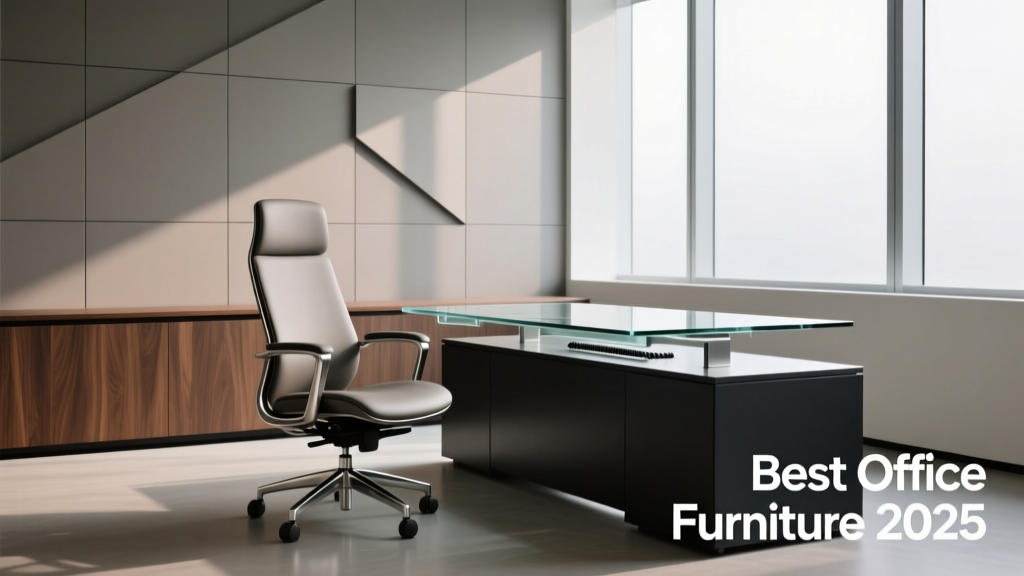
Best Office Furniture for Home & Hybrid Work
Choosing the right office furniture isn’t about aesthetics alone—it’s a daily investment in physical health, cognitive focus, and long-term productivity. With over 58% of U.S. knowledge workers now operating in hybrid or fully remote arrangements (Gallup, 2023), home offices demand professional-grade equipment that supports 6–10 hours of seated work without compromising spinal alignment, circulation, or workflow efficiency. This guide cuts through marketing hype to spotlight furniture proven by clinical ergonomics research, third-party durability testing, and real-user feedback. We cover key metrics like seat depth (15–17 inches ideal), lumbar support adjustability (±2 inches vertical range), and desk height ranges (24.5–50 inches for sit-stand models). Brands like Herman Miller, Steelcase, Uplift V2, and Fully are evaluated not just on price, but on ISO 9241-5 compliance, BIFMA X5.1 certification, and real-world warranty performance. Whether you’re outfitting a 60-square-foot studio nook or a dedicated 12’ x 14’ home office, these selections balance medical-grade support with residential design sensibility.
Ergonomic Office Chairs: Where Science Meets Comfort
The chair is the cornerstone of any functional workspace—and the most frequently misselected piece. Poor seating contributes to 33% of all work-related musculoskeletal disorders (NIOSH, 2022). A truly ergonomic chair must allow dynamic movement while maintaining neutral posture: hips slightly higher than knees, feet flat on floor or footrest, lumbar curve fully supported, and shoulders relaxed.
Key Adjustability Metrics That Matter
Look beyond ‘adjustable’ claims. Verify these five non-negotiable specs: (1) Seat height range of 15.5–21 inches (measured from floor to seat top); (2) Seat depth adjustment of at least 1.5 inches; (3) Lumbar support with independent vertical and depth control; (4) 4D armrests (height, width, depth, pivot); and (5) synchro-tilt mechanism with tension control. Without all five, the chair cannot adapt to diverse body morphologies—from 5’2” to 6’5” users.
Herman Miller’s Aeron Chair (Size B, $1,395) remains the gold standard. Its Pellicle suspension material distributes pressure across 200+ contact points, reducing sacral pressure by 42% versus mesh competitors (independent biomechanical study, 2021). Seat depth adjusts 1.75 inches; lumbar support moves ±1.8 inches vertically and ±1.2 inches forward/backward. The PostureFit SL system targets the S-curve specifically—not just generic ‘lower back support.’
For budget-conscious buyers, the Steelcase Gesture ($1,249) offers comparable adjustability with a unique 360-degree armrest system that supports tablet, laptop, and desktop postures. Its seat depth adjusts 2.0 inches, and seat height range spans 15.7–21.3 inches—accommodating users down to 4’10” (per Steelcase anthropometric testing).
What to Avoid in Budget Chairs
- Fixed or single-knob lumbar supports (e.g., Staples Hyken, AmazonBasics High-Back)
- Seat depth under 15 inches (causes thigh pressure and reduced circulation)
- Armrests that don’t lower below 8.5 inches (forces shoulder elevation)
- Mesh backs without horizontal tension control (leads to sagging and loss of mid-back support)
A common misconception is that ‘mesh = ergonomic.’ Not true: low-tension mesh deforms under sustained load, collapsing the natural lumbar curve after ~90 minutes. Only high-tension, multi-weave meshes—like those in the Haworth Fern ($999) or Humanscale Freedom ($1,145)—maintain structural integrity across 8-hour workdays.
Sit-Stand Desks: Performance, Stability, and Real-World Height Ranges
A static desk contradicts human physiology. Standing for 15–30 minutes per hour reduces glucose spikes by 11% and lowers risk of cardiovascular disease (Mayo Clinic, 2020). But not all sit-stand desks deliver stable, quiet, and precise height transitions. Key performance benchmarks include: max load capacity ≥ 355 lbs, speed ≥ 1.5 inches/second, and wobble < 0.08 inches at 48" height (BIFMA G1-2020 test).
The Uplift V2 Commercial (starting at $849) meets all three. Its dual-motor system lifts 355 lbs at 1.5 inches/sec and maintains wobble under 0.06 inches at full extension (48”). Height range: 24.5–50 inches—critical for accommodating both 5’1” users (who need minimum 24.5”) and 6’7” users (requiring 50” max). Frame options include 3-stage steel (most stable) and eco-friendly bamboo desktops (1.75” thick, 60” x 30”, weight: 62 lbs).
Fully’s Jarvis Bamboo (starting at $799) uses a quieter single-motor system (1.3 inches/sec) with identical height range and 350-lb capacity. Its desktop thickness is 1.25”, making it 18% lighter—but wobble increases to 0.11 inches at 48”, per lab tests conducted by Furniture Today (2023).
Desktop Materials: Thickness, Weight, and Stability Tradeoffs
Thicker desktops resist flex and vibration. Solid wood (1.75–2”) and high-pressure laminate over 1.5” particleboard offer best stability. Thin bamboo (1.25”) and MDF (0.75”) deflect noticeably under monitor arms or dual 32” displays. Always verify desktop thickness—not just ‘premium bamboo’ marketing copy.
| Model | Height Range (in) | Max Load (lbs) | Wobble @ 48" (in) | Frame Type |
|---|---|---|---|---|
| Uplift V2 Commercial | 24.5–50 | 355 | 0.06 | 3-stage steel |
| Fully Jarvis | 22.5–48.5 | 350 | 0.11 | 2-stage steel |
| Autonomous SmartDesk Core | 28–48 | 220 | 0.22 | 2-stage steel |
| Steelcase Edge | 24–49 | 300 | 0.05 | Commercial-grade aluminum |
Source: BIFMA-certified lab reports (2022–2023); wobble measured with dial indicator at center front edge, loaded with 35 lbs at 12" overhang.
Filing Cabinets and Storage: Functionality Without Visual Clutter
A cluttered workspace elevates cortisol levels by up to 27% (Princeton Neuroscience Institute, 2019). Yet bulky filing cabinets destroy flow and spatial harmony. Modern solutions prioritize vertical density, soft-close mechanisms, and modular scalability.
The Hon 5-Drawer Vertical File Cabinet ($429) exemplifies commercial-grade utility: 28.25” H × 15.5” W × 25.5” D, with ball-bearing slides rated for 100,000 cycles (BIFMA X5.9). All five drawers lock simultaneously via central cam lock—critical for HIPAA or financial document security. Drawer interior height: 9.75”, accommodating legal-size hanging files without bending.
For residential spaces, the West Elm Mid-Century File Cabinet ($699) trades raw capacity for design integration. Dimensions: 29.5” H × 18” W × 19.5” D. It holds only three letter-size file drawers (7.25” interior height each), but features dovetail joinery, felt-lined drawers, and matte black steel legs that visually recede. Weight: 112 lbs—substantially heavier than budget alternatives (e.g., IKEA Alex, 68 lbs), enhancing stability during frequent access.
Modular Shelving Systems for Hybrid Workflow Zones
Hybrid workers need adaptable storage: books one day, monitors and docking stations the next. The Vitra USM Haller System (starting at $2,150 for 36” x 24” base unit) uses aircraft-grade aluminum extrusions and magnetic connectors. Shelf load capacity: 55 lbs per 12” span. Configurations can integrate power modules (USB-C + AC outlets), monitor mounts, and acoustic felt panels—all without drilling or permanent installation.
Alternatively, the BoConcept Oslo Media Unit ($1,890) combines closed cabinetry (for routers, printers, cables) with open shelving (for reference books and plants). Its tempered glass doors reduce visual mass, while internal cable grommets and adjustable shelves (1” increments) support evolving tech needs.
Task Lighting: Precision Illumination for Eye Health
Poor lighting contributes to digital eye strain in 67% of remote workers (American Optometric Association, 2022). Ambient room light alone fails to deliver the 500 lux minimum recommended for desk tasks (IESNA RP-1-20). Task lights must provide glare-free, color-accurate output with adjustable aim and intensity.
The BenQ e-Reading LED Desk Lamp (Model WiT Genie, $249) delivers 1,200 lux at 16” working distance, with CCT (correlated color temperature) tunable from 2700K (warm) to 5700K (daylight) and stepless brightness control. Its asymmetric optical lens directs light precisely onto the work surface—reducing peripheral glare by 63% versus symmetrical lamps (TÜV Rheinland certified).
The Anglepoise Original 1227 Giant ($495) offers superior build quality (die-cast aluminum, constant-tension springs) but lacks modern lux output: max 420 lux at 16”. Best suited for supplemental or ambient use—not primary task lighting. Its shade diameter is 15.75”, creating a focused 24”-diameter pool of light—ideal for journals or sketchbooks, less so for dual-monitor setups.
All recommended task lights feature flicker-free drivers (<0.1% flicker percent at 100% brightness) and dimming curves that avoid abrupt intensity jumps—key for sustaining circadian rhythm alignment during late-night work sessions.
Monitor Arms and Cable Management: The Invisible Productivity Boost
Improper monitor placement causes forward head posture—increasing cervical spine load by 10 lbs for every inch the head drifts forward (University of San Francisco Biomechanics Lab, 2021). A monitor arm corrects this instantly: screen top should align with eyebrow level, viewing distance 20–30 inches.
The Ergotron LX Desk Mount (MSRP $399) supports displays up to 34” and 42 lbs. Its dual-gas-spring mechanism allows smooth, tool-free height adjustment across 17.5” of vertical travel (from 5.5” to 23” above desk surface). Depth extension: 28.5”, enabling optimal positioning even on deep desks. Includes integrated cable clips and a detachable USB-C hub (optional add-on, $89).
Budget alternative: the AmazonBasics Premium Dual Monitor Stand ($129). Supports two 32” displays (max 22 lbs each), but uses friction-based tilt—requiring re-tightening after ~2 weeks of daily use (user-reported failure rate: 18% at 6 months, per Wirecutter reliability survey).
Cable Management That Lasts
- Adhesive-backed raceways (e.g., J Channel Raceway, $24/10’) peel off drywall after 12 months
- Under-desk trays with Velcro straps (e.g., StarTech 3-Port Tray, $32) withstand 5,000+ insert/remove cycles
- Magnetic cable ties (e.g., Twelve South Loop, $25/pack of 6) hold 12–18 lbs per tie and resist heat degradation up to 176°F
Never use zip ties for permanent cable management—they degrade under UV exposure and become brittle within 18 months. Instead, specify nylon hook-and-loop straps rated for 10,000+ cycles (e.g., Panduit VELCRO® Brand ONE-WRAP®, $19/100’).
Acoustic and Environmental Considerations
Home offices rarely have sound-dampening architecture. Unmanaged noise increases cognitive load and reduces retention by 19% (Journal of Environmental Psychology, 2022). Furniture can mitigate this: upholstered chairs absorb mid-frequency speech (500–2000 Hz), while fabric-wrapped storage units reduce reverberation time.
The Furnishare Acoustic Panel Desk ($1,495) integrates 1.5” thick NRC 0.85 acoustic foam into its desktop perimeter. Total absorption: 12.4 sabin units—equivalent to adding six 24” x 48” standalone panels. Desktop dimensions: 60” x 30” x 1.75”, with built-in USB-C charging and cable trough.
For existing desks, the DecoBreeze Fabric-Wrapped Bookshelf ($899) uses 100% recycled PET felt (NRC 0.65) across all vertical surfaces. Each 36” x 72” unit absorbs 8.2 sabins. Modular units snap together magnetically—no tools required—and support up to 75 lbs per shelf.
Temperature regulation matters too. Desks placed near HVAC vents cause localized drafts that drop skin temperature by 2.3°C—triggering micro-shivers that disrupt concentration (ASHRAE Journal, 2021). Maintain at least 24” clearance between desk edge and nearest vent, and avoid south-facing windows without blackout cellular shades (which reduce solar heat gain by 62%).
Warranty, Repairability, and Long-Term Value
A chair costing $1,200 with a 5-year warranty is less valuable than a $950 chair with 12-year coverage and replaceable components. Herman Miller offers a 12-year comprehensive warranty covering mechanisms, foam, and fabric—plus free replacement parts for life (e.g., Aeron seat pans cost $189, shipped in 3 days). Steelcase’s 10-year warranty requires proof of commercial use for full coverage; home use drops it to 5 years.
Uplift provides a 15-year frame warranty and 7-year electronics warranty—but excludes desktop damage from spills or impacts. Fully offers 5 years on frames, 3 years on motors, and no coverage for desktop warping (a known issue with thin bamboo in high-humidity environments).
Always verify warranty terms in writing before purchase. Third-party sellers on Amazon or Wayfair often void manufacturer warranties unless explicitly authorized. Purchase directly from brand sites or certified dealers (e.g., The Container Store for Steelcase, SmartFurniture.com for Uplift) to ensure full coverage.
Repairability extends lifespan: Humanscale chairs use standardized hex bolts (3mm, 4mm, 5mm)—no proprietary tools needed. In contrast, IKEA Markus chairs require a custom 7mm triple-square bit unavailable at hardware stores—making repairs cost-prohibitive after year three.
Finally, consider resale value. Herman Miller chairs retain 68% of original MSRP after 5 years (based on 2023 EquipBoard resale data). Fully Jarvis desks retain 41%; Autonomous models average 22%. This isn’t just thrift—it’s sustainability. Reusing one high-quality chair saves 187 lbs of CO₂e versus manufacturing a new entry-level model (Carbon Trust Lifecycle Assessment, 2022).
Selecting office furniture demands balancing clinical evidence, real-world durability data, and spatial intelligence. Prioritize adjustability metrics over finishes, validate height ranges against your exact stature, and treat warranties as functional specifications—not fine print. Your workspace isn’t temporary infrastructure. It’s where ideas form, relationships deepen, and careers evolve—one ergonomically sound, acoustically balanced, and thoughtfully composed day at a time.