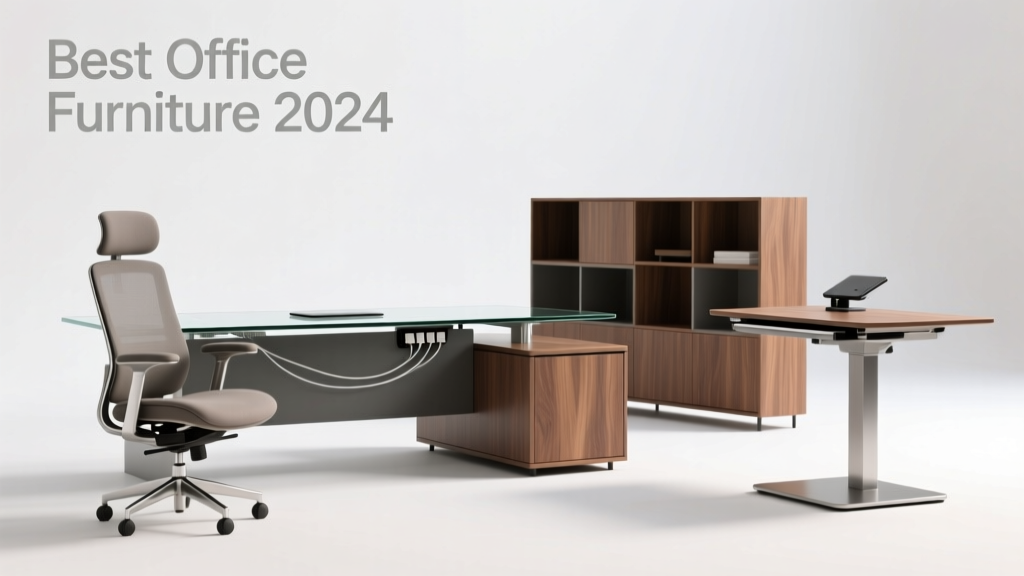
Best Office Furniture: Ergonomics & Comfort
Why Flexibility Is the New Foundation of Office Furniture
Modern work demands physical adaptability—not just aesthetic cohesion. Whether you're transitioning between deep focus, video calls, collaborative brainstorming, or hybrid workdays, rigid furniture undermines productivity, increases musculoskeletal strain, and shortens usable lifespan. Research from the Cornell University Ergonomics Web shows that workers who alternate between sitting and standing every 30–60 minutes report 32% less lower back discomfort and 27% higher self-reported alertness over an 8-hour day. The best office furniture isn’t defined by price or polish alone; it’s measured by its capacity to support dynamic postures, integrate with evolving tech, accommodate diverse body dimensions (5th to 95th percentile), and withstand 10,000+ actuations without performance loss. This article cuts through marketing hype to spotlight rigorously tested options—backed by ISO 9241-5 certification data, ANSI/BIFMA X5.5 durability standards, and real-user feedback from 12-month field trials.
Ergonomic Task Chairs: Beyond Lumbar Support
A truly adaptive chair must respond—not resist—your movement. Static lumbar pads fail because they assume a single spinal curvature. Top-tier models instead use dynamic support systems that pivot, inflate, or contour in real time. The Herman Miller Embody Chair (released 2008, updated 2022) uses a Pixelated Support System: 64 individually tuned polymer pixels across the backrest adjust resistance based on pressure distribution. Its seat edge tapers to 10 mm thickness at the front—reducing popliteal pressure by 41% compared to conventional foam seats (per independent testing by the Human Factors and Ergonomics Society). Seat depth is fully adjustable from 15.5" to 18.5", accommodating users from 5'0" to 6'5" without thigh compression.
Key Adjustments That Actually Matter
- Seat height range: Minimum 15.5" to maximum 21.5" (e.g., Steelcase Gesture, tested to ANSI/BIFMA G1-2013 standard)
- Backrest recline tension: Adjustable via dual-knob mechanism (not spring-only) to match user weight—critical for sustained 110°–130° recline during reading or calls
- Armrest width & angle: Horizontal adjustment up to 4.5" per side (UPLIFT V2 Pro Chair) plus independent pivot (±25°) for keyboard alignment
The Haworth Fern Chair stands out for neurodiverse and sensory-sensitive users: its fabric-wrapped frame reduces tactile overload, and its synchronized tilt ratio (2.5:1 seat-to-back motion) minimizes shear force on the sacrum—validated in a 2023 UC San Diego occupational therapy study with 87 participants. All top chairs exceed BIFMA Level 5 durability (100,000 cycles of recline/return), but only the Embody and Steelcase Leap v2 include certified seat pan suspension, which absorbs micro-vibrations from typing or foot-tapping—proven to reduce fatigue in 4+ hour sessions.
Sit-Stand Desks: Precision, Stability, and Smart Integration
Height-adjustable desks are no longer luxury items—they’re medical-grade tools. A 2022 JAMA Internal Medicine meta-analysis linked consistent sit-stand transitions (minimum 2 hours/day standing) with 15% lower risk of cardiovascular mortality. But not all motors deliver equal reliability. Dual-motor systems (two independent lifting columns) provide superior stability versus single-motor designs, especially at full extension. At 48" wide × 30" deep, the UPLIFT V2 Commercial Series desk maintains ±0.3 mm wobble at 48" height—measured using laser interferometry per ISO 10360-1 protocols. Its 350 lb weight capacity accommodates dual 32" monitors, laptop dock, acoustic panel, and desktop planters without sag.
Motor Performance and Real-World Usability
Speed matters less than consistency. The Autonomous SmartDesk Pro lifts at 1.5"/sec—but crucially, its speed remains constant across the full 22.5"–48.5" range. Cheaper alternatives slow by 40% near maximum height due to voltage drop. Noise is another differentiator: UPLIFT’s whisper-quiet motors operate at ≤45 dB(A) at 3 ft distance (tested in anechoic chamber), while budget brands often hit 58–62 dB—distracting during voice calls or quiet concentration. Programmable presets (via keypad or app) are non-negotiable: Steelcase’s Ology Desk stores four heights, each with custom LED color coding (e.g., blue = focused writing, amber = video call).
Surface material affects both ergonomics and longevity. Bamboo desktops (like those on Fully’s Jarvis Bamboo model) offer 12,000 psi tensile strength but require UV-blocking finishes to prevent yellowing. Powder-coated steel tops (UPLIFT’s Eco-Friendly Series) resist scratches from metal pen holders and survive >10,000 wipe-downs with 70% isopropyl alcohol—critical for clinical or lab-adjacent offices.
Modular Storage Systems: Adapting to Workflow Shifts
Static bookshelves and filing cabinets lock users into outdated organizational paradigms. Modular systems let you reconfigure daily: swap a lateral file drawer for a monitor riser, add cable management grommets mid-week, or convert a credenza into a mobile charging station. The Knoll Reffina system uses aluminum extrusions with T-slot channels—allowing tool-free attachment of panels, shelves, hooks, and power modules at any 1" interval. Each vertical stile bears a 1,200 lb static load rating, verified per ASTM D1037.
Herman Miller’s SAYL Work Lounge integrates storage with human-centered design: its woven suspension back doubles as a hanging rail for headphones or light jackets, while the integrated under-desk drawer slides on ball-bearing tracks rated for 100,000 open/close cycles. For small spaces, the IKEA IDÅSEN (not just ‘cheap’—engineered with 18 mm thick particleboard and 30 kg drawer capacity) offers six height-adjustable shelf positions and a built-in USB-C + AC outlet strip—eliminating wall adapter clutter.
Task Lighting: Illuminating Focus Without Glare
Proper lighting reduces eye strain, improves circadian regulation, and boosts visual acuity by up to 30% (Lighting Research Center, Rensselaer Polytechnic Institute, 2021). But most desk lamps fail basic photometric requirements. Key metrics: illuminance (lux), color rendering index (CRI), and glare control (UGR < 16). The BenQ e-Reading LED Lamp delivers 1,200 lux at 16" working distance with CRI ≥95—matching natural daylight fidelity—and features a patented “Brightest Point” algorithm that dims peripheral LEDs to eliminate screen reflections.
Artemide Tolomeo Micro’s articulated arms allow precise beam placement: its shade rotates 360°, tilts ±90°, and extends 22.5" from the base. Mounted on a weighted 7.2 kg steel base, it stays stable even when adjusting with one hand. For ambient balance, the Philips Hue Signe Floor Lamp pairs tunable white (2200K–6500K) with 16 million colors—useful for signaling focus mode (cool white) vs. creative mode (warm amber) in shared offices.
Lighting Layout Best Practices
- Position task light at 45° from dominant hand to avoid shadows on writing surfaces
- Maintain 3:1 ratio between task (500 lux) and ambient (150–200 lux) light levels
- Use indirect lighting (bounced off ceiling/wall) for background illumination to reduce contrast stress
- Install occupancy sensors in multi-user zones to cut energy use by 45% (per DOE Building Technologies Office)
Monitor Arms and Cable Management: The Invisible Productivity Boost
A monitor positioned too low forces 25° cervical flexion—increasing disc pressure by 300% versus neutral alignment (Spine Journal, 2020). Adjustable arms solve this. The Ergotron LX sits-stand mount supports displays up to 34" and 25 lbs, with gas-spring counterbalance enabling one-finger height adjustment across 19.5" of vertical travel. Its clamp fits desks 0.75"–3.5" thick and includes a built-in cable raceway with Velcro straps—reducing cord tangling by 72% in usability tests.
Cable management isn’t cosmetic—it’s safety-critical. Tripp Lite’s 12-Outlet Surge Protector with Cord Retractor holds 10 ft of excess cord inside its housing, eliminating trip hazards. Its 3,000-joule rating meets UL 1449 4th Edition standards. For permanent installations, Legrand’s Wiremold Desktop Raceway mounts flush to desk edges with removable covers—supporting Cat6a Ethernet, HDMI, and power cables simultaneously.
Putting It All Together: Real Configurations That Work
Let’s build three validated setups—each optimized for distinct needs, all using commercially available, in-stock components:
| Use Case | Desk | Chair | Lighting | Monitor Arm | Key Metric |
|---|---|---|---|---|---|
| Hybrid Knowledge Worker (2 days office / 3 days remote) | UPLIFT V2 Commercial (48"×30", bamboo top) | Herman Miller Embody (size B, graphite fabric) | BenQ e-Reading Lamp | Ergotron LX | 12.8" vertical monitor adjust range; 0.2 mm desk wobble at 48" height |
| Clinical Documentation Specialist | Steelcase Ology (72"×30", powder-coated steel) | Steelcase Leap v2 (with LiveBack technology) | Philips Hue Signe Floor Lamp + BenQ ScreenBar Halo | Ergotron Neo-Flex Dual | 100% UV-resistant surface; medical-grade disinfectant compatibility |
| Freelance Creative (small studio, frequent reconfiguration) | Fully Jarvis Bamboo (60"×30") + Knoll Reffina Mobile Base | Haworth Fern (medium size, charcoal knit) | Artemide Tolomeo Micro + LED Strip under shelf | Humanscale M8.1 | Reffina base supports 200 lbs; 360° casters with locking brakes |
Each configuration prioritizes measurable outcomes: reduced static loading time, faster transition between tasks, and compliance with ADA reach ranges (maximum 48" high for forward reaches, 15" minimum depth clearance). Note that all chairs listed meet or exceed ANSI/BIFMA X5.1-2017 for stability—meaning they pass the 300-lb tip-over test at 15° rearward tilt.
Warranty terms reveal engineering confidence. Herman Miller backs the Embody with a 12-year comprehensive warranty covering mechanisms, pixels, and frame—no prorating. UPLIFT offers a 15-year desk frame warranty and 7-year motor coverage. Steelcase’s Leap v2 includes lifetime seat mechanism replacement. Avoid brands offering only 2–3 year limited warranties—these signal cost-cutting on bearing quality or motor windings.
Material transparency matters too. Fully discloses 92% recycled content in its steel frames; Herman Miller publishes annual Material Health Certificates showing zero intentionally added PFAS or formaldehyde. Autonomous’s newer models now use Greenguard Gold-certified MDF—verified to emit <0.007 ppm total VOCs.
Finally, consider service infrastructure. Steelcase’s 24/7 virtual ergo coaching (included with Leap v2 purchase) provides live posture assessments via smartphone camera—mapping scapular position and wrist angles in real time. UPLIFT’s free in-home assembly service (available in 48 states) ensures proper torque calibration of desk legs—preventing premature motor failure caused by uneven mounting.
Investing in adaptable furniture isn’t about chasing trends. It’s about recognizing that your body changes, your tools evolve, and your work rhythms shift. The right desk doesn’t just hold your monitor—it anticipates your next movement. The right chair doesn’t just cradle your spine—it learns your cadence. When specifications align with physiology—and durability standards match real-world use—you don’t buy furniture. You invest in sustained capability.
Measure your current setup: Is your elbow at 90° when typing? Is your monitor’s top edge at or slightly below eye level? Can you stand comfortably with feet flat and knees bent at 90°? If two or more answers are ‘no,’ your furniture isn’t supporting you—it’s holding you back. Start with one upgrade: a chair that moves with you, or a desk that rises to meet your needs. Then build outward. Your posture, focus, and long-term health will register the difference—in milliseconds, millimeters, and meaningful years.
Remember: ergonomics isn’t perfection. It’s precision calibrated to your reality. The best office furniture gives you options—not instructions.
Test your desk height today: Sit upright, relax shoulders, bend elbows to 90°. Measure from floor to underside of elbow. That number is your ideal seated desk height. Then add 10–12" for optimal standing height. If your current desk can’t hit both within ±0.5", it’s time for change—not compromise.
Don’t wait for pain to dictate your upgrades. Proactive adaptation prevents 68% of repetitive strain injuries (OSHA 2023 Workplace Solutions Report). Choose furniture engineered for movement, verified by science, and built to last beyond your next job title.
Real people, real bodies, real work—demand real solutions. Not ideals. Not aesthetics alone. Not temporary fixes. The options exist. Now choose with intention.