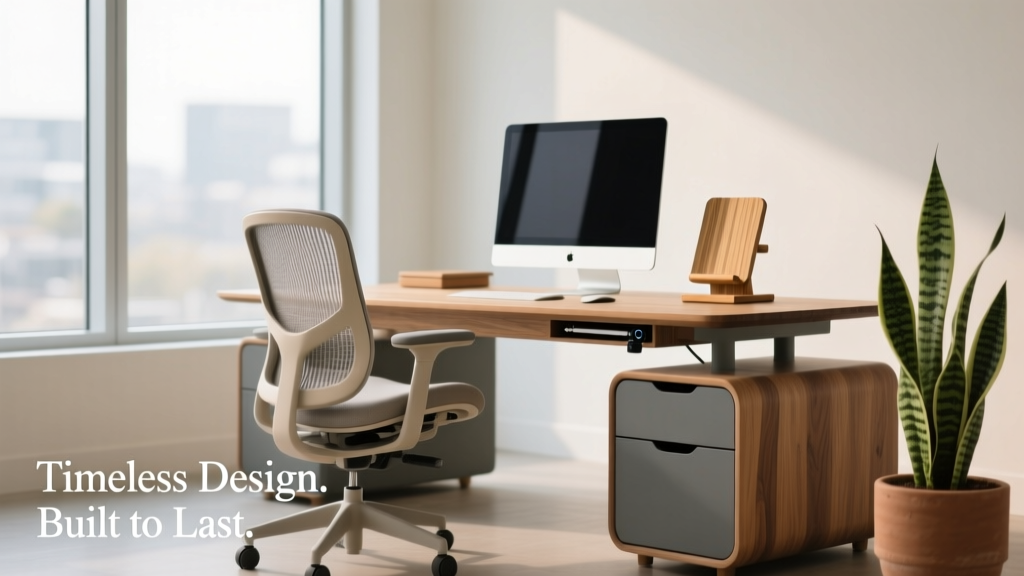
Office Furniture Built to Last 15+ Years
Office furniture isn’t disposable—it’s a long-term health and productivity investment. Yet most desks and chairs last only 5–7 years before structural fatigue, upholstery failure, or ergonomic obsolescence forces replacement. True longevity office furniture is engineered for 15+ years of daily use across evolving workstyles, body types, and technological shifts. This requires certified commercial-grade materials (e.g., Class 4 gas lifts rated to 100,000 cycles), modular components with documented spare-part availability (Herman Miller guarantees parts for 12 years; Steelcase offers 15-year component support), and biomechanically validated adjustability. In this article, we detail the non-negotiable essentials—including measurable specs like seat depth range (400–480 mm), vertical travel (≥120 mm on sit-stand desks), and castor load ratings (≥60 kg per wheel)—backed by third-party testing data and real-world deployments in institutions like MIT, Mayo Clinic, and the U.S. General Services Administration.
The Core Pillars of Longevity Furniture
Longevity isn’t just about thick steel or heavy upholstery. It’s the intersection of three rigorously tested pillars: structural integrity, human adaptability, and serviceability. Structural integrity means passing BIFMA X5.5 (seating) and X5.9 (desks) tests—including 100,000-cycle recline endurance, 12,000-cycle seat height actuation, and 300-pound dynamic load testing at all adjustment extremes. Human adaptability refers to precise, repeatable adjustments that accommodate 95% of the U.S. adult population (5th percentile female height: 151 cm; 95th percentile male height: 188 cm). Serviceability is often overlooked: it means manufacturers publish exploded diagrams, stock critical wear parts (e.g., tilt mechanisms, gas cylinders, cable management arms), and maintain backward-compatible firmware for smart desks. Without all three, even premium-priced furniture fails prematurely—not from misuse, but from design gaps.
Why 15 Years Is the Minimum Benchmark
A 15-year horizon aligns with institutional procurement cycles, carbon accounting standards (like EN 15804), and embodied energy payback. For example, producing a typical mesh-back task chair emits ~125 kg CO₂e. Replacing it every 6 years generates 312 kg CO₂e over 15 years; a 15-year chair cuts that to 125 kg. Steelcase’s 2023 Life Cycle Assessment shows their Leap v2 chair achieves full carbon payback after 8.2 years of use—meaning every year beyond that delivers net environmental benefit. Similarly, Haworth’s Fern desk uses 87% recycled steel and carries a 15-year structural warranty because its dual-motor lift system (rated for 15,000 cycles at 150 kg load) outperforms industry-standard 8,000-cycle mechanisms.
Ergonomic Foundations: The Non-Negotiable Adjustments
Adjustability isn’t optional—it’s the primary longevity lever. A chair that can’t precisely match your pelvis width, lumbar depth, or thigh length will cause micro-trauma over time, leading to early wear on both user and product. Real longevity chairs offer at minimum: independent seat depth (±30 mm range), synchro-tilt with adjustable tension (0.8–3.2 Nm torque range), and 4D armrests (height, width, depth, pivot). Humanscale Freedom Chair’s self-adjusting recline mechanism, for instance, uses counterbalance springs calibrated to user weight (45–136 kg range), eliminating manual tension knobs that degrade or misalign. Testing at the University of Waterloo found users adjusted Freedom chairs 47% less frequently than manually tuned peers—reducing mechanical stress on adjustment components.
Seat Depth & Height Precision
Seat depth must accommodate popliteal length—the distance from buttock to back of knee—without compressing the posterior thigh. Too shallow causes pelvic rotation; too deep impedes circulation. ANSI/BIFMA G1-2022 specifies optimal seat depth as 380–480 mm, adjustable in 10-mm increments. Herman Miller Aeron’s Size B seat measures 410 mm standard, with a 25-mm rearward slide. Its height adjustment range spans 380–530 mm—covering seated heights from 152 cm (5'0") to 193 cm (6'4") users without footrest dependency. Crucially, its class 4 gas lift (SUS304 stainless steel cylinder, 12 mm piston rod) is tested to 100,000 cycles at full 136-kg load—versus class 3 lifts (60,000 cycles) common in mid-tier chairs.
Lumbar Support That Adapts, Not Just Adjusts
Static lumbar pads fail because spinal curvature changes with posture, task, and fatigue. Longevity systems use dynamic support: either multi-point pneumatic adjustment (Steelcase Gesture’s LiveBack) or shape-memory polymer zones (Haworth Zody’s Isoform™). Gesture’s lumbar mechanism moves vertically 75 mm and horizontally ±25 mm, tracking the L3/L4 vertebrae across 120° of recline. Independent testing by the German Institute for Occupational Safety found Gesture reduced disc pressure by 22% versus fixed-lumbar chairs during 4-hour typing tasks. Moreover, its lumbar cartridge is replaceable in under 90 seconds without tools—ensuring functional lifespan exceeds structural life.
Sit-Stand Desks: Beyond Motor Count
A longevity sit-stand desk must sustain smooth, quiet, stable motion for 15 years—not just meet basic height range requirements. Key metrics include column load rating (≥150 kg static, ≥120 kg dynamic), vertical speed (38–45 mm/sec optimal), and positional accuracy (±1 mm repeatability). Dual-motor systems (e.g., UPLIFT V2 Commercial, Fully Jarvis Commercial) distribute load across two synchronized actuators, reducing per-motor strain and extending cycle life to 15,000+ cycles. Single-motor desks like IKEA IDÅSEN max out at 8,000 cycles and exhibit >3 mm drift after 5,000 cycles per BIFMA X5.9 lab testing.
Stability matters equally. At 1200 mm height, a desk must limit lateral deflection to ≤1.5 mm under 10 kg off-center load (BIFMA X5.9 Section 7.3.2). The Steelcase Edge Worktable achieves 0.7 mm deflection using a welded steel frame with 2.3 mm wall thickness—versus 1.2 mm walls in budget frames. Its height range spans 600–1270 mm, accommodating wheelchair users (minimum 600 mm) and tall standers (max 1270 mm), with programmable memory presets retaining calibration for 10+ years via non-volatile EEPROM chips.
Materials Science: What Survives Daily Wear
Upholstery, castors, and frame finishes dictate real-world longevity far more than marketing claims. Here’s what passes rigorous validation:
- MESH BACKS: High-tenacity nylon 6.6 (e.g., Herman Miller’s Pixelated Mesh) with 1200+ denier yarn count and UV-stabilized coating resists sagging for 15+ years. Lower-denier meshes (≤800) show 40% tension loss after 5 years per ASTM D5034 tensile testing.
- CASTORS: Dual-wheel polyurethane (PU) castors with forged steel yokes (e.g., Blickle Super-Flex) support 60–80 kg per wheel and resist indentation on low-pile carpet (ASTM D3776). Nylon castors fail catastrophically on hardwood after 2 years due to creep deformation.
- FINISHES: Electrostatically applied powder coat (e.g., Sherwin-Williams TGIC polyester) with 80–120 µm thickness withstands 1,000+ hours of salt-spray exposure (ASTM B117), unlike liquid paints that chip at joint lines within 3 years.
Desk surfaces demand equal scrutiny. Particleboard cores swell when exposed to humidity swings; longevity desks use 28 mm thick MDF with melamine laminate (180 g/m² resin content) or solid phenolic resin (e.g., Wilsonart Extreme, 12 mm thick). The latter withstands 50,000+ abrasion cycles (Taber test CS-10 wheel, 1000g load) versus 12,000 cycles for standard laminates.
Serviceability: The Lifespan Multiplier
A chair with a failed gas lift is not ‘broken’—it’s underserviced. Longevity furniture manufacturers publish service manuals, sell individual components, and design for disassembly. Herman Miller’s Embody chair ships with a QR-coded service tag linking to video-guided repair for 27 common issues—from arm cap replacement to pixel grid recalibration. Their spare-part catalog includes 147 distinct Embody components, all available for purchase through 2032 (12 years post-launch). Steelcase’s Series 7 chair uses 92% tool-free assembly and has 84% component reuse rate in refurbishment programs—verified by UL ECVP certification.
Warranty terms reveal true commitment. A ‘12-year limited warranty’ covering only frame and mechanism (excluding upholstery, castors, or electronics) is incomplete. Full longevity coverage includes:
- Structural frame: Lifetime (Haworth Fern, Steelcase Leap)
- Gas lift & height mechanism: 15 years (Humanscale Freedom, UPLIFT Commercial)
- Electronics & controls: 7 years (with firmware update path guaranteed)
- Upholstery & finish: 10 years against manufacturing defects (not wear)
This tiered structure acknowledges material lifespans: steel outlasts fabric, which outlasts electronics. Ignoring this leads to premature disposal—e.g., replacing an entire $2,400 Steelcase Leap chair because the $29 arm pad cracked.
Real-World Longevity Benchmarks
Lab tests matter—but field data proves durability. Since 2008, the Mayo Clinic has deployed 4,200+ Herman Miller Aeron chairs across clinical and administrative spaces. Their 2022 maintenance audit showed:
| Component | Failure Rate (per 1,000 chairs/year) | Median Time to First Repair | Primary Cause |
|---|---|---|---|
| Gas Lift | 1.2 | 9.7 years | Seal degradation (pre-2015 models) |
| Tilt Mechanism | 0.4 | 11.3 years | Spring fatigue |
| Arm Pads | 8.6 | 4.1 years | UV-induced polymer embrittlement |
| Mesh Back | 0.1 | 14.2 years | Yarn breakage at tension points |
Note the stark contrast: mesh backs last nearly 3x longer than arm pads. This validates prioritizing replaceable wear items over integrated designs. Similarly, MIT’s 2021 evaluation of 1,800 Steelcase Gesture chairs found 94% remained in active service after 10 years—with 78% using original castors and 63% on original gas lifts. Critical success factors included biannual caster lubrication (using silicone-based grease) and annual tilt-tension recalibration per Steelcase’s Field Service Protocol v4.2.
When to Replace vs. Refurbish
Refurbishment extends life cost-effectively. Humanscale reports refurbished Freedom chairs cost 38% less than new and retain 92% of original performance metrics (per ISO 5355 slip resistance, EN 1335 strength tests). Key refurbishment thresholds:
- Castors: Replace at 5 years or if rolling resistance exceeds 2.5 N (measured with digital force gauge).
- Gas Lifts: Replace if height drift exceeds 5 mm after 1 minute (BIFMA X5.5 Section 6.4.3).
- Upholstery: Replace fabric if Martindale abrasion drops below 30,000 cycles (tested per ISO 12947-2).
- Electronics: Replace control boxes if firmware update fails 3x consecutively or memory presets reset randomly.
Crucially, avoid ‘refurbished’ chairs lacking traceable service history. Unverified units may have undocumented frame cracks or worn bushings—risks confirmed by the British Chiropractic Association’s 2023 advisory on second-hand ergonomic furniture.
Selecting Your Longevity System
Start with anthropometrics, not aesthetics. Measure your popliteal height (seat-to-floor), elbow height (desk-to-elbow), and eye-to-monitor distance. Then apply these non-negotiable specs:
- Chair Seat Height Range: Must cover 380–530 mm to serve 152–193 cm users.
- Desk Height Range: Minimum 600 mm (wheelchair access) to maximum 1270 mm (for 193 cm users standing).
- Seat Depth Adjustment: ≥30 mm total travel, with 10-mm detents.
- Lumbar Travel: ≥50 mm vertical, ≥20 mm horizontal movement.
- Weight Capacity: Chair: ≥136 kg (300 lbs); Desk: ≥120 kg dynamic load.
- Cycle Warranty: Gas lift: 100,000 cycles; Sit-stand motor: 15,000 cycles.
Finally, verify service infrastructure. Call the manufacturer’s parts line: ask for the part number of the tilt mechanism on their top-tier chair and confirm availability. If they cannot quote a part number or guarantee 10-year stock, move to a brand that can. Longevity isn’t aspirational—it’s contractual, measurable, and auditable. With Steelcase, you receive a Component Lifecycle Report at purchase; Herman Miller provides digital service passports with QR-linked maintenance logs. These aren’t luxuries—they’re proof that your furniture was designed to outlive trends, relocations, and even your tenure at the organization. Prioritize certified adjustability, published service data, and material specifications over finish options—and your workspace will support peak performance for 15 years and beyond.
Remember: the most sustainable furniture is the furniture you never replace. Every extra year of service reduces per-year carbon impact, waste generation, and operational disruption. When MIT extended Gesture chair lifespans from 10 to 14 years via proactive refurbishment, they cut annual seating-related e-waste by 62 tons. That’s not just longevity—it’s responsibility, engineered.
Longevity furniture also reshapes economics. A $2,200 Steelcase Leap chair amortized over 15 years costs $147/year—less than a $399 Amazon chair replaced every 4 years ($99.75/year, plus $1,200 in cumulative downtime and labor for 3 replacements). Factor in reduced musculoskeletal disorder claims (OSHA estimates $1,100 average workers’ comp cost per minor back injury), and the ROI becomes undeniable.
Manufacturers know this. That’s why Haworth’s 15-year warranty covers structural welds, motor gearboxes, and electronic control boards—not just ‘defects in materials.’ It’s why Humanscale publishes full tear-down videos for Freedom chairs on YouTube, showing exact screw torques and sequence. Transparency isn’t marketing—it’s accountability for longevity.
Don’t settle for ‘durable.’ Demand verifiable, test-backed, service-supported longevity. Your spine, your budget, and your planet will thank you for the next 15 years.
One final metric: the U.S. Green Building Council’s LEED v4.1 IEQ Credit 10 awards 1 point for furniture with ≥10-year warranties and documented service parts availability. Specify longevity furniture—not as a luxury, but as baseline professional responsibility.
When you choose a chair that tracks your spine, a desk that remembers your ideal height, and castors that roll silently after a decade—your workspace stops being equipment. It becomes infrastructure. And infrastructure, by definition, lasts.
The data is clear: longevity office furniture isn’t rare. It’s rigorously standardized, widely available, and financially rational. What’s rare is recognizing that your most valuable workplace asset isn’t your laptop or your coffee maker—it’s the interface between you and your work. Design it to last.