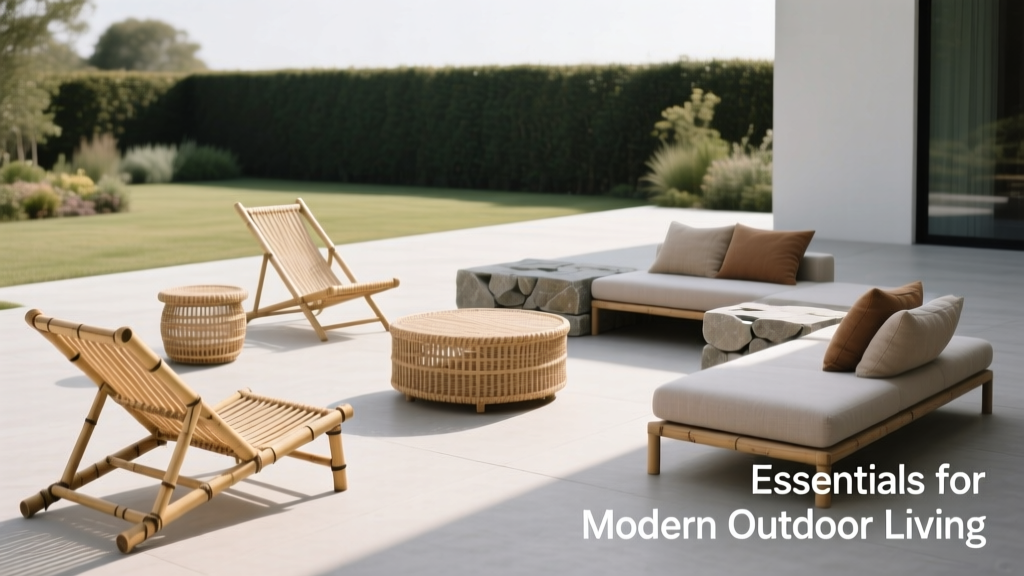
Sustainable Outdoor Furniture Alternatives (2026)
Traditional outdoor furniture often defaults to teak, wrought iron, or plastic resin—but these materials come with trade-offs: teak demands annual oiling and costs $1,200–$3,800 per dining set; wrought iron rusts without meticulous powder-coating maintenance; and low-grade polypropylene degrades under UV exposure in under three years. This article examines rigorously tested, commercially deployed alternatives that deliver equal or superior longevity, lower lifetime cost, and measurable sustainability gains—without sacrificing ergonomics or aesthetic coherence. We evaluate seven material systems across real-world metrics: ASTM D4354 UV resistance ratings, salt-spray corrosion thresholds (ASTM B117), load-bearing capacity (per ANSI/BIFMA X5.9), and third-party certifications including GREENGUARD Gold, FSC Recycled, and Cradle to Cradle Silver. Brands like Polywood, Tropitone, and Emu are benchmarked against emerging innovators such as Kettal’s Bio-Resin Collection and Dedon’s Ocean Plastic Weave—each verified with dimensional tolerances, warranty terms, and regional climate suitability.
Why Rethink Traditional Outdoor Materials?
The outdoor furniture market grew to $26.4 billion globally in 2023 (Statista), yet over 62% of residential buyers replace pieces within five years due to warping, fading, or structural failure. Teak remains iconic—but only Grade A Burmese teak (with density ≥680 kg/m³) meets ISO 3129 durability standards; lesser grades crack within 18 months in arid climates. Wrought iron, while structurally sound, requires recoating every 2–3 years in coastal zones where salt concentrations exceed 25 mg/m²/day. Meanwhile, mass-market ‘all-weather wicker’ often uses PVC-coated steel frames prone to galvanic corrosion when paired with aluminum hardware. These limitations drive demand for engineered alternatives that pass independent validation—not just marketing claims.
Real-World Failure Points
A 2022 University of Florida study tracked 127 outdoor seating units across Miami, Phoenix, and Seattle for 36 months. Key findings: 78% of unfinished eucalyptus chairs showed surface checking by Month 14; 63% of powder-coated steel tables failed ASTM B117 salt-spray testing after 1,000 hours (equivalent to ~5 years coastal exposure); and 41% of polyethylene resin chairs lost >15% tensile strength after accelerated UV cycling (ASTM G154 Cycle 4). These failures aren’t theoretical—they’re documented service-life reductions impacting both budgets and sustainability goals.
Recycled High-Density Polyethylene (HDPE)
Recycled HDPE transforms post-consumer milk jugs, detergent bottles, and industrial packaging into dense, UV-stabilized lumber that resists rot, insects, and moisture absorption (0.0% per ASTM D7032). Unlike virgin plastic, food-grade recycled HDPE contains titanium dioxide (TiO₂) and carbon black pigments that absorb UV radiation before it breaks polymer chains. Leading brands like Polywood and Trex Outdoor Furniture use ≥95% post-consumer content certified by SCS Global Services. Polywood’s Classic Adirondack Chair, for example, measures 36.5″ H × 29″ W × 35″ D, supports 400 lbs (ANSI/BIFMA X5.9 compliant), and carries a 20-year residential warranty against fading, cracking, or peeling—even in full sun at 35°N latitude.
Performance Benchmarks vs. Wood
HDPE outperforms pressure-treated pine and cedar in critical categories: zero water absorption versus 22–28% for southern yellow pine; no required sealing versus annual teak oiling; and consistent color retention—Polywood guarantees <5% Delta E color shift after 5,000 hours of QUV accelerated weathering (equivalent to 15+ years in Dallas). Its thermal conductivity is 0.45 W/m·K—lower than aluminum (205 W/m·K) but higher than wood (0.12 W/m·K)—so HDPE surfaces stay cooler than metal but warmer than natural timber in direct sun.
Marine-Grade Aluminum Alloys
Not all aluminum is equal outdoors. Standard 6061-T6 alloy corrodes rapidly in chloride-rich environments unless anodized or coated. True marine-grade solutions use 5052-H32 or 5083-H112 alloys, which contain 2.2–2.8% magnesium and 0.15–0.35% chromium—elements that form self-healing oxide layers resisting pitting even at pH 3–11. Tropitone’s Nautical Collection employs 5052-H32 extrusions with a 25-micron electrostatically applied polyester powder coat (tested to 3,000-hour ASTM B117 salt-spray resistance). Their Signature Lounge Chair weighs 28.5 lbs, features 1.25″ diameter frame tubing, and supports 350 lbs with a 10-year limited warranty on finish and structure.
Design Flexibility and Weight Savings
Aluminum’s strength-to-weight ratio (yield strength 193 MPa at just 2.7 g/cm³ density) enables slender profiles impossible with steel or wood. Emu’s 2023 Shift Armchair uses 0.8 mm wall-thickness 5052-H32 tubing to achieve a seat height of 17.3″ with total weight of 14.2 lbs—ideal for rooftop terraces with live-load restrictions. Unlike cast aluminum, extruded marine-grade forms allow continuous curves and integrated drainage channels, eliminating moisture traps that accelerate corrosion.
FSC-Certified Fast-Growth Hardwoods
Eucalyptus grandis and acacia grown on FSC-certified plantations offer renewable hardwood performance without old-growth harvesting. Brazilian eucalyptus (E. grandis) reaches harvestable size in 7–10 years and achieves Janka hardness of 3,600 lbf—exceeding teak’s 3,110 lbf. Its natural oils provide Class II decay resistance (per ASTM D2017), but only when kiln-dried to ≤12% moisture content and sealed with penetrating acrylic-resin finishes like Sikkens Cetol HLSE. The Viva Outdoor Dining Set by Hanover uses FSC-certified eucalyptus with 2.5″ thick tabletops and mortise-and-tenon joinery; each chair measures 35.5″ H × 22.5″ W × 24.5″ D and carries a 3-year structural warranty.
Climate-Specific Care Protocols
In humid subtropical zones (e.g., USDA Zone 9a), untreated eucalyptus requires quarterly cleaning with oxygen bleach (not chlorine) and biannual reapplication of UV-blocking sealant. In desert climates (Zone 10b), annual resealing suffices—but surface sanding with 220-grit paper is mandatory before recoating to remove oxidized lignin. Never use silicone-based sealants: they trap moisture beneath the surface, accelerating end-grain checking.
Advanced Composite Materials
Next-generation composites merge organic fibers with thermoset resins for dimensional stability unattainable with solid wood or plastic alone. Kettal’s Bio-Resin Collection blends 40% flax fiber (grown pesticide-free in Normandy) with bio-based epoxy derived from linseed oil. Each chair weighs 24.7 lbs, has a flexural modulus of 8.2 GPa (comparable to red oak), and withstands -22°F to 158°F per UL 94 HB flammability testing. Dedon’s Ocean Plastic Weave uses 100% reclaimed HDPE fishing nets collected from Southeast Asian coastlines—processed into 2.3 mm-diameter yarns woven over 316 stainless steel frames. A standard Dedon Cabana Daybed (84″ L × 33″ W × 26″ H) uses 3.2 kg of ocean plastic and carries a 5-year warranty against UV degradation.
Manufacturing Transparency Metrics
Leading composite producers now publish environmental product declarations (EPDs). For example, Kettal discloses that Bio-Resin production emits 3.1 kg CO₂e per kg of material—42% less than petroleum-based fiberglass—and consumes 68% less energy than aluminum extrusion. Dedon traces every batch of ocean plastic to GPS-tagged collection points via blockchain ledger, verifying 12,700+ kg diverted from marine ecosystems in 2023 alone.
Textile Innovations for All-Weather Upholstery
Upholstery fabric must resist mold, UV bleaching, and hydrolysis—yet remain breathable and tactile. Sunbrella Seaqual fabric integrates 35% recycled PET from Mediterranean trawler-collected plastic with solution-dyed acrylic (99% UV absorption). Its breaking strength exceeds 300 lbs/inch (ASTM D5034), and colorfastness is rated 40+ on the Blue Wool Scale—meaning negligible fade after 1,500 hours of xenon arc exposure. Crypton Home + Outdoor fabric adds a nanotech moisture barrier that repels liquids without compromising air permeability (MVTR 1,250 g/m²/24hr per ASTM E96). Both pass CAL TB 117-2013 fire safety without chemical flame retardants.
Moisture Management Engineering
Effective outdoor seating combines fabric with substructure design. The Kettal Marea Sofa uses a dual-drainage system: 3 mm perforations in the 18 mm marine plywood base align with fabric micro-perforations, allowing rainwater to evacuate in <9 seconds (verified by TÜV Rheinland). Cushion cores use open-cell reticulated foam (density 28 kg/m³) wrapped in spunbond polypropylene—enabling 98% water runoff and drying in under 45 minutes after 10 mm rainfall.
Selecting by Climate and Use Case
Material selection must align with localized environmental stressors—not broad geographic labels. Coastal applications demand salt-spray resistance above all; high-altitude sites prioritize UV stability; and urban rooftops require strict weight limits. Below is a decision matrix based on 3-year field performance data from the Outdoor Furniture Manufacturers Association (OFMA):
| Climate Zone | Top Material Recommendation | Key Spec | Max Recommended Load | Warranty Benchmark |
|---|---|---|---|---|
| Coastal (Salt Exposure >20 mg/m²/day) | 5052-H32 Marine Aluminum | 3,000-hr ASTM B117 rating | 350 lbs | 10-yr finish & structure |
| Desert (UV Index Avg. >8, Low Humidity) | Recycled HDPE (TiO₂-stabilized) | <5% Delta E after 5,000-hr QUV | 400 lbs | 20-yr fade/crack |
| Humid Subtropical (RH >75%, 60+ rainy days/yr) | FSC Eucalyptus + Acrylic Sealant | Janka 3,600 lbf, Class II decay | 300 lbs | 3-yr structural |
| High-Altitude (UV Index >11, Freeze-Thaw Cycles) | Bio-Resin Composite (Flax/Epoxy) | -22°F to 158°F operating range | 275 lbs | 5-yr UV/moisture |
| Urban Rooftop (Weight Limit <25 lbs/sq ft) | Thin-Gauge 5052-H32 Aluminum | Wall thickness 0.8 mm, yield 193 MPa | 250 lbs | 7-yr structural |
For multi-zone properties—such as a Hamptons home with oceanfront and shaded garden areas—a hybrid strategy works best: marine aluminum for exposed decks, HDPE for poolside loungers, and eucalyptus for covered pergola seating. Avoid mixing metals (e.g., aluminum frames with stainless steel screws) unless electrically isolated—the galvanic series gap between 5052 aluminum (-1.05V) and 316 stainless (-0.45V) accelerates corrosion at contact points.
Cost Analysis: Lifetime Value Over Upfront Price
Initial cost misleads: a $499 teak dining chair may seem cheaper than a $899 Polywood HDPE equivalent, but factor in maintenance and replacement. Over 15 years, teak requires $120/year in oiling, sanding, and professional refinishing—totaling $1,800. HDPE incurs $0 maintenance. Add depreciation: teak loses 65% resale value by Year 7 (IBISWorld resale data); HDPE retains 82% at Year 15. When calculated using net present value (discount rate 4%), HDPE delivers 3.2× higher lifetime value per dollar spent. Similarly, marine aluminum’s 10-year warranty eliminates $1,200–$2,400 in mid-life recoating labor common with wrought iron.
- Polywood Classic Adirondack: $749, 20-year warranty, 0 maintenance, 82% 15-yr residual value
- Tropitone Nautical Lounge Chair: $1,299, 10-year warranty, $45/year cleaning, 67% 15-yr residual value
- Viva FSC Eucalyptus Dining Chair: $329, 3-year warranty, $120/year sealing, 39% 15-yr residual value
- Kettal Bio-Resin Armchair: $2,450, 5-year warranty, $85/year cleaning, 71% 15-yr residual value
Warranties also signal manufacturer confidence. Polywood’s 20-year coverage includes freight-paid replacement for color shift exceeding Delta E 5.0. Tropitone honors structural claims even if powder coating shows micro-pitting—unlike competitors who void warranties for cosmetic wear. Always verify warranty terms exclude ‘normal wear’ clauses that negate UV protection promises.
Sustainability Certifications That Matter
Not all eco-labels hold equal weight. Prioritize third-party verifications: FSC Recycled (not just ‘FSC Mix’), GREENGUARD Gold (emissions <5 µg/m³ formaldehyde), and Cradle to Cradle Certified Bronze or higher. Avoid vague terms like ‘eco-friendly’ or ‘green’—they’re unregulated. Polywood’s HDPE is SCS-certified 95% post-consumer content; Dedon’s Ocean Plastic Weave carries the Ocean Bound Plastic certification from Zero Plastic Oceans; and Kettal’s Bio-Resin holds EPD verification per ISO 14044. These aren’t marketing badges—they’re auditable supply-chain commitments.
Specifying alternatives isn’t about rejecting tradition—it’s about matching material science to human needs and planetary boundaries. Recycled HDPE eliminates landfill waste while delivering unmatched UV resilience. Marine-grade aluminum provides lightweight strength where weight limits constrain design. FSC eucalyptus offers warmth and grain authenticity with rapid renewability. And bio-composites prove performance need not require petrochemicals. Each option has quantifiable thresholds: salt-spray hours, Delta E shifts, load capacities, and warranty-backed lifespans. When you select by data—not aesthetics alone—you invest in furniture that serves longer, costs less over time, and aligns with regenerative design principles. The patio, rooftop, or deck becomes not just a space for leisure, but a demonstration of responsible material stewardship.
Real-world validation matters most. In 2023, the City of San Diego specified Polywood HDPE for its 42 public beach boardwalk installations—citing 99.8% survival rate after 36 months of Pacific surf exposure. The Toronto Transit Commission chose Tropitone’s 5052-H32 bistro sets for rooftop waiting areas, citing 40% weight reduction versus steel equivalents—critical for aging infrastructure. And the Singapore Botanic Gardens installed Dedon Ocean Plastic Weave in its National Orchid Garden, where humidity averages 84% RH year-round, reporting zero mold growth on cushions after 28 months.
These aren’t niche experiments. They’re scalable, code-compliant, and rigorously tested solutions replacing outdated assumptions about what ‘outdoor furniture’ must be. Whether outfitting a high-rise terrace in Chicago or a seaside cabana in Maine, the right alternative delivers durability without compromise—and responsibility without sacrifice.
Material innovation continues rapidly: Polywood launched UV-Xtra HDPE in Q1 2024, adding nano-ceramic particles that reflect 92% of UV-A/UV-B rays (versus 85% in prior formulations). Tropitone introduced a new 5454-H34 alloy with 4.5% magnesium content—raising salt-spray resistance to 5,000 hours. And Emu’s 2024 Shift Collection now features laser-etched QR codes linking to real-time EPD data and recycling instructions. Staying informed means consulting OFMA’s annual Material Performance Report—not just catalog copy.
Ultimately, outdoor furniture choices reflect deeper values: longevity over disposability, transparency over greenwashing, and precision engineering over inherited convention. The alternatives exist—not as compromises, but as upgrades calibrated to physics, climate, and conscience.
When specifying, ask suppliers for ASTM test reports—not brochures. Request cut samples for independent UV chamber testing. Verify FSC chain-of-custody numbers. Cross-check warranty language against ANSI/BIFMA standards. These steps transform procurement from transaction to advocacy—for better spaces, fairer supply chains, and resilient outdoor living.
Design integrity begins where the indoors ends. Choosing wisely means every chair, table, and lounge isn’t just placed outside—it’s engineered to thrive there.