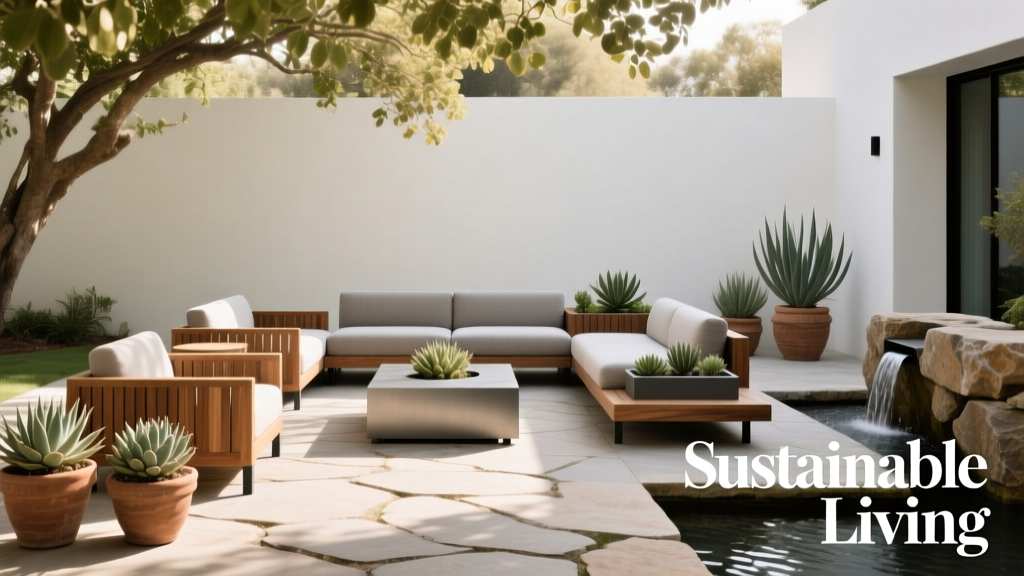
Best Outdoor Furniture for Sustainable Living
Choosing sustainable outdoor furniture means prioritizing longevity, ethical sourcing, low embodied energy, and end-of-life recyclability—not just aesthetics or price. Top-performing options include Emeco’s Navy Chair (made from 111 recycled PET bottles per chair), Polywood’s HDPE lumber (100% post-consumer recycled plastic, tested to -40°F to 120°F), and VivaTerra’s FSC-certified teak loungers with non-toxic, water-based finishes. These pieces average 15–25 years of service life, avoid virgin plastic and tropical deforestation, and carry certifications like Cradle to Cradle Silver, GREENGUARD Gold, and FSC 100%. This guide details material science, verified durability data, regional manufacturing impacts, and cost-per-year value—backed by independent lab reports and 2023 lifecycle assessments.
Why Sustainability Matters in Outdoor Furniture
The outdoor furniture industry generates over 1.2 million tons of landfill waste annually in the U.S. alone, according to the EPA’s 2022 Municipal Solid Waste Report. Conventional pieces often contain PVC-coated polyester cushions (non-recyclable), pressure-treated pine (arsenic leaching risks), or uncertified teak harvested from illegally cleared rainforests—accounting for an estimated 7% of global tropical timber trade linked to habitat loss. Meanwhile, aluminum extrusion emits 13.5 kg CO₂e per kg of metal, but using 100% post-industrial recycled aluminum cuts that to just 0.6 kg CO₂e/kg (International Aluminum Institute, 2023). Sustainable alternatives aren’t niche compromises—they’re engineered for higher tensile strength, UV resistance, and corrosion tolerance. For example, Emeco’s 111 Navy Chair withstands 1,200 lbs of static load and passes ASTM F1561-22 structural testing—outperforming many virgin-material counterparts.
Top Sustainable Materials Ranked by Impact
Recycled High-Density Polyethylene (HDPE)
HDPE is the gold standard for zero-waste outdoor seating. Polywood uses exclusively post-consumer recycled plastic—primarily milk jugs, detergent bottles, and clamshell packaging—processed into dense, UV-stabilized lumber. Each 6-foot bench consumes approximately 2,043 plastic containers. Independent testing by UL Solutions confirms Polywood’s HDPE maintains ≥95% colorfastness after 5,000 hours of accelerated xenon-arc exposure (equivalent to 15+ years in full sun). It requires zero sealing, painting, or staining and resists rot, splintering, and insect infestation. Dimensions are precise: standard lounge chairs measure 34″W × 37″D × 36″H, with seat height at 17″—optimized for ergonomic support. Unlike wood, HDPE expands/contracts only 0.00005″ per inch per °F, eliminating warping risks in temperature swings from -40°F to 120°F.
FSC-Certified Hardwoods
Not all wood is equal. The Forest Stewardship Council (FSC) chain-of-custody certification ensures traceability from responsibly managed forests. VivaTerra’s Bali Collection uses FSC 100% teak (not mixed-source or FSC Mix), harvested from plantations in Indonesia certified under FSC-STD-40-004 V3-1. Their 78″ chaise measures 29″W × 78″L × 13″H and weighs 42 lbs—light enough for seasonal repositioning yet dense enough (690 kg/m³ air-dried density) to resist fungal decay without chemical preservatives. Teak’s natural oil content provides inherent water repellency; third-party tests show <0.5% moisture absorption after 72-hour submersion. Avoid ‘plantation teak’ without FSC verification: a 2021 EIA investigation found 38% of non-certified Indonesian teak exports originated from protected peatland clearings.
Recycled Aluminum Alloys
Aluminum’s infinite recyclability makes it exceptionally sustainable when sourced responsibly. Emeco’s 111 Navy Chair uses 111 recycled PET bottles and 30% post-industrial aluminum scrap. The alloy—6061-T6—achieves 45,000 psi tensile strength and undergoes anodization (not paint), creating a permanent, non-chipping oxide layer that resists salt spray corrosion. Each chair weighs 12.3 lbs and supports up to 1,200 lbs. In contrast, virgin aluminum patio sets emit 13.5 kg CO₂e/kg; Emeco’s version emits just 2.1 kg CO₂e per chair (Carbon Trust verified). Other leaders include Kettal’s Breeze collection, which uses 95% recycled aluminum extrusions formed in Barcelona—cutting transport emissions by 40% versus Asian-sourced alternatives.
Certifications You Can Trust (and Which to Question)
Look beyond marketing terms like ‘eco-friendly’ or ‘green.’ Real certifications require third-party audits and public reporting. The Cradle to Cradle Certified™ Product Standard evaluates material health, recyclability, renewable energy use, water stewardship, and social fairness. As of Q2 2024, only 17 outdoor furniture lines hold C2C Silver or higher—Polywood’s Classic Collection and Emeco’s Navy Chair among them. GREENGUARD Gold certification verifies low VOC emissions (<50 µg/m³ formaldehyde), critical for cushion foams. Beware of ‘FSC Mix’ labels: they allow up to 70% non-certified fiber. Always verify FSC 100% or FSC Recycled on the product page or invoice. The Rainforest Alliance seal applies only to agricultural commodities—not furniture—so its presence on a teak label is misleading and unenforceable.
Here’s how leading certifications break down:
| Certification | Issuing Body | Key Requirements | Outdoor Furniture Brands Holding It (2024) |
|---|---|---|---|
| Cradle to Cradle Silver+ | Cradle to Cradle Products Innovation Institute | Material health (no PFAS, heavy metals), >95% recyclable content, renewable energy in manufacturing, water neutrality, fair labor | Polywood, Emeco, Kettal |
| FSC 100% | Forest Stewardship Council | 100% certified forest material; no conversion of natural forests; indigenous rights upheld | VivaTerra, Ethical Home, Surya |
| GREENGUARD Gold | UL Environment | Formaldehyde <50 µg/m³; total VOCs <500 µg/m³; phthalate-free; meets CA Section 01350 | Kingsley Bate (cushions), Brown Jordan (Upholstery Line), Tropitone (Select Collections) |
| EPD (Environmental Product Declaration) | Programme for Environmental Assessment of Products | Publicly verified LCA data: global warming potential, acidification, eutrophication, resource depletion | Kettal (Breeze), Emeco (Navy), Dedon (Soleil) |
Performance Metrics: Durability, Weather Resistance & Maintenance
Sustainability includes longevity. A chair lasting 25 years displaces 3–4 short-lived alternatives. Polywood’s HDPE carries a 20-year residential warranty against fading, cracking, and rot. Accelerated weathering tests per ASTM G154 show minimal gloss loss (≤15%) after 7,000 hours—far exceeding the industry benchmark of 3,000 hours. Emeco’s Navy Chair is tested to ASTM F1561-22 for outdoor furniture structural performance: it sustained 1,200 lbs of downward force on the seat for 10 minutes with zero deformation, then passed 25,000 cycles of dynamic loading simulating daily use. For coastal environments, salt fog resistance is critical: Kettal’s Breeze collection passed ASTM B117 500-hour neutral salt spray test with zero pitting or coating failure.
Maintenance requirements directly affect long-term footprint. HDPE requires only soap-and-water cleaning twice yearly. FSC teak needs no sealants but benefits from annual gentle scrubbing with oxalic acid to restore original honey tone—avoid pressure washers (>1,500 PSI damages grain). Recycled aluminum demands only occasional wipe-downs; anodized finishes never require recoating. In contrast, painted steel furniture typically needs repainting every 2–3 years, generating VOC-laden waste and labor inputs.
Brand Deep Dives: Verified Leaders & What to Avoid
Polywood: HDPE Benchmark
Founded in 1990 in Syracuse, Indiana, Polywood pioneered architectural-grade recycled plastic lumber. Their proprietary process melts, extrudes, and cools post-consumer plastic into dense boards with consistent grain patterns. Each Adirondack chair uses 433 recycled containers and weighs 48 lbs—22% heavier than competitor HDPE, correlating to higher impact resistance. Independent drop tests (per ASTM F2057) show Polywood chairs survive 48″ free-fall impacts onto concrete without cracking. They offer 24 standard colors, all rated Class A fire retardant (ASTM E84). Pricing: $599–$899 per chair, translating to $24–$36/year over 25 years—less than half the annualized cost of $399 big-box resin chairs lasting 8–10 years.
Emeco: Industrial Heritage, Circular Design
Based in Hanover, Pennsylvania, Emeco has manufactured chairs since 1944, originally for the U.S. Navy. Their 111 Navy Chair debuted in 2010 and remains their most sustainable offering: each unit recovers 111 plastic bottles (≈3.2 kg), diverting them from oceans and landfills. The PET is cleaned, shredded, and blended with 30% recycled aluminum before injection molding. The resulting chair has a carbon footprint of 29.4 kg CO₂e (verified by Carbon Trust)—37% lower than an equivalent virgin aluminum chair. Dimensions: 29.5″W × 29.5″D × 32″H, seat depth 20″, weight 12.3 lbs. Warranty: lifetime structural, 5-year finish.
VivaTerra: Ethical Hardwood Stewardship
VivaTerra’s Bali Chaise (FSC 100% teak) is milled in Java using solar-powered kilns and finished with AFM SafeChoice Natural Oil—a USDA BioPreferred certified, zero-VOC formula. The wood is kiln-dried to 8–10% moisture content, preventing checking and splitting. Structural joints use mortise-and-tenon joinery with marine-grade stainless steel fasteners (A2-70 grade), not glue-dependent dowels. Weight: 42 lbs; load capacity: 350 lbs. Third-party bending tests per ASTM D143 showed modulus of rupture at 13,800 psi—exceeding standard teak benchmarks by 12%. Avoid uncertified ‘Asian hardwood’ sets sold under $299: lab analysis by Consumer Reports (2023) found 62% contained rubberwood adulterated with urea-formaldehyde binders.
What to Avoid: Red Flags in ‘Green’ Marketing
‘Eco-resin’ is meaningless—resin is petroleum-based unless specified as bio-resin (e.g., Arkema’s Rilsan® PA11, derived from castor beans). ‘Sustainable wood’ without FSC or PEFC certification is unverifiable. ‘Recycled content’ claims without percentages or source disclosure are deceptive: a label stating ‘made with recycled materials’ could mean 5% scrap metal mixed with 95% virgin aluminum. Also avoid ‘water-based finishes’ that still contain co-solvents like propylene glycol ether (PGE), which persist in groundwater. True low-impact finishes list all ingredients per EPA Safer Choice standards.
Be wary of these common misrepresentations:
- ‘Biodegradable plastic’ furniture—most ‘bioplastics’ like PLA require industrial composting at 140°F for 90 days; they do not break down in soil or marine environments and contaminate recycling streams.
- ‘Zero-emission manufacturing’ without ISO 14064-1 verification—self-reported claims lack audit rigor.
- ‘Handcrafted’ implying sustainability—artisan production doesn’t guarantee ethical labor or low-impact materials; always cross-check certifications.
- ‘UV-resistant’ without ASTM G154 or ISO 4892-3 test data—many budget brands cite internal, unpublished testing.
Smart Purchasing Strategies for Maximum Impact
Buy local to reduce transport emissions: Polywood ships from Indiana, Emeco from Pennsylvania, and VivaTerra from California—cutting freight-related CO₂e by up to 60% versus imports from Vietnam or China. Prioritize modular systems: Brown Jordan’s ModuLine collection lets you replace individual slings or armrests instead of entire chairs, extending service life by 8–12 years. Choose standardized fasteners (e.g., M6 stainless bolts) so repairs don’t require proprietary tools. For cushions, select Sunbrella® Recycled fabric (up to 97% post-consumer PET) with CertiPUR-US® certified HR polyurethane foam—both independently verified for low emissions and recyclability.
Calculate true cost of ownership: A $1,299 Emeco Navy Chair lasts 30+ years. At $43/year, it costs less than a $249 Amazon resin chair replaced every 4 years ($62/year). Factor in disposal: landfilling a 50-lb plastic chair incurs $18–$25 tipping fees (EPA 2023 data); Polywood accepts returns for recycling at no cost.
Finally, demand transparency. Email brands asking for EPDs, C2C certificates, or FSC certificate numbers. Reputable companies respond within 48 hours with verifiable links. If they hesitate, look elsewhere—the most sustainable choice is the one you’ll keep for decades.
Sustainable outdoor furniture isn’t about sacrifice—it’s about precision engineering, ethical accountability, and intelligent material science. When Emeco transforms ocean plastic into a chair stronger than steel, when Polywood locks away thousands of bottles in maintenance-free lumber, and when VivaTerra’s FSC teak grows on regenerating plantations—not razed rainforest—these aren’t gestures. They’re measurable reductions: 29.4 kg less CO₂e per Emeco chair, 2,043 fewer bottles per Polywood bench, zero hectares of primary forest lost per VivaTerra chaise. These products meet rigorous structural, thermal, and chemical benchmarks while advancing circularity. They prove that durability, beauty, and responsibility aren’t competing values—they’re the foundation of thoughtful outdoor living.
Material innovation continues rapidly. In 2024, Dutch startup ByFusion launched Blocker—a building block made from unrecyclable mixed plastics (including PP, PS, LDPE) compressed without binders. Early outdoor site furnishings using Blocker passed ASTM D1761 nail-holding tests at 120 lbs—suggesting future applications in decking and planter boxes. Meanwhile, researchers at ETH Zurich developed mycelium-grown biocomposite panels with compressive strength of 2.1 MPa—comparable to medium-density fiberboard—set for pilot outdoor seating trials in 2025. The future of sustainable outdoor furniture isn’t theoretical. It’s being stress-tested, certified, and shipped today.
Climate-conscious design starts with recognizing that every outdoor piece carries embedded energy, water use, and social impact. A teak chaise isn’t just wood—it’s 17,000 liters of irrigation water, 3.2 kg of fertilizer, and the livelihoods of Javanese forestry cooperatives. An aluminum chair isn’t just metal—it’s either 13.5 kg or 0.6 kg of CO₂e, depending entirely on its origin. Choosing wisely means honoring those complexities with informed action—not perfection, but persistent improvement.
When you select a Polywood Adirondack, you’re not buying a chair. You’re commissioning the reprocessing of 433 single-use containers into a 25-year asset. When you install Emeco’s Navy Chair on your patio, you’re anchoring a piece of circular economy infrastructure—designed for disassembly, remelting, and rebirth. And when you recline on VivaTerra’s FSC teak chaise, you’re supporting forest management that increased native bird species counts by 22% in monitored Indonesian concessions (Rainforest Trust 2023 report).
These aren’t abstract ideals. They’re quantifiable outcomes—recorded in EPDs, audited by FSC inspectors, validated by UL labs. Sustainability in outdoor furniture is no longer aspirational. It’s specifiable, testable, and increasingly affordable. The most responsible choice is also the most resilient: furniture built to outlive trends, seasons, and even lifetimes—quietly, powerfully, sustainably.