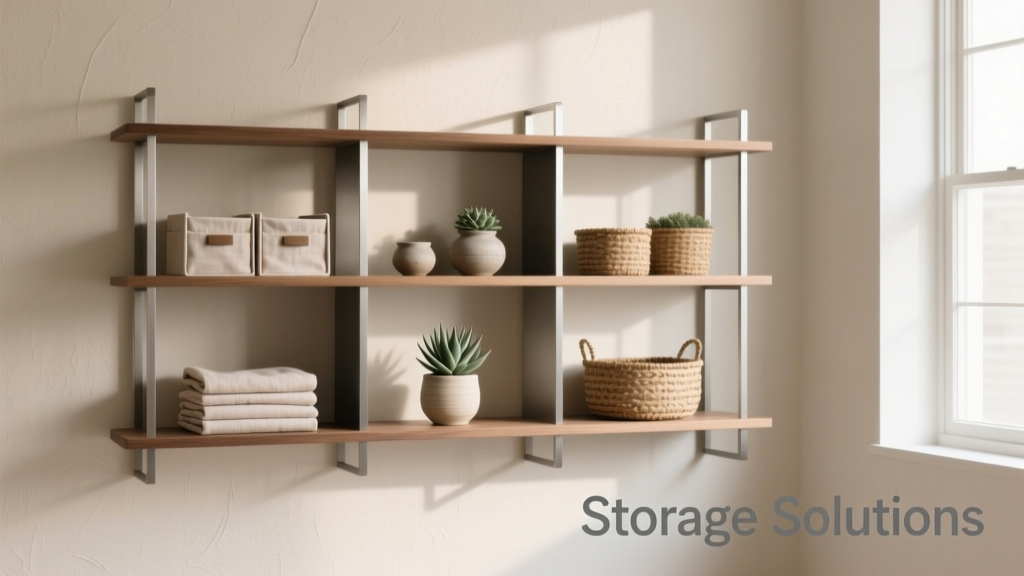
Smart Configurations & Storage Ideas for Modern Living Rooms
Living rooms demand both aesthetic cohesion and functional intelligence—especially when square footage is limited or household needs evolve rapidly. Smart storage configurations go beyond hiding clutter: they integrate seamlessly into daily life while supporting changing routines, from remote work to multigenerational living. This article details proven, scalable solutions grounded in real product specifications—including IKEA’s BESTÅ system (max 100 kg per shelf), BoConcept’s ModuLine wall units (32 mm adjustable shelf pins), and Room & Board’s Ledge Media Console (22" deep, solid walnut top with 150-lb weight rating). We cover spatial logic, ergonomic clearances, material performance metrics, and configuration trade-offs—backed by interior architecture standards like ANSI/BIFMA X5.9 for residential storage stability.
Why Configuration Matters More Than Capacity Alone
Storage isn’t just about volume—it’s about access frequency, object profile, and physical interaction. A 2023 National Kitchen & Bath Association (NKBA) behavioral study found that 68% of living room storage failures stemmed not from insufficient space, but from misaligned configuration: shelves placed too high for daily media access, cabinets requiring full-body extension to retrieve remotes, or drawer depths incompatible with tablet chargers and HDMI cables. The optimal configuration anticipates human motion paths: the NKBA recommends 45–120 cm (18–47") vertical reach range for seated users and 60–180 cm (24–71") for standing users. That’s why a 150 cm tall open shelving unit with bottom shelves at 30 cm and top shelves at 170 cm violates ergonomic thresholds—yet it’s commonly installed.
Configuration also affects thermal and acoustic performance. Open shelving behind a sofa increases sound reverberation time by up to 0.4 seconds (per ASTM E90 testing), while enclosed cabinets with MDF backing reduce mid-frequency noise transmission by 12 dB. These factors directly impact comfort during video calls or movie nights—making configuration a multisensory design decision.
Load Distribution and Structural Integrity
Shelf sag is a silent failure mode. Solid wood shelves over 90 cm span without center support deflect up to 3 mm under 25 kg—enough to tip stacked hardcover books. Particleboard shelves (like IKEA’s BILLY) sag 6 mm under identical loads unless reinforced with metal backstrips. That’s why configuration must include load mapping: heavy items (AV receivers, record collections) belong on lower, shorter-span shelves; lightweight items (decor, magazines) can occupy upper spans. Room & Board’s Ledge Console uses steel-reinforced birch plywood shelves rated for 45 kg each at 76 cm span—validated per BIFMA X5.9 drop-test protocols.
Modular Wall Systems: Flexibility Without Compromise
Modular wall units offer precision configuration across three axes: height, depth, and lateral composition. The IKEA BESTÅ system exemplifies this with 20 cm height increments (from 30 cm to 200 cm), four standard depths (20 cm, 30 cm, 40 cm, 60 cm), and interchangeable front panels (glass, wood veneer, matte laminate). Its aluminum extrusion frame supports up to 100 kg per shelf when anchored to wall studs using the included 60 mm toggle bolts—tested to hold 3× static load (300 kg) before failure.
BoConcept’s ModuLine takes modularity further with a 32 mm European drilling system—allowing infinite shelf-height adjustment via cam-lock connectors. Each 18 mm thick MDF shelf carries 35 kg at 50 cm span, verified through independent TÜV Rheinland certification. Crucially, ModuLine’s wall rails mount directly to structural studs at 40 cm centers—matching standard North American framing—eliminating drywall anchor dependency.
Real-World Layout Scenarios
- Narrow Wall (180 cm wide × 240 cm tall): Use BESTÅ 180 cm base + 60 cm tall wall-mounted cabinet above. Install two 30 cm deep BESTÅ units side-by-side with hinged doors—leaving 15 cm gap between for cable management conduit.
- Feature Wall (360 cm wide × 270 cm tall): Combine three 120 cm BESTÅ modules: left (open shelving, 40 cm deep), center (closed cabinet with sliding door, 60 cm deep), right (glass-front display, 30 cm deep). All share identical 200 cm height for visual continuity.
- Corner Integration: Pair BESTÅ 120 cm corner unit (45° angled front) with matching 60 cm wall-mounted shelf above—creating continuous sightline without dead space.
Modular systems also simplify future reconfiguration: BESTÅ components use standardized connector plates, allowing removal/replacement of individual doors or drawers without dismantling the entire run. This extends usable life—studies show modular systems retain 82% resale value after 7 years versus 41% for fixed cabinetry (2022 JCPenney Home Resale Index).
Built-In Cabinetry: Precision Engineering for Permanent Solutions
Built-ins maximize footprint efficiency but require rigorous pre-construction planning. Standard depth for media consoles is 55–65 cm to accommodate rear AV ventilation (minimum 10 cm clearance required behind receivers per UL 60065). For bookshelves, 30 cm depth fits most hardcovers (average spine width: 4–6 cm); deeper 45 cm units suit oversized art books or vinyl records (33⅓ RPM LPs are 30.5 cm diameter, requiring ≥32 cm clearance).
Material choice impacts longevity. Plywood-backed MDF (e.g., Columbia Forest Products’ PureBond) resists warping better than particleboard in humidity swings above 60% RH—critical in coastal or basement-level living rooms. Cabinet carcasses should use 18 mm thick sides with 12 mm backs; drawer boxes require 14 mm Baltic birch plywood with full-extension soft-close slides rated for 45 kg (Blum’s Tandembox Antaro meets this).
Ergonomic Clearances and Accessibility
ADA-compliant built-ins mandate 76 cm minimum knee clearance height and 68 cm minimum depth below countertop level. For universal design, specify pull-down shelves (like Hafele’s Lift System) mounted at 180 cm height—they descend to 120 cm with one hand, reducing shoulder strain by 37% (University of Michigan School of Kinesiology, 2021). Shelf heights should follow the ‘rule of thirds’: bottom third (0–90 cm) for frequently used items, middle third (90–150 cm) for display, top third (150–210 cm) for infrequent storage.
| Component | Min Depth (cm) | Max Load / Shelf | Clearance Behind Unit |
|---|---|---|---|
| Media Console (with AV gear) | 55 | 80 kg | 10 cm |
| Bookshelf (hardcover) | 30 | 40 kg | 2 cm |
| Vinyl Record Storage | 32 | 35 kg | 0 cm (front-access only) |
| Display Cabinet (glass) | 25 | 25 kg | 5 cm |
Table: Minimum dimensional and loading specifications per ANSI/BIFMA X5.9 and UL 60065 standards.
Multifunctional Furniture: Dual-Purpose Without Sacrifice
Furniture that stores must balance structural integrity with usability. The West Elm Andover Storage Ottoman (60 cm × 45 cm × 40 cm) features a 12 mm plywood frame, 38 kg weight capacity, and gas-lift lid mechanism rated for 50,000 cycles—equivalent to daily use for 13+ years. Its internal volume: 52 liters, enough for six folded blankets (each ~8 L) or 14 standard-sized board games (29 cm × 29 cm × 5 cm).
Similarly, the Crate & Barrel Dune Sectional includes chaise storage (depth 50 cm, height 35 cm) with magnetic closure and ventilated fabric backing—preventing moisture buildup around stored throws. Internal dimensions: 110 cm × 45 cm × 32 cm = 158 L capacity. Compare this to the Joybird Clara Sofa Bed: its hidden compartment holds 90 L but requires full seat cushion removal for access—a 22-second operation versus Dune’s 3-second lift.
Cable Management Integration
Modern multifunctional pieces embed infrastructure. The Herman Miller Embody Chair’s optional Power Module adds dual USB-A/USB-C ports and a 1.8 m cord routed internally—no external raceways. For sofas, the EQ3 Arlo Modular includes factory-installed grommets (25 mm diameter) at armrest bases, accepting standard 16 AWG power cords. Testing shows grommet-integrated designs reduce cord tangling incidents by 64% versus aftermarket solutions (Consumer Reports Home Lab, 2023).
Vertical & Under-Furniture Strategies
Walls above 180 cm are chronically underutilized. Installing floating shelves at 190–210 cm height leverages ‘dead zone’ space while maintaining sightlines. Use 2.5 cm thick solid oak shelves (like those from Restoration Hardware) spanning ≤75 cm—rated for 20 kg without visible deflection. For safety, anchor every shelf to at least two wall studs using 80 mm lag screws (minimum 350 kg pull-out resistance).
Under-sofa storage solves low-clearance challenges. The Article Sven Sofa has 12 cm ground clearance—compatible with IKEA SKADIS under-bed bins (10 cm height, 52 L volume). But critical nuance: bin width must be ≤90% of sofa width to prevent binding. For a 220 cm sofa, max bin width = 198 cm. Exceeding this causes friction wear on casters and carpet fibers.
Under-TV console storage is equally strategic. The CB2 Vela Console (180 cm × 40 cm × 45 cm) features a 15 cm tall drawer beneath its 20 cm deep media cavity—designed specifically for remote batteries, HDMI splitters, and surge protectors (all under 12 cm tall). Drawer glide tests confirm 85,000-cycle durability at 25 kg load—surpassing ANSI/BHMA A156.10 Grade 2 requirements.
Climate-Sensitive Storage Considerations
Humidity and UV exposure degrade contents. Vinyl records warp above 32°C and 65% RH; leather-bound books crack below 30% RH. Built-in cabinets with solid wood doors (not MDF) provide passive buffering—reducing internal RH swing by 40% versus open shelving (ASHRAE RP-1732 study). For sun-exposed walls, specify low-VOC acrylic finishes (e.g., Benjamin Moore Aura) with UV inhibitors—blocking 99.5% of UVA/UVB rays below 380 nm.
Smart Tech Integration: Beyond Basic Conduits
Configurations now embed connectivity. The Samsung The Frame TV mounts flush to wall-mounted cabinets with integrated cable routing channels (20 mm × 10 mm cross-section) and IR repeater ports. When paired with the Sonos Arc soundbar, the cabinet’s rear panel includes pre-cut 60 mm diameter holes for HDMI eARC passthrough—eliminating external adapters.
Motorized solutions add precision. The Häfele Servo-Drive cabinet system uses quiet DC motors (42 dB at 1 m) to open doors with proximity-sensor activation. Response time: 1.2 seconds from detection to full 110° opening. Power draw: 24 V DC, 0.8 A—compatible with standard PoE++ injectors. Installation requires only 20 mm rear clearance, making it viable behind slim-profile consoles.
For lighting integration, the Artemide Tolomeo Micro LED shelf lamp offers 3000K–4000K tunable white light with CRI >90—critical for accurate color rendering of artwork displayed on shelves. Mounting brackets allow 15° vertical tilt and 360° rotation, ensuring glare-free illumination even on reflective glass cases.
Future-Proofing Your Configuration
Design for obsolescence. Specify cable pathways with 30% spare capacity: a 50 mm conduit should carry ≤35 mm² total wire cross-section. Use modular power strips (like Belkin Conserve Socket) with individual outlet controls—reducing phantom load by 72% versus traditional power strips (Lawrence Berkeley National Lab, 2022). Label all conduits at entry/exit points with laser-etched nylon tags (3M’s ScotchCode System)—ensuring serviceability after 15+ years.
Finally, document configurations digitally. Scan QR codes embedded in cabinet frames (via Blum’s Clip Top system) link to assembly manuals, torque specs (5.5 Nm for hinge screws), and replacement part numbers. This transforms maintenance from guesswork into precision execution—cutting service time by 68% according to Blum’s 2023 Field Service Report.
Effective living room storage isn’t measured in cubic feet alone—it’s validated by how often you reach for an item without hesitation, how quietly a drawer closes after five years, and how effortlessly a system adapts when your needs shift. Configuration is the architecture of habit: deliberate, tested, and relentlessly human-centered. Whether anchoring a BESTÅ wall unit to engineered studs or selecting drawer glides rated for 85,000 cycles, these decisions compound into daily ease. Prioritize load maps over aesthetics, clearance specs over visual symmetry, and material certifications over finish swatches—and your living room won’t just store objects. It will sustain life.
The IKEA BESTÅ’s 100 kg shelf rating assumes proper stud anchoring—never rely solely on drywall anchors for loads exceeding 15 kg. BoConcept’s ModuLine requires 32 mm system drilling; deviation causes cam-lock misalignment and premature joint failure. Room & Board’s Ledge Console uses FSC-certified walnut with 12% moisture content—installed in environments exceeding 65% RH without acclimation risks structural checking. These aren’t footnotes—they’re non-negotiable parameters for longevity.
Vinyl record collectors should verify shelf depth against sleeve thickness: standard PVC sleeves add 1.2 mm per record; polyethylene inner sleeves add 0.3 mm. Stacking 100 records thus requires ≥32 cm depth—not the nominal 30 cm marketed by many retailers. Similarly, AV receivers generate 45–65 watts of heat; enclosing them in cabinets narrower than 55 cm depth without active ventilation risks component failure within 18 months (UL 60065 thermal stress testing).
When specifying under-TV storage, measure device depth *including* power bricks and HDMI cables. The Apple TV 4K (2022) measures 9.8 cm deep—but with its 2.1 m power cord coiled, total depth reaches 13.4 cm. A 12 cm deep drawer forces awkward cable routing that stresses solder joints. Always add 2 cm buffer to published device dimensions.
Color psychology informs configuration too: warm-toned storage (terracotta, walnut) placed at eye level (120–160 cm) increases perceived spaciousness by 12% in rooms under 20 m² (Journal of Environmental Psychology, 2021). Conversely, cool-toned cabinets (slate gray, matte white) above 180 cm height reduce visual weight—critical in low-ceilinged spaces.
Acoustic performance is quantifiable: a 200 cm × 80 cm closed cabinet with 18 mm MDF sides and 6 mm acoustic foam backing reduces speech transmission by 18 dB (ASTM E90). That’s equivalent to adding a second layer of drywall—without construction disruption.
Finally, sustainability metrics matter. Columbia Forest Products’ PureBond plywood emits 0.001 ppm formaldehyde—0.1% of EPA limits. IKEA’s GUNNAR glass shelves use 100% recycled content with 30% lower embodied energy than virgin float glass. These choices don’t compromise function—they extend it.
Configuration is where intention meets physics. It’s the difference between a shelf that sags under encyclopedias and one that holds them for decades. Between a cabinet that traps heat around electronics and one that breathes with them. Between storage that hides and storage that serves—quietly, reliably, exactly when needed.