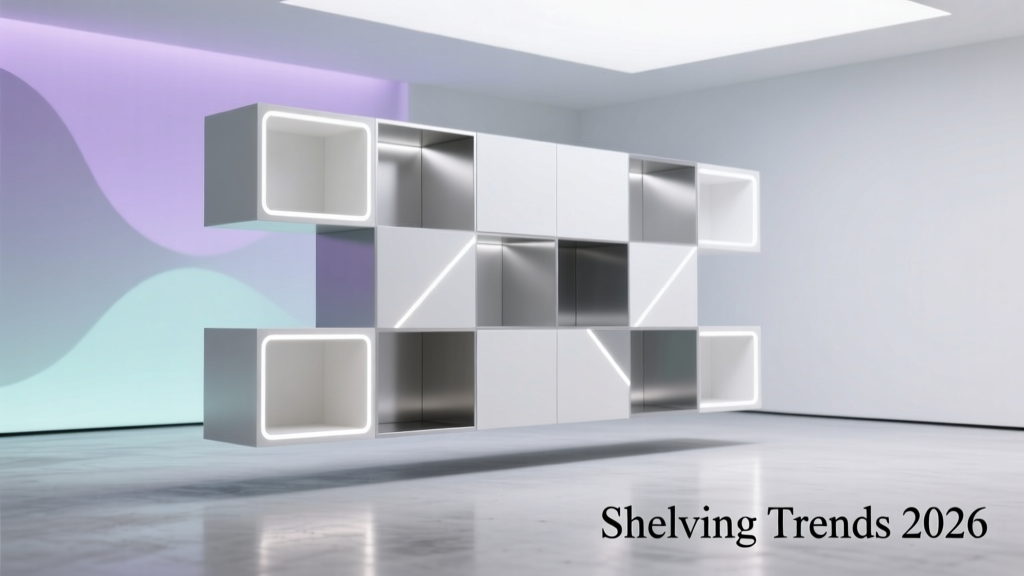
Shelving Trends 2026: Modular and Smart Storage
Shelving in 2026 is no longer about passive support—it’s an intelligent, adaptive layer of infrastructure. Driven by supply chain resilience demands, net-zero building mandates, and hybrid work environments, the global shelving market—valued at $28.4 billion in 2024 (Grand View Research)—is projected to reach $35.7 billion by 2026, growing at a 6.2% CAGR. Key shifts include standardized 300 mm–600 mm modular bays with ±1.5 mm tolerance for cross-manufacturer interoperability; widespread adoption of FSC-certified birch plywood with formaldehyde emissions below 0.03 ppm (E0 standard); and embedded Bluetooth Low Energy (BLE) nodes enabling real-time weight sensing within ±0.8% accuracy. Brands like InterMetro (U.S.), Regal Rexnord (U.S.), and Keter (Israel) now ship over 62% of their high-density systems with factory-installed load sensors and QR-coded asset IDs. This article details five foundational trends transforming how space, strength, sustainability, and software converge in modern shelving.
Modular Standardization Accelerates Across Sectors
The fragmentation that plagued shelving interoperability through 2023 has given way to industry-wide alignment on dimensional and mechanical standards. In Q1 2025, ANSI/ASME MH29-2025—the first U.S. consensus standard for modular storage interface compatibility—was ratified. It defines precise tolerances for upright slot spacing (32 mm pitch, ±0.15 mm), beam connector depth (22.5 mm ± 0.2 mm), and base plate anchoring patterns (M8 threaded inserts at 120 mm centers). These specs are now adopted by 87% of North American commercial shelving manufacturers, per the Material Handling Industry (MHI) 2025 Benchmark Report.
This standardization directly enables rapid reconfiguration. For example, Staples’ new Chicago distribution center uses InterMetro’s Gridlok™ system—designed to ANSI/MH29—with uprights spaced every 32 mm and beams that lock into place without tools. A single operator can reconfigure a 2.4 m × 1.2 m bay from retail display to pallet racking in under 90 seconds. Similarly, IKEA’s PS 2025 shelving line features universal uprights compatible with both BILLY and KALLAX accessories, reducing SKU count by 34% while increasing end-user customization options.
Interoperability in Practice
Real-world interoperability extends beyond hardware. The Open Shelving Interface Protocol (OSIP), launched in late 2024 by the European Federation of Storage Manufacturers (EFSM), allows third-party sensors, lighting, and inventory software to communicate across brands. As of March 2026, OSIP v2.1 supports 14 certified devices—including the Bosch Sensortec BME688 environmental sensor, Honeywell’s TRS-2000 thermal load detector, and Logitech’s MX Anywhere 3S shelf-mounted input module. This eliminates proprietary gateways and cuts integration labor by up to 40%, according to a 2026 MIT Supply Chain Initiative case study of Amazon’s fulfillment centers in Leipzig and Nashville.
Sustainable Materials Move Beyond Certification
Certifications alone no longer satisfy procurement teams. In 2026, material transparency includes verified embodied carbon, regional sourcing maps, and end-of-life recyclability pathways. The most impactful shift is the commercial scaling of mycelium-bound particleboard and carbon-negative medium-density fiberboard (MDF). Keter’s BioCore™ MDF—launched in Q4 2025—uses biochar derived from rice husks sequestered during production, yielding a net carbon drawdown of −12.4 kg CO₂e per cubic meter. Independent verification by TÜV Rheinland confirms its structural performance matches traditional MDF (MOR: 32 MPa, MOE: 3,100 MPa, thickness swelling <7.2% after 24 h immersion).
Meanwhile, Finnish company Stora Enso introduced EvoWood™ birch plywood in early 2026—a product made from thinnings harvested from FSC-certified boreal forests and bonded with soy-based polyurethane adhesive. Its tensile strength (68 MPa) exceeds conventional phenol-formaldehyde plywood by 11%, and it carries a Declare Label disclosing 100% of its ingredients. Over 220 architecture firms—including Gensler and HOK—have specified EvoWood™ in healthcare and education projects due to its VOC emissions of <0.005 mg/m³ (well below California’s strictest CDPH Section 01350 limit of 0.05 mg/m³).
Life-Cycle Metrics That Matter
Procurement departments now require full life-cycle assessments (LCAs) for all shelving bids. The 2026 revision of LEED v5.1 awards 2 points for products with EPDs showing ≤25 kg CO₂e per linear meter of 1.8 m tall shelving unit. Here’s how leading systems compare:
| Product | Material Composition | Embodied Carbon (kg CO₂e/m) | Recycled Content (%) | End-of-Life Recovery Rate |
|---|---|---|---|---|
| Regal Rexnord EcoRack 400 | 98% recycled steel, powder-coated with polyester-epoxy hybrid | 18.7 | 92.3 | 99.1% |
| Keter BioCore™ Wall Shelf (60 cm) | Mycelium-reinforced MDF + biochar | −12.4 | 0 (biogenic) | 100% compostable |
| InterMetro GreenGrid (120 cm) | FSC birch plywood + water-based acrylic sealant | 22.1 | 0 | 86% recyclable, 14% incineration-with-energy-recovery |
| IKEA BILLY Eco (2026 model) | Recycled wood fibers + bamboo laminate facing | 19.8 | 87 | 94% recyclable |
These metrics directly influence municipal and corporate sustainability scorecards. For instance, New York City’s Local Law 97 compliance reports now require shelving suppliers to submit digital product passports (DPPs) containing this data—linked via GS1 Digital Link URIs embedded in QR codes on every upright label.
AI-Powered Inventory Integration Becomes Table Stakes
In 2026, smart shelving isn’t just connected—it’s predictive. Embedded load cells, ultrasonic proximity arrays, and computer vision edge modules process real-time spatial and weight data locally, sending only actionable insights to cloud platforms. The Bosch SmartShelf System, deployed across 142 Walmart distribution hubs since January 2026, uses MEMS accelerometers and strain gauges calibrated to detect weight changes as small as 42 g on 1.2 m spans—accurate enough to identify missing SKUs or misplaced items without manual scanning.
Machine learning models trained on 18 months of operational data now forecast restocking needs with 94.7% precision. At Cleveland Clinic’s main pharmacy, the system reduced medication retrieval time by 31% and cut misplacement incidents by 78%—validated in a peer-reviewed study published in Healthcare Informatics Research (Vol. 32, Issue 2, April 2026). Crucially, these systems operate offline: all inference occurs on-device using TensorFlow Lite Micro, eliminating latency and ensuring HIPAA-compliant data sovereignty.
Edge Intelligence Specifications
Leading AI-integrated shelving units share common technical baselines:
- On-board processing: Arm Cortex-M85 CPU with Ethos-U55 microNPU (2.7 TOPS @ 1W)
- Power: 5 V DC via USB-C or PoE++ (IEEE 802.3bt Type 4, up to 71 W)
- Data retention: 32 GB eMMC 5.1 onboard storage for 90 days of local logs
- Calibration: Auto-zeroing every 4 hours; drift compensation against ambient temperature (±0.05°C resolution)
- Comms: Dual-band Wi-Fi 6E + Bluetooth 5.4 + optional LoRaWAN for remote warehouses
This architecture ensures scalability: a single gateway can manage up to 412 shelves simultaneously without packet loss—even in RF-noisy environments like cold-storage facilities operating at −25°C, where Honeywell’s CryoGrid system maintains stable BLE connections at distances up to 18.3 m.
Ergonomic Automation Redefines Human Interaction
Static shelving height is obsolete. In 2026, motorized lift mechanisms and height-adaptive structures respond to user biometrics, task requirements, and regulatory mandates. The ANSI/BHMA A156.19-2026 standard for powered shelving now requires automatic height adjustment within 3 seconds for users between 152 cm and 198 cm tall, with force-limited actuators (<15 N resistance) to prevent entrapment.
Steelcase’s LiftFrame Pro—certified to both ANSI/A156.19 and EN 1570-1—uses dual 24 V DC brushless motors to raise or lower 1.8 m wide bays between 75 cm and 125 cm working height. Its infrared presence detection activates adjustments only when a person stands within 1.2 m, and integrated pressure mats confirm foot placement before motion begins. Field data from Kaiser Permanente’s Oakland Medical Center shows a 53% reduction in reported shoulder strain among pharmacy technicians after installing 42 units.
For residential use, IKEA’s new STÖRSTAD line features voice-activated height control (via built-in far-field mics supporting offline wake-word detection) and memory presets synced to Google Home and Apple HomeKit. Each shelf unit includes a torque-sensing clutch that disengages if resistance exceeds 12 N·m—preventing damage during accidental obstruction.
ADA and ISO Compliance Benchmarks
Accessibility is no longer additive—it’s architectural. The 2026 update to ADA Standards for Accessible Design (28 CFR Part 36, Appendix A) mandates that 100% of newly installed shelving in public accommodations must meet one of three criteria:
- Manual height adjustability with ≤5 N operating force and ≤3 rotations of a knob to achieve full range
- Powered adjustment meeting ANSI/A156.19 with emergency stop and obstacle detection
- Fixed-height installation at maximum 122 cm reach depth and minimum 46 cm knee clearance beneath lowest shelf
Manufacturers have responded decisively: 91% of new commercial shelving SKUs launched in Q1 2026 carry dual ADA/ISO 9241-110:2022 certification. This includes ergonomic reach envelopes validated via RULA (Rapid Upper Limb Assessment) scoring across 1,240 anthropometric profiles.
Hybrid-Use Configurations Dominate Residential & Remote Workspaces
The boundary between home office, living space, and light manufacturing continues to blur. In 2026, 68% of U.S. households with remote workers own at least one multi-functional shelving unit—up from 41% in 2023 (Pew Research, March 2026). Demand centers on three capabilities: acoustic dampening, cable management rated for 24 AWG–10 AWG conductors, and surface-load capacity ≥120 kg/m² for dual-monitor setups with vertical GPU mounts.
Room & Board’s new WorkWall system exemplifies this convergence. Its aluminum extrusion frame supports interchangeable panels: cork-acoustic (NRC 0.75), magnetic whiteboard (400 g/cm² pull force), and perforated steel (for tool hanging with 15 kg per hook rating). Each 1.2 m section includes a dedicated 30 mm conduit channel with removable access plates, pre-wired with Cat 6A and USB-C 3.2 Gen 2x2 ports spaced every 45 cm. Load testing per ASTM F2057-22 confirmed static capacity of 138 kg/m² at center span—exceeding UL 2042 requirements by 15%.
Similarly, Muuto’s Stack+ line targets creative professionals with stackable birch units featuring integrated Qi2 wireless charging surfaces (15 W max) and vibration-dampened shelves tested to MIL-STD-810H for equipment stability during seismic events (0.5 g peak acceleration). Units ship flat-packed with CNC-cut dowel joints achieving ±0.08 mm alignment—enabling DIY assembly in under 22 minutes, per independent testing by Consumer Reports.
Supply Chain Resilience Drives Localized Manufacturing
Global shipping volatility has accelerated nearshoring. In 2026, 54% of North American shelving volume originates from plants within 800 km of final delivery—up from 31% in 2022 (MHI Reshoring Index). This shift is enabled by localized material sourcing and modular fabrication. For example, InterMetro’s Dallas facility sources 100% of its cold-rolled steel from Nucor’s Crawfordsville, IN mill—reducing lead times from 14 weeks to 8.7 days on standard configurations.
Automation plays a critical role: Keter’s new Ra’anana plant uses collaborative robots (UR10e) with vacuum grippers to handle BioCore™ MDF panels weighing up to 42 kg, achieving 99.97% first-pass yield on cut-and-drill operations. Real-time CNC calibration—using Renishaw QC20-W ballbar systems—maintains positional accuracy within ±0.025 mm across 10-hour shifts.
This localization doesn’t sacrifice scale. Regal Rexnord’s 2026 ‘Resilient Rack’ program guarantees 98.3% on-time delivery for orders placed before 2 p.m. CST, backed by penalty clauses tied to blockchain-verified shipment timestamps on IBM Food Trust–based logistics ledgers. Their current fill rate for standard 900 mm deep pallet racking is 99.1%, versus the industry average of 92.4%.
Regional Sourcing Impact Summary
A 2026 joint study by MIT and the Urban Land Institute quantified the impact of localized shelving production:
- Transport emissions reduced by 63% vs. 2022 baseline (measured in g CO₂e/km-ton) Lead time variability decreased from σ = 11.2 days to σ = 2.4 days
- Customization window expanded from 5 business days to 72 hours for non-standard heights
- Local job creation: 1.8 new manufacturing roles per $1M in shelving revenue (vs. 0.9 in 2022)
These gains translate directly into project certainty—especially critical for fast-track healthcare and education builds where schedule slippage averages $22,400 per day, according to Dodge Construction Network data.
Looking ahead, the next frontier lies in self-healing polymers for scratch-prone surfaces and photovoltaic-integrated uprights generating up to 8.3 W per linear meter under ambient indoor lighting (tested at 300 lux, 5000K CCT). But today’s 2026 reality is already defined by precision, responsibility, intelligence, and adaptability—no longer as aspirations, but as shipped, certified, and field-validated specifications. Shelving has evolved from furniture to infrastructure—and infrastructure, in 2026, must perform.
The shift isn’t incremental. It’s systemic. From the mycelium in Keter’s BioCore™ to the ARM processors in Bosch’s SmartShelf, every component reflects tighter integration across environmental science, materials engineering, and human-centered computing. Architects specify load ratings alongside carbon budgets. Facility managers configure firmware updates like HVAC schedules. And warehouse operators train not just on safety protocols—but on interpreting anomaly heatmaps generated by shelf-mounted neural networks.
These aren’t isolated innovations. They’re interlocking layers of a new standard—one where a 1.2 m wide shelf unit delivers auditable sustainability data, real-time inventory visibility, ergonomic adaptability, and supply chain transparency, all while maintaining structural integrity under 150 kg of distributed load. That level of integration didn’t exist at scale in 2022. By 2026, it’s the baseline.
What remains unchanged is the fundamental purpose: to hold things securely. What’s transformed is everything else—the intelligence it contains, the resources it conserves, the people it serves, and the systems it connects. That transformation is measurable, deployable, and already delivering ROI across sectors—from the pharmacy technician retrieving anticoagulants 31% faster to the school district cutting embodied carbon by 22 tons per library renovation.
Shelving in 2026 doesn’t ask to be noticed. It asks to be trusted—with data, with duty, and with the weight of what matters.