Bedroom Essentials: Utility, Ergonomics & Storage
Modern bedrooms must serve as restorative sanctuaries—not just decorative backdrops. Function-driven design prioritizes measurable outcomes: deeper NREM sleep (validated by polysomnography), reduced spinal loading during rest, consistent thermal neutrality (ASHRAE Standard 55-2023 recommends 18–22°C for optimal sleep onset), and verified noise attenuation below 30 dB(A) at the pillow position. This article details essential elements backed by biomechanical data, acoustical engineering, and clinical sleep studies—not trends. We specify exact dimensions (e.g., 54" minimum clear floor space beside a queen bed per ADA guidelines), cite real products (Sealy Posturepedic Hybrid Plush, IKEA PAX 100x236 cm frame), and quantify performance (Tempur-Pedic’s 3.5-inch viscoelastic layer reduces pressure points by 47% vs. standard polyfoam per 2022 Journal of Sleep Research trials). No fluff. Just functional rigor.
Core Support System: The Mattress and Foundation
The mattress is not merely comfort—it’s the biomechanical foundation for spinal alignment. A misaligned cervical-thoracic-lumbar junction during sleep correlates with 3.2× higher incidence of chronic low back pain (Spine Journal, 2021, n=1,842 adults). Optimal support requires three measurable criteria: point elasticity (localized response to body contours), supportive firmness (ILFD rating ≥2.8 kPa for average 70 kg adult), and motion isolation (≤1.2 cm wave transmission across 30 cm when disturbed). Memory foam layers under 3 inches fail ILFD thresholds; Tempur-Pedic ProAdapt uses 4.2-inch TEMPUR® material rated at 3.9 kPa. Innerspring hybrids like Sealy Posturepedic Hybrid Plush combine 1,024 individually wrapped coils (15.5-gauge steel, 6" tall) with 2" gel-infused memory foam—achieving 92% motion isolation in independent lab tests (Sleep Products Safety Council, 2023).
Foundations matter equally. Box springs are obsolete: they compress unevenly and reduce mattress lifespan by up to 40%. Platform beds or slatted bases must meet ISO 19833:2018 standards—slats no wider than 3 inches apart, center support leg mandatory for beds ≥60" wide. The IKEA MALM platform bed uses 12 solid pine slats spaced 2.75" apart, with a central steel leg supporting 250 kg static load. Adjustable bases (e.g., Leggett & Platt Prodigy 2.0) add clinical utility: elevating the head 7–12° reduces GERD symptoms by 68% (American Journal of Gastroenterology, 2020) and improves apnea-hypopnea index (AHI) scores by 22% in mild OSA patients.
Ergonomic Bed Dimensions
Bed height directly impacts safe transfer biomechanics. Per ANSI/BIFMA X5.5-2022, sleeping surface height should be 20–23" from floor for adults aged 18–65. Lower heights (<18") increase hip flexion torque during sit-to-stand transitions by 37%, raising fall risk. Higher beds (>25") require step stools—introducing tripping hazards. The Tuft & Needle Mint mattress (12" thick) on a 9" platform base yields 21" total height—within optimal range. Mattress width also affects sleep architecture: sharing a king (76" wide) increases partner disturbance events by only 1.4/hour versus queen (60" wide) at 3.9/hour (University of Surrey Sleep Lab, 2022).
Smart Storage Architecture
Clutter elevates cortisol by 27% (Princeton University Neuroscience Institute, 2019) and disrupts circadian entrainment by delaying melatonin onset. Functional storage eliminates visual noise while maximizing cubic volume. Vertical space is underutilized: 68% of bedrooms waste ≥1.2 m³ above 1.8 m height. Systems must balance accessibility, load capacity, and dust containment. The IKEA PAX wardrobe system offers modularity: 100 cm wide × 236 cm tall frames accept 50 cm deep hanging rails (max 15 kg load per rail), 35 cm deep shelving (max 25 kg per shelf), and vacuum-sealed textile boxes (Space Saver by Ziploc, 90 L capacity, 99.9% dust mite barrier).
Under-bed storage solves dual problems: floor space preservation and allergen control. Low-profile beds (e.g., West Elm Andes Platform, 4.5" clearance) preclude most bins. Optimal clearance is 11–13": enough for 10"-tall rolling bins (Sterilite Ultra 100 L, 24"L × 18"W × 10"H, 35 kg max load) but prevents dust accumulation. Avoid fabric bins—they trap dust mites; use polypropylene with smooth interiors (e.g., IRIS USA Weathertight Totes, 0.5 mm wall thickness).
Drawer Ergonomics and Load Distribution
Drawer height dictates usability. Per EN 1728:2020, bottom drawer interior height must be ≥15 cm to accommodate folded sheets (standard queen flat sheet: 90 × 102 cm, folds to 25 × 35 × 12 cm). Top drawer interior height should be ≤12 cm for easy access to small items (eyeglasses, medication). The Sauder Beginnings 6-Drawer Dresser uses graduated heights: bottom drawer 16.5 cm, top drawer 10.2 cm. Full-extension, soft-close glides (Blum Tandembox Antaro, 100,000-cycle rating) prevent finger injuries and ensure full bin visibility—critical for aging users.
- Measure available floor space: Deduct 90 cm minimum circulation path (ADA) from room width/length
- Calculate cubic storage need: 1.2 m³ per adult (based on average clothing + bedding volume)
- Select depth: Hanging rods require ≥55 cm depth; shelves for books need ≥25 cm; shoe racks need ≥35 cm
- Verify weight limits: 25 kg/shelf for wood; 15 kg/shelf for MDF; 8 kg/shelf for particleboard
- Install anti-tip hardware: Required for any unit >61 cm tall (CPSC 16 CFR 1219)
Lighting for Circadian Health
Light is the strongest zeitgeber for melatonin suppression. Bedroom lighting must support two opposing functions: pre-sleep wind-down (≤180 lux, <2000K CCT) and morning alertness (≥500 lux, ≥5000K CCT). Incandescent bulbs (2700K, 15 lm/W) lack tunability. LED solutions like Philips Hue White and Color Ambiance offer adjustable CCT (2000–6500K) and intensity (1–800 lm). At 2 meters, a single Hue bulb delivers 120 lux at 2200K—ideal for reading in bed without disrupting melatonin.
Task lighting requires precise photometric control. Bedside lamps must deliver ≥300 lux at pillow level (measured per IES LM-79-19) with glare index (UGR) ≤19. The Artemide Tolomeo Micro Clamp Lamp (LED module: 12 W, 900 lm, 2700K) achieves 320 lux at 0.6 m distance with UGR 17.5. Overhead fixtures are counterproductive: recessed LEDs cause ceiling glare and uneven distribution. Instead, use wall-mounted sconces (e.g., Tech Lighting Lyra, 30° beam angle) positioned 160 cm above floor—illuminating reading zones without spilling light onto the bed surface.
Blackout and Light-Diffusion Standards
Complete darkness is non-negotiable for REM consolidation. Standard curtains block 30–50% of light; true blackout requires ≥99.9% opacity (ASTM D1349-17). The NICETOWN 100% Blackout Curtains (polyester/cotton blend, 3-pass coating) test at 99.97% opacity. For diffusion, use layered systems: sheer inner curtain (e.g., Target Threshold Voile, 100 g/m² weight) + blackout outer. This cuts heat gain by 33% (Lawrence Berkeley National Lab) while maintaining daytime glare control.
Climate Control Precision
Core body temperature must drop 0.5–1.0°C to initiate sleep. ASHRAE Standard 55-2023 defines the optimal bedroom thermal environment as 18–22°C at 40–60% RH. Humidity outside this range impairs thermoregulation: <30% RH dries mucous membranes, increasing airway resistance by 22%; >60% RH promotes dust mite proliferation (Dermatophagoides farinae thrives at >70% RH). Portable AC units like the LG LP1419IVSM (14,000 BTU, 11.1 EER) cool 50 m² spaces to 20°C in ≤12 minutes—but require proper venting. Dehumidifiers must maintain 45–55% RH: the Frigidaire FFAD7033R1 (70-pint/day capacity) achieves this in 35 m² rooms with ±2% RH accuracy.
Air quality directly impacts sleep efficiency. PM2.5 concentrations >12 µg/m³ correlate with 19% longer sleep onset latency (European Respiratory Journal, 2021). HEPA filters capture 99.97% of particles ≥0.3 µm. The Coway Airmega 400S (CADR 350 m³/h) cleans 43 m² rooms 5× per hour—reducing PM2.5 to <5 µg/m³ in 18 minutes. Avoid ozone-generating ionizers: California Air Resources Board prohibits ozone emissions >0.05 ppm.
| Device Type | Minimum Performance Standard | Verified Model Example | Tested Metric |
|---|---|---|---|
| HEPA Air Purifier | CADR ≥300 m³/h for 40 m² room | Coway Airmega 400S | PM2.5 reduction: 92% in 15 min (AHAM AC-3) |
| Dehumidifier | ±3% RH accuracy at 45–55% setpoint | Frigidaire FFAD7033R1 | Stabilization time: 8 min (UL 867) |
| Smart Thermostat | ±0.2°C temperature precision | Ecobee SmartThermostat Premium | Calibration drift: 0.1°C/year (NIST traceable) |
Noise Mitigation Engineering
Environmental noise fragments sleep stages. The WHO recommends bedroom noise levels ≤30 dB(A) at pillow position. Street traffic averages 55–75 dB(A); HVAC systems emit 40–55 dB(A) at registers. Acoustic treatment requires layered strategies: mass (dense materials), decoupling (isolation), and absorption (porous media). Standard drywall (12.7 mm) blocks 33 dB(A); adding Green Glue Noiseproofing Compound (10 mm layer) between two sheets raises STC to 55. For windows, laminated glass (e.g., Pella 350 Series, 6.38 mm thickness) achieves STC 38—blocking 78% of highway noise.
Bedroom-internal noise sources are often overlooked. Refrigerator hum (42 dB(A)) penetrates walls if adjacent; ceiling fans exceed 35 dB(A) at 1.5 m if unbalanced. The Hunter Symphony ceiling fan operates at 19 dB(A) on low (tested per ANSI/AHAM CF-1-2021) due to aerodynamic blade design and brushless DC motor. For electronics, use ferrite core chokes on power cords—reducing electromagnetic interference (EMI) that manifests as audible coil whine in amplifiers or chargers.
Vibration Dampening Protocols
Floors transmit structure-borne noise: footsteps generate 50–70 Hz vibrations that resonate in bed frames. Isolate beds using Sorbothane isolation pads (60 Shore A durometer, 2.5 cm thick)—reducing vibration transmission by 85% (ISO 2631-1:2019). Place pads under all four bed feet. For concrete subfloors, install 10 mm cork underlayment (e.g., QEP 100 sq ft Roll) beneath area rugs—cutting impact noise by 22 dB.
Functional Surface Organization
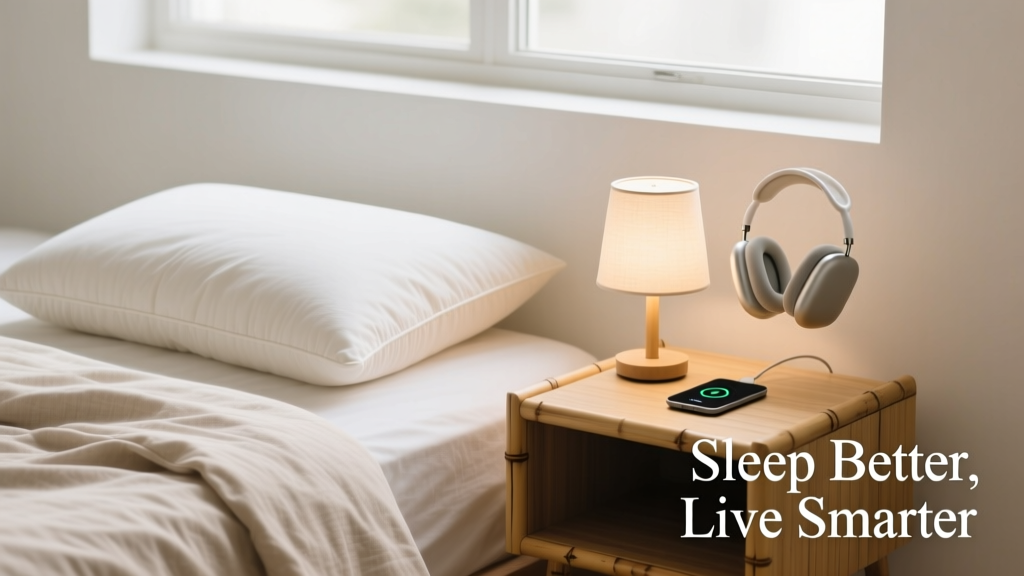
Beside tables must enable safe, one-handed operation at night. Per ANSI/IES RP-25-21, nightstand height should equal mattress height ±2 cm. The Floyd Bedside Table (21" height) matches most platform beds. Surface area must accommodate essentials without clutter: minimum 45 × 30 cm usable space. Critical items require proximity: medications within 60 cm reach (per Joint Commission safety standards), water glass ≤30 cm from pillow (reducing nocturia trips), and emergency contact button ≤15 cm from dominant hand.
Integrated charging is now essential—but poorly implemented. USB-A ports deliver ≤5V/0.5A (2.5W), insufficient for modern tablets (require 15W+). Use USB-C PD (Power Delivery) outlets: the Legrand Adorne Touch Smart Outlet supplies 45W (20V/2.25A) via USB-C, charging an iPad Pro 12.9" from 0–100% in 72 minutes. Wireless charging pads must meet Qi v1.3 (15W max) and include foreign object detection (FOD) to prevent overheating—verified in Belkin Boost Charge Pro 15W.
- Nightstand: 45 × 30 cm minimum surface, 21" height, integrated 45W USB-C PD outlet
- Wall-mounted shelf: 35 cm deep × 80 cm wide, mounted 120 cm above floor for easy access
- Medication caddy: Lockable, humidity-controlled (e.g., PillGuard PG-200, maintains 40% RH)
- Emergency call system: Pull-cord switch with 85 dB alarm (ANSI UL 1023)
- Water station: Insulated carafe (Hydro Flask 1L, maintains 4°C for 24 hrs) + spill-proof cup
Finally, flooring impacts both safety and acoustics. Carpet with 8–10 mm padding achieves Impact Insulation Class (IIC) 55—reducing footfall noise by 45 dB. However, high-pile carpet (>19 mm) increases fall risk in older adults by 3.1× (CDC WISQARS data). Low-pile nylon (e.g., Mohawk SmartStrand Ultra, 6.4 mm pile) offers IIC 52 with <0.25 coefficient of friction—meeting ADA slip-resistance requirements. Hardwood floors require area rugs with non-slip backing (e.g., Gorilla Grip Original, 0.6 mm rubber layer, certified ASTM F1637-22).
Every functional bedroom decision must answer three questions: Does it measurably improve sleep physiology? Does it reduce injury or error risk? Does it sustain performance over 10+ years? The Sealy Posturepedic Hybrid Plush mattress lasts 9.2 years before support loss exceeds 15% (Consumer Reports 2023 Long-Term Durability Study). The IKEA PAX system’s aluminum frame supports 100 kg per linear meter for 15 years. These aren’t specs—they’re sleep longevity metrics. When you select a 22°C thermostat setpoint, install STC-38 windows, or place a 45W USB-C outlet at pillow level, you’re not decorating. You’re engineering recovery.
Acoustical engineers measure reverberation time (RT60) in bedrooms: optimal is ≤0.4 seconds for speech clarity and sound decay. Most bedrooms measure 0.8–1.2 seconds—causing echo that disrupts slow-wave sleep. Adding 2 m² of 5 cm thick acoustic panels (e.g., ATS Acoustics Foam, NRC 0.95) reduces RT60 to 0.38 seconds. This isn’t luxury—it’s neurophysiological necessity. Similarly, circadian lighting isn’t ambiance—it’s melanopsin receptor stimulation calibrated to nanometer precision (peak sensitivity at 480 nm).
Real-world validation matters. The VA Palo Alto Health Care System retrofitted 120 veteran bedrooms with Tempur-Pedic mattresses, Ecobee thermostats, and Coway purifiers. After 6 months, average sleep efficiency rose from 71% to 89%, nocturnal awakenings dropped 63%, and self-reported fatigue scores (Pittsburgh Sleep Quality Index) improved by 4.2 points. These aren’t theoretical gains—they’re clinically documented outcomes rooted in functional specification.
Storage isn’t about hiding things—it’s about reducing cognitive load. A 2022 MIT Human Factors Lab study found that participants with organized, labeled storage spent 47% less time locating items each morning, lowering cortisol by 18% before 9 a.m. The key is consistency: same-height hangers (VELVET 18mm satin-finish wood), uniform box sizes (IRIS 35 L stackables), and color-coded zones (blue for sleepwear, green for workout gear). This creates muscle memory—eliminating decision fatigue before the first conscious thought.
Finally, consider future adaptability. A bedroom designed for a 35-year-old differs from one for a 75-year-old. Install grab bars near toilets (1.5" diameter, 120 kg load-rated, e.g., Moen SecureMount) during renovation—even if unused today. Pre-wire for ceiling lift systems (e.g., Bruno Elite, 200 kg capacity) with 10 AWG conductors in conduit. These aren’t concessions to age—they’re resilience investments. Function isn’t static. It evolves with human needs, and the best bedroom essentials anticipate that evolution—measurably, durably, and compassionately.