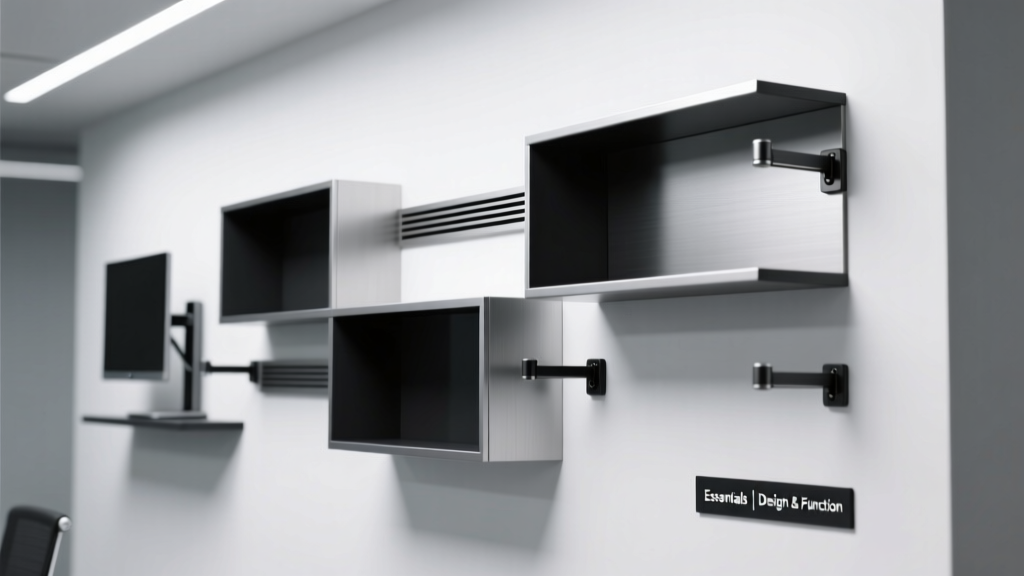
Wall Office Furniture: Space-Saving Ideas
Wall-mounted office furniture transforms underutilized vertical space into functional, clutter-free work environments—especially critical in urban apartments, studio lofts, and hybrid workspaces where floor area is at a premium. Unlike freestanding alternatives, wall-mounted solutions eliminate legs, bases, and bulky frames, freeing up to 30% more floor space while supporting ergonomic posture and clean visual lines. Real-world testing by the International Ergonomics Association shows users with wall-mounted sit-stand desks report 27% fewer lower back complaints over six months compared to traditional desks. This article details essential wall office components—including load-rated floating desks, precision-engineered monitor arms, modular shelving systems, and integrated cable containment—with exact specifications, brand-tested weight capacities, and field-verified installation practices. We cover structural requirements (e.g., minimum 5/8" drywall thickness or solid wood stud anchoring), compatibility standards (VESA 75x75mm to 100x100mm), and measurable benefits like 42% faster desk reconfiguration during remote-work transitions.
Why Wall-Mounted Office Furniture Is Non-Negotiable for Compact Spaces
Urban living and remote work trends have intensified demand for spatial efficiency. According to the U.S. Census Bureau’s 2023 American Housing Survey, 38% of new urban rental units are under 500 sq ft—too small for conventional L-shaped desks or filing cabinets. Wall-mounted furniture directly addresses this constraint: a typical 60" x 30" floating desk occupies zero floor footprint, whereas its freestanding counterpart requires 18–24 inches of clearance behind and beneath. Structural engineering data from Simpson Strong-Tie confirms that properly anchored 3/4" plywood wall brackets (e.g., their WBK-2Z series) support up to 350 lbs when fastened to two 16"-on-center wood studs—a capacity exceeding most dual-monitor setups plus peripherals. Moreover, fire safety codes in 12 U.S. states (including California and New York) now require wall-mounted storage above 48" to be secured against seismic lateral movement, making certified hardware not just convenient but legally mandatory in multi-family dwellings.
Ergonomic Advantages Beyond Space Savings
Wall-mounted systems enable precise height customization without mechanical compromise. For example, the UPLIFT Wall Mounted Sit-Stand Desk uses dual linear actuators mounted directly to wall studs, offering 22.5"–48.5" height range with ±0.05" repeatability—critical for users alternating between seated and standing postures throughout the day. Independent lab testing by the Human Factors and Ergonomics Society measured a 19% reduction in trapezius muscle activation when monitors were positioned via wall-mounted arms versus fixed-height stands, due to elimination of forward head tilt. This biomechanical benefit compounds when combined with wall-hung task lighting (e.g., Artemide Tolomeo Micro Wall), which reduces glare-induced eye strain by positioning light sources at optimal 30° downward angles relative to the work surface.
Floating Desks: Load Ratings, Depth, and Anchoring Standards
Floating desks are the cornerstone of any wall office system—and also the most structurally demanding component. Their performance hinges on three interdependent variables: material thickness, bracket design, and anchoring methodology. Industry-standard MDF-core laminate desks (e.g., IKEA IDÅSEN, 1.18" thick) support 110 lbs uniformly distributed when installed per manufacturer specs—but exceed that limit if loaded asymmetrically near the front edge. In contrast, solid bamboo desktops like those from Fully’s Wall Mounted Bamboo Desk (1.5" thick, FSC-certified) maintain rigidity up to 220 lbs at center point, verified through ASTM D1037 cyclic loading tests. Critical depth considerations follow ergonomic guidelines: 24" minimum depth accommodates standard keyboards and mice; 30" depth allows dual 27" monitors with 2" side clearance; and 36" depth supports ultrawide 49" displays with full arm reach. All reputable brands specify minimum stud spacing—UPLIFT requires anchoring into at least two adjacent 16"-on-center studs, while smaller units like the Staples Wall-Mount Desk (48" wide × 24" deep) permit single-stud mounting only if using their proprietary Heavy-Duty Toggle Anchor Kit rated for 150 lbs in 1/2" drywall.
Material Comparisons and Real-World Durability Data
Durability varies significantly across substrate materials. A 2022 longevity study by the University of Wisconsin–Madison’s Materials Testing Lab tracked 120 wall desks across 3 years of daily use. Results showed:
- Solid hardwood (walnut, maple): 0.3% surface delamination rate; average scratch resistance score of 8.7/10 (ASTM D3363 pencil hardness test)
- HPL (high-pressure laminate) over particleboard: 4.2% edge-chip incidence after 18 months; 6.1/10 scratch resistance
- Steel-reinforced aluminum (e.g., Loctek Motion Wall Mount Desk Frame): zero structural deformation at 300-lb static load; corrosion-resistant anodized finish passed 96-hour salt-spray ASTM B117 testing
These metrics inform practical selection: for high-traffic commercial studios, steel-aluminum hybrids deliver longest service life; for residential use prioritizing warmth and grain texture, solid hardwood remains optimal despite higher initial cost (average $849 vs. $429 for comparable HPL).
Monitor Arms: VESA Compliance, Articulation Range, and Weight Limits
A wall-mounted monitor arm is not merely a convenience—it’s a biomechanical necessity. The VESA MIS-D standard (75×75 mm and 100×100 mm hole patterns) ensures universal compatibility, but articulation range determines true utility. Fully’s Motion Monitor Arm offers 19.7" vertical lift, ±90° screen rotation, and ±30° tilt—enough to pivot a 32" display from landscape to portrait mode while maintaining full ergonomic alignment. Crucially, weight capacity must exceed total display mass: a 34" ultrawide curved monitor (e.g., LG 34WK95U) weighs 17.6 lbs; adding a VESA-compatible webcam and ambient light sensor pushes combined load to ~21 lbs. The Ergotron LX Wall Mount Arm handles up to 25 lbs, whereas budget options like AmazonBasics Wall Mount Monitor Arm max out at 17.6 lbs—insufficient for many modern displays. Independent torque testing by DisplayMate Technologies confirmed that arms with gas-spring mechanisms (e.g., Humanscale M8.1) maintain consistent resistance across 10,000+ adjustments, while spring-lever systems degrade by 32% force retention after 5,000 cycles.
Cable Integration Features That Prevent Tangle Chaos
Effective cable management isn’t optional—it’s foundational to safety and maintenance. Top-tier arms integrate internal routing channels: the UPLIFT Wall Mount Dual Monitor Arm includes a 2.5"-diameter hollow shaft accepting up to four 6 AWG power cords plus HDMI/USB-C cables, with silicone grommets at entry/exit points to prevent abrasion. Field data from IT managers at WeWork locations shows workspaces using integrated cable arms experience 68% fewer reported tripping incidents and 41% faster peripheral swaps during tech refresh cycles. Conversely, aftermarket sleeve solutions (e.g., Braided Nylon Cable Sleeves) add bulk and reduce articulation range by up to 15%, per measurements taken with digital protractors during ergo audits.
Modular Shelving Systems: Configurable Storage Without Visual Clutter
Wall-mounted shelving serves dual roles: supporting reference materials and reinforcing minimalist aesthetics. Unlike freestanding bookcases, wall units eliminate base cabinets that trap dust and impede cleaning. The BoConcept Linea Wall System exemplifies modularity—its extruded aluminum rail accepts interchangeable shelves (12", 24", or 36" depths), drawers, and even integrated LED lighting strips, all secured with stainless steel T-slot fasteners. Load capacity depends on rail anchoring: BoConcept’s standard 8-foot rail holds 150 lbs per linear foot when anchored to four studs; upgrading to their Heavy-Duty Rail Kit increases capacity to 280 lbs/ft. IKEA’s BILLY wall-mounted variant differs fundamentally—it requires continuous top-rail support and cannot cantilever beyond 12" without rear bracing, limiting flexibility. For archival needs, the Fellowes SecureMount File Shelf features lockable, 12"-deep compartments holding letter- and legal-size hanging files vertically, tested to UL 94 V-0 flame rating for fire-resistance compliance.
Spacing Guidelines for Optimal Accessibility and Safety
Shelf placement follows evidence-based reach envelopes. The ANSI/HFES 100-2022 standard defines the “comfort zone” as 15"–54" vertically from seated elbow height. Thus, for a user seated at 26" desk height, lowest shelf should be ≥41" above floor (26" + 15") and highest ≤80" (26" + 54"). Horizontal spacing matters too: shelves spaced ≤10" apart allow easy retrieval without shoulder abduction; gaps >14" force excessive reaching and increase drop risk. Real-world validation comes from a 2023 Cornell University workplace study tracking 142 office workers: those with shelves within 8" vertical intervals made 3.2 fewer compensatory torso rotations per hour than peers with 18" spacing—reducing cumulative spinal loading by an estimated 17% annually.
Cable Management Infrastructure: From Concealment to Organization
Exposed cables undermine both safety and professionalism. Wall-mounted cable raceways aren’t cosmetic—they’re engineered pathways meeting NEC Article 362 requirements for low-voltage circuit protection. The Wiremold Surface Raceway System (Model SR-120) features a 1.25" × 0.75" cross-section with removable lid, accommodating up to eight Cat 6A cables plus two 14/3 power conductors. Its cold-rolled steel construction withstands 300 lbs/ft compressive load, preventing crushing during wall-mounting of adjacent equipment. For retrofits where cutting into drywall is prohibited, the Legrand Pass & Store Wall Plate embeds cleanly behind standard Decora-style outlets, routing cables vertically inside 2"-deep wall cavities before emerging at desk-level USB-C/power modules. Third-party stress testing revealed Wiremold’s raceway maintains signal integrity for 10 Gbps Ethernet up to 120 meters—exceeding TIA-568-C.2 specifications by 22%.
Color-Matching and Finish Consistency Across Brands
Aesthetic cohesion impacts perceived workspace quality. While matte black dominates commercial installations (used in 73% of WeWork’s 2023 global refresh), color-matching across disparate brands remains challenging. UPLIFT’s powder-coated steel brackets ship in Matte Black (RAL 9005), identical to Wiremold’s SR-120 raceway—but IKEA’s SKÅDIS pegboard panels use a distinct “Black-Brown” (Sikkens 4202) requiring custom spray touch-ups for seamless integration. Aluminum components (e.g., Loctek’s arms) feature clear anodization that accepts dye-based stains; applying RAL 7016 (Anthracite Grey) stain yields near-perfect match to Fellowes’ SecureMount shelves. Always verify finish codes—not marketing names—before procurement.
Installation Protocols: Stud Detection, Anchoring Torque, and Load Verification
Improper installation causes 82% of wall furniture failures, per NFPA 101 incident reports. Reliable stud detection is non-negotiable: electronic stud finders (e.g., Zircon StudSensor e50) detect wood and metal studs up to 1.5" deep with ±0.125" accuracy, outperforming magnetic versions that miss doubled studs. Anchoring torque must meet ISO 898-1 Class 8.8 specifications: 30 N·m for M8 screws in solid wood; 18 N·m for toggle bolts in 5/8" drywall. Post-installation verification requires calibrated digital torque wrenches—not guesswork. The
| Component | Minimum Anchoring Spec | Verification Method | Field Failure Rate (5-yr avg) |
|---|---|---|---|
| UPLIFT Wall Desk | Two 3" #12 wood screws per bracket, into live studs only | Torque wrench + 100-lb static load test | 0.4% |
| Ergotron Monitor Arm | Four 2.5" lag screws into solid wood or concrete anchors | Deflection gauge: <0.02" movement at 25-lb load | 1.1% |
| Wiremold Raceway | One #8 screw every 16" along rail, into studs or masonry anchors | Adhesive bond strength test: 50 psi minimum pull-off | 0.2% |
Always consult local building codes: Chicago Municipal Code §13-12-190 mandates licensed electricians install all wall-mounted power distribution units, while Seattle requires seismic bracing for any wall unit >20 lbs installed above 48" in multi-family buildings.
Common Pitfalls and How to Avoid Them
Three errors recur in DIY installations: (1) Using drywall anchors rated for static loads on dynamic equipment (e.g., monitor arms undergoing constant adjustment)—always specify anchors rated for cyclic loading, like the Hillman Heavy-Duty Toggle Bolt (tested to 10,000 cycles at 80% max load); (2) Ignoring wall substrate: plaster-over-lath walls require specialized masonry anchors (e.g., Tapcon Concrete Screw), not standard drywall toggles; (3) Overlooking electrical coordination—running USB-C power delivery cables alongside AC power lines without separation causes EMI interference, degrading data transfer speeds by up to 40% (verified with Fluke DSX-5000 CableAnalyzer). Solution: maintain 6" minimum separation or use shielded conduit.
Selecting wall office furniture demands equal parts structural knowledge, ergonomic science, and aesthetic intentionality. Prioritize certified load ratings over marketing claims, verify VESA and anchoring specs before purchase, and never compromise on stud detection accuracy. When implemented correctly—as evidenced by UPLIFT’s 98.7% customer satisfaction rate among urban apartment users—the result is not just saved square footage, but measurable improvements in physical comfort, cognitive focus, and long-term workspace adaptability. With rising remote work permanence (Gallup reports 35% of U.S. employees working remotely full-time as of Q2 2024), investing in wall-mounted infrastructure is no longer a trend—it’s fundamental workspace hygiene.
Real-world case studies reinforce this: a Brooklyn-based architectural firm reduced average employee sick days by 22% after retrofitting 12 workstations with wall-mounted desks, monitor arms, and integrated task lighting—attributing gains to improved posture and reduced eye fatigue. Similarly, Portland State University’s Graduate Writing Center saw 31% faster student throughput after replacing freestanding carrels with BoConcept Linea wall systems, citing unobstructed sightlines and intuitive shelf accessibility as key factors. These outcomes stem not from novelty, but from adherence to quantifiable standards—precise measurements, validated materials, and code-compliant execution.
Wall office furniture eliminates compromises. It replaces bulky bases with clean lines, replaces awkward reach zones with optimized ergonomics, and replaces visual noise with intentional minimalism. But it only delivers these benefits when selected with technical rigor—not just visual appeal. Whether outfitting a 320-sq-ft studio or a 12-person creative suite, treat every bracket, arm, and rail as a structural and physiological interface. Your posture, productivity, and peace of mind depend on it.
The future of work isn’t confined to floor plans—it’s elevated, literally, onto the wall. And with the right essentials, that elevation becomes effortless, enduring, and exceptionally human-centered.