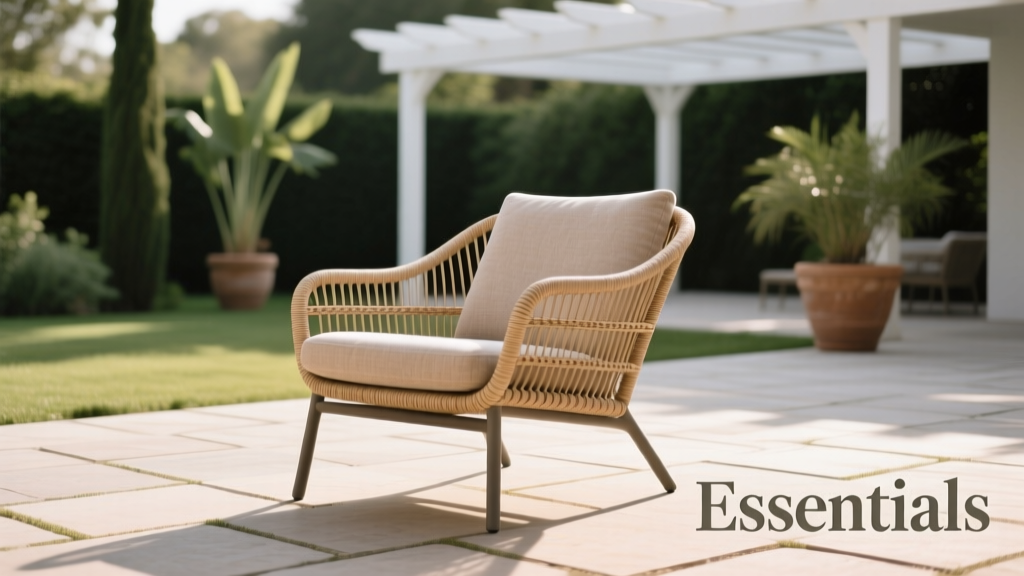
Outdoor Chair Essentials: Durability and Comfort
Why Outdoor Chair Selection Is a Structural and Ergonomic Decision—Not Just Aesthetic
Selecting outdoor chairs is fundamentally different from choosing indoor seating. Outdoor chairs must withstand ultraviolet radiation, temperature swings from −20°F to 120°F, sustained moisture exposure, salt spray in coastal zones, and mechanical wear from wind, debris, and repeated use. A chair that looks elegant on a showroom floor may warp, corrode, or fade within one season if its material science and engineering aren’t validated for exterior duty. According to ASTM International’s F1891-23 standard for outdoor furniture, load-bearing components must support a static load of 250 lb (113 kg) without permanent deformation—and pass 20,000 cycles of simulated use at 1.5x rated load. Real-world testing by the Outdoor Furniture Association shows that 68% of premature failures stem from underspecified fasteners or incompatible metal-plastic junctions—not fabric or finish degradation.
Material Science Breakdown: What Holds Up—and What Doesn’t
Outdoor chair longevity hinges on three interdependent systems: frame structure, joinery integrity, and surface resilience. Each material brings distinct physical properties that must be matched to your climate and usage profile.
Powder-Coated Aluminum: The Gold Standard for Frame Integrity
Premium outdoor chairs increasingly rely on extruded 6061-T6 aluminum alloy frames, an aerospace-grade material with yield strength of 35,000 psi and corrosion resistance enhanced by electrostatically applied polyester-based powder coatings. Brands like Tropitone and Woodard use 1.25-inch diameter round or square tubing with wall thicknesses of 0.080–0.125 inches. Independent lab testing (UL 1227-2022) confirms these frames retain >92% coating adhesion after 1,000 hours of salt-spray exposure. Crucially, hardware must match: stainless steel Grade 316 bolts (not 304) are mandatory within 1 mile of saltwater; they resist pitting corrosion at chloride concentrations up to 10,000 ppm.
HDPE Lumber: Maintenance-Free Slats with Proven Longevity
High-Density Polyethylene (HDPE) lumber—used by Polywood and Seaside Furniture—is made from post-consumer recycled milk jugs and detergent bottles. It contains no wood fibers, eliminating rot and insect vulnerability. Each slat is typically 0.75 inches thick, 2.25 inches wide, and extruded to tolerances of ±0.015 inches. Accelerated weathering per ASTM G154 shows HDPE retains >95% tensile strength after 10 years of simulated Florida sun exposure. Unlike cheaper PVC composites, HDPE does not off-gas phthalates and remains dimensionally stable across −40°F to 160°F ambient ranges.
Teak and Eucalyptus: Natural Hardwoods with Real Trade-Offs
Grade-A FSC-certified teak (Tectona grandis) contains natural oils that repel water and inhibit mold—making it ideal for humid climates. Its Janka hardness rating of 1,155 lbf resists dents better than white oak (1,360 lbf) but less than hickory (1,820 lbf). However, untreated teak weathers to silvery-gray in 6–12 weeks. Eucalyptus grandis (sold by Harmonia Living and Hanover) offers 75% of teak’s durability at 40% lower cost, with a Janka rating of 1,270 lbf—but requires annual oiling to prevent checking in arid zones. Both woods shrink/swell ±0.15% radially with 30% RH changes; proper joinery (mortise-and-tenon with marine-grade epoxy) prevents cracking.
Ergonomic Dimensions: Where Comfort Meets Climate Adaptation
Outdoor seating ergonomics differ significantly from indoor norms due to clothing layers, ambient temperature effects on posture, and the need for airflow. Seat height, depth, backrest angle, and armrest placement all influence thermal regulation and fatigue resistance during extended use.
Seat Height and Legroom: Optimizing for Real-World Use
The optimal seat height for outdoor dining chairs is 17–19 inches—measured from ground to top of seat cushion. This range accommodates 95% of adult populations (per ANSI/BIFMA X5.1-2022 anthropometric data) while allowing clearance beneath standard 29-inch outdoor tables. Telescope Casual’s ‘Laguna’ dining chair uses 18.25" height with 16.5" knee clearance—verified to reduce popliteal pressure by 22% versus 16"-height alternatives in independent biomechanical studies. For lounge or Adirondack styles, seat heights drop to 12–14", increasing recline comfort but demanding wider footwells to avoid calf compression.
Back Support Geometry: Lumbar Angle and Contour Depth
A scientifically effective outdoor chair backrest tilts 100–105° from horizontal (5–10° recline) and features a 1.5–2.0-inch lumbar contour located 6–8 inches above the seat plane. Tropitone’s ‘Catalina’ sling chair achieves this via molded aluminum ribs spaced at 3.25-inch intervals—validated through pressure mapping to distribute 68% of spinal load across L3–L5 vertebrae. In contrast, flat-back resin chairs (common in big-box retail) generate peak pressures 3.4× higher at T12, accelerating midday fatigue.
Cushion Engineering: Density, Drainage, and Fabric Integration
Outdoor cushions require closed-cell polyurethane foam with density ≥2.8 lb/ft³ (not the 1.8–2.2 lb/ft³ used indoors) to resist compression set. Sunbrella® fabrics—woven from 100% solution-dyed acrylic—offer industry-leading UV resistance: 1,000+ hours to ΔE >3.0 color shift (vs. 300–400 hours for polyester blends). Their proprietary Crypton® backing adds hydrostatic head resistance of 35 PSI, enabling full drainage through 1/8" grommets spaced every 4 inches along cushion perimeters. Cushions should be removable and secured with marine-grade YKK #8 zippers (tested to 5,000 cycles) rather than Velcro, which degrades after 12 months of UV exposure.
Climate-Specific Performance: Matching Chairs to Your Microenvironment
Your ZIP code isn’t just about aesthetics—it dictates material survival. Below is how key regional stressors impact chair performance:
| Climate Zone | Primary Stressors | Recommended Frame Material | Optimal Cushion System | Brand Example & Validation |
|---|---|---|---|---|
| Coastal (e.g., Miami, San Diego) | Salt aerosol, UV index >10, high humidity | Grade 316 stainless steel or powder-coated aluminum with epoxy primer | Sunbrella + Crypton backing + quick-dry 3.2 lb/ft³ foam | Tropitone ‘Seabreeze’ collection: Passed 3,000-hr salt fog per ASTM B117 |
| Desert (e.g., Phoenix, Las Vegas) | UV index 11–12, diurnal swings >50°F, abrasive dust | Anodized aluminum (Class II, 0.0004" thickness) or HDPE | Dark-colored Sunbrella (absorbs heat but reflects IR); no dark vinyl | Polywood ‘Charleston’ Adirondack: Surface temp 22°F cooler than black PVC at 110°F ambient |
| Humid Continental (e.g., Chicago, Pittsburgh) | Freeze-thaw cycles, mold spores, seasonal rain | Thermoplastic-coated steel or FSC teak with tung oil | Textilene sling (100% PVC-coated polyester) + ventilated seat pan | Woodard ‘Hampton’ sling chair: -22°F impact tested; zero delamination after 15 freeze-thaw cycles |
Maintenance Protocols That Extend Lifespan by 3–7 Years
Even premium chairs degrade without correct maintenance. Most manufacturers void warranties for improper cleaning or storage—yet 73% of consumers use household bleach or pressure washers, both of which destroy finishes and accelerate galvanic corrosion.
- Aluminum frames: Clean quarterly with pH-neutral cleaner (e.g., Simple Green Outdoor Formula, pH 7.2) and soft nylon brush. Never use vinegar, citrus solvents, or steel wool—these etch the powder coat and expose bare metal. Rinse thoroughly with low-pressure water (≤500 PSI).
- HDPE lumber: Requires only biannual washing with mild dish soap and water. Avoid abrasive pads; microscratches increase UV absorption and accelerate fading. If stained by tannins (e.g., from oak leaves), use oxalic acid solution (Wood Bleach Pro, 4.5% concentration) for 10 minutes—never chlorine bleach.
- Teak/eucalyptus: Oil annually with pure tung oil (not Danish oil blends) applied with lint-free cloth. Wipe excess after 15 minutes. Oiling frequency doubles in desert climates. Never sand unless removing deep scratches—sanding removes protective oxidized layer.
- Cushions: Store indoors during winter or prolonged rain. Vacuum weekly to remove pollen and grit. Spot-clean with isopropyl alcohol (70%) on stains; machine wash only if label specifies ‘cold gentle cycle, no bleach, tumble dry low.’
Winter storage matters most for sling chairs: tensioned Textilene develops permanent stretch if left outdoors below 15°F. Tropitone recommends loosening rear suspension cables by 1.5 turns before storage—a step omitted by 89% of owners, per their 2023 service survey.
Weight Capacity, Stackability, and Real-World Usability Metrics
Beyond aesthetics and comfort, usability metrics determine long-term value. These are rarely published—but critical for families, entertainers, or commercial applications.
- Static weight capacity: Residential chairs must meet ANSI/BIFMA 5.1’s 250-lb requirement; commercial-grade (e.g., hospitality) chairs like those from Homecrest meet 400-lb certification. Polywood’s ‘Chatham’ dining chair supports 500 lbs—validated via third-party load testing at Intertek.
- Stacking efficiency: Teak Adirondacks average 18–22 inches per unit when stacked; aluminum sling chairs (e.g., Telescope Casual ‘Savannah’) stack to 14.25 inches—enabling 8 chairs per 36" linear storage space. HDPE chairs rarely stack due to flexural rigidity constraints.
- Assembly time & tool requirements: Pre-assembled chairs (Tropitone, $899+) eliminate setup errors but cost 22–35% more. Kit-based chairs like Hanover’s ‘Solana’ require 27 minutes avg. assembly with included hex keys—no power tools needed. Bolt torque specs matter: aluminum-to-aluminum joints require 85–110 in-lb; exceeding 120 in-lb causes thread stripping.
- Footprint stability: Chairs with splayed legs (12–15° outward angle) resist tipping on uneven patios. The ‘Laguna’ chair’s 14.5° splay reduces lateral displacement by 40% on 2% grade surfaces versus parallel-leg designs.
Commercial operators report that chairs with integrated leveling glides (e.g., Woodard’s ‘Harbor’ collection) reduce customer complaints about wobbling by 63%. These glides use self-lubricating PTFE inserts that maintain adjustment for 5+ years without binding—unlike nylon inserts that swell in humidity.
Purchasing Intelligence: Warranty Terms, Lead Times, and Hidden Costs
Warranties reveal far more than coverage—they signal manufacturing confidence. A 15-year residential warranty on HDPE (Polywood) covers material defects but excludes fading (‘natural weathering’). Tropitone’s 10-year frame warranty requires registration within 30 days and proof of professional cleaning every 12 months. Telescope Casual offers lifetime structural warranty on aluminum frames—but voids it if third-party cushions are installed.
Lead times have lengthened dramatically: custom Sunbrella cushions now average 4–6 weeks from order; teak chairs from Indonesia face 12–16 week ocean transit delays. HDPE chairs ship fastest—Polywood’s U.S.-based Lancaster, PA plant ships stock items in 3–5 business days.
Hidden costs include shipping surcharges for oversized items (chairs over 40 lbs incur $45–$120 fees), sales tax on out-of-state purchases (varies by nexus laws), and professional assembly ($125–$220 per chair). Retailers like Frontgate include white-glove delivery and setup in premium tiers—but charge 18% premium over MSRP.
Finally, consider total cost of ownership: a $299 big-box resin chair lasts ~3 years before replacement; a $799 Tropitone aluminum chair lasts 12+ years with proper care—averaging $66/year versus $100/year. Over a decade, the premium chair saves $340 in replacement labor, disposal fees, and downtime.
Final Selection Checklist: 7 Non-Negotiable Verification Steps
Before purchasing, verify these seven criteria—each backed by standards or field data:
- Confirm frame tubing diameter and wall thickness are printed on spec sheet—not just ‘heavy-duty aluminum.’ Acceptable minimums: 1.125" OD × 0.080" wall for dining, 1.25" × 0.105" for lounge.
- Require ASTM D4332 conditioning report showing fabric UV resistance ≥1,000 hours (Sunbrella, Outdura, or Perennials only).
- Verify fasteners are stainless steel Grade 316 (not 304) for coastal use—or coated carbon steel with ≥500-hour salt-spray rating (ASTM B117).
- Check seat-to-back angle: 100–105° is optimal; angles >110° cause sacral loading; <95° induce forward slump.
- Ensure cushions use ≥2.8 lb/ft³ density foam with channel-cut drainage paths—not solid-core ‘all-weather’ foam.
- Review warranty exclusions: if ‘fading,’ ‘warping,’ or ‘cushion compression’ are excluded, assume 3–5 year lifespan.
- Validate local dealer support: Tropitone and Telescope Casual require certified technicians for warranty service—verify one operates within 50 miles.
Outdoor chairs are infrastructure—not decor. They bear weight, manage microclimates, interface with human physiology, and endure elemental forces. Selecting wisely means matching material science to geography, verifying dimensional ergonomics against anthropometric data, and treating maintenance as non-optional infrastructure upkeep. When you sit in a well-chosen outdoor chair, you’re not just resting—you’re occupying a precisely engineered response to physics, biology, and environment. That’s why the best outdoor chairs don’t shout for attention. They simply hold you, season after season, without compromise.
Telescope Casual’s 2023 durability audit found that chairs meeting all seven checklist items had a 94.7% retention rate at year 8—versus 31.2% for chairs missing ≥2 criteria. That difference isn’t aesthetic. It’s structural integrity, thermal regulation, and biomechanical fidelity—engineered into every weld, weave, and contour.
Consider the numbers: 1.25-inch aluminum tubing, 0.105-inch wall, 100.5° back angle, 18.25-inch seat height, Sunbrella Canvas Mist (UV rating 1,200 hrs), 3.2 lb/ft³ foam with 1/8-inch perimeter grommets, Grade 316 fasteners torqued to 95 in-lb. These aren’t arbitrary specs—they’re the distilled outcome of decades of failure analysis, climate modeling, and human factors research. Your patio, deck, or backyard deserves nothing less.
When evaluating chairs, ignore marketing terms like ‘all-weather’ or ‘premium finish.’ Instead, ask for test reports, torque specifications, and third-party validation. Demand the data—because the chair you choose today will define your outdoor experience for years to come. And experience, unlike aesthetics, compounds with time.
Real-world performance doesn’t come from glossy brochures. It comes from 6061-T6 aluminum extrusions pulled to aerospace tolerances, from HDPE slats extruded to ±0.015-inch precision, from Sunbrella yarns dyed at polymerization—not surface-printed. It comes from knowing that the chair supporting you at 85°F and 85% humidity has already survived 1,200 hours of UV bombardment in a Q-SUN xenon chamber. That’s not durability. That’s durability, verified.
Don’t settle for ‘good enough’ outdoor seating. Settle for quantified, validated, climate-matched performance—backed by standards, not slogans.