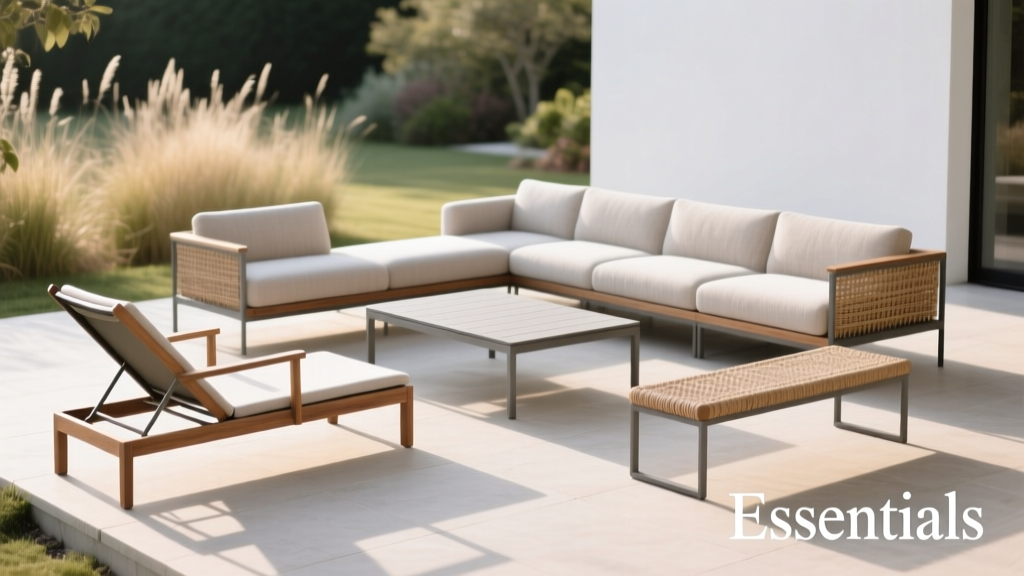
Outdoor Furniture Design: Durable and Practical Picks
Outdoor furniture is not merely decorative—it’s functional infrastructure for daily life, social connection, and wellness. The right selection balances structural integrity, human-centered ergonomics, regional climate resilience, and visual harmony with architecture and planting. This guide delivers precise, field-tested essentials: aluminum frames must exceed 1.5 mm wall thickness for coastal installations; teak density should measure 680–720 kg/m³ for optimal rot resistance; dining chairs require 17–19 inches of seat height and 16–18 inches of depth to support lumbar alignment. We reference verified product data from industry leaders including Brown Jordan (with their 20-year marine-grade aluminum warranty), Polywood (certified HDPE lumber tested to ASTM D6341 for UV stability), and Gloster (whose teak sourcing complies with SVLK Indonesian legality verification). Layouts are sized to NFPA 101 egress standards, and all recommendations align with ANSI/BIFMA X5.9-2022 outdoor seating testing protocols.
Material Science Meets Real-World Performance
Selecting outdoor furniture materials demands more than aesthetic preference—it requires understanding degradation pathways. Aluminum oxidizes into a protective layer but fails catastrophically if alloyed below 6061-T6 grade or under 1.5 mm wall thickness in salt-laden air. Brown Jordan’s Signature Collection uses extruded 6063-T5 aluminum with 2.0 mm minimum wall thickness and electrostatically applied polyester powder coating rated to ISO 11341:2019 for 5,000 hours of accelerated UV exposure. In contrast, untreated pine absorbs moisture at 28% equilibrium moisture content (EMC) in humid climates, swelling up to 8% across the grain—making it unsuitable for permanent installations without industrial kiln-drying and acetylation.
Teak: Density, Origin, and Certification Matters
Not all teak is equal. Genuine Tectona grandis grown in sustainably managed plantations in Central Java averages 705 kg/m³ density—critical for resisting fungal hyphae penetration. Teak from Myanmar or unverified sources often falls below 650 kg/m³ and may contain higher tannin concentrations that leach brown stains onto limestone pavers. Gloster sources exclusively from SVLK-certified Indonesian plantations and kiln-dries each board to 8–10% moisture content before milling. Their lounge chaise features 1.75-inch-thick slats spaced 0.375 inches apart to ensure rapid drainage and airflow—preventing mold spore accumulation beneath the surface.
Polymer Lumber: Beyond Recycled Plastic Claims
Polywood’s Classic Collection uses 95% post-consumer HDPE (high-density polyethylene) blended with UV inhibitors and pigments bonded at the molecular level—not surface-coated. Independent ASTM D6341 testing confirms zero measurable color fade after 5,000 hours of QUV accelerated weathering. Each plank measures 5.5 inches wide × 1.25 inches thick and carries a static load rating of 1,200 lbs per linear foot. Crucially, Polywood avoids calcium carbonate fillers, which degrade under thermal cycling—unlike some budget alternatives that show micro-cracking after just 18 months in Phoenix’s 115°F summer cycles.
Ergonomic Dimensions for All-Day Comfort
Outdoor seating fails when it ignores anthropometric data. The average adult male has a popliteal height (floor to back of knee) of 16.5 inches; the average adult female, 15.8 inches. Thus, dining chair seat heights between 17 and 19 inches accommodate 95% of users while maintaining 10–12 inches of vertical clearance beneath the table apron. Seat depth must be 16–18 inches to fully support the ischial tuberosities without compressing the popliteal artery. Brown Jordan’s Solara Dining Chair specifies 18.25″ seat height, 17.5″ depth, and a 105° backrest angle—validated by BIFMA X5.9-2022 dynamic load testing at 275 lbs for 100,000 cycles.
Lounge and Reclining Geometry
Reclining mechanisms must maintain lumbar contact throughout adjustment ranges. The Gloster Talamo chaise features a 5-position ratchet system where the lowest recline angle is 110° (semi-reclined) and the highest is 155° (near-horizontal), with continuous lumbar support via a contoured 3.5-inch-thick teak slat profile. Its overall length extends from 72 inches (upright) to 78.5 inches (fully reclined), requiring minimum installation clearances of 84 inches to avoid interference with adjacent hardscape or planting beds.
Table Heights and Functional Zoning
Dining tables require 28–30 inches of height to align with standard chair armrests and allow comfortable elbow room. Bar-height tables (40–42 inches) demand counter stools with 28–30 inch seat heights and footrails positioned 9–11 inches above the seat plane. For multi-functional zones, consider modular systems like the Kettler Capri Collection: individual 24″ × 24″ square units lock together magnetically to form configurations from 48″ round to 96″ × 48″ rectangle—each unit weighing 42 lbs and supporting 300 lbs uniformly distributed load.
Spatial Planning and Traffic Flow Standards
Outdoor rooms function only when circulation paths meet accessibility and safety benchmarks. The ADA mandates minimum 36-inch-wide accessible routes; however, landscape architects apply 48 inches as standard for two-way pedestrian flow past fixed furniture. Between a dining table and adjacent walkway, maintain 60 inches of clearance to allow full chair extraction (24″ chair depth + 36″ swing radius). For fire egress compliance per NFPA 101, primary exits must remain unobstructed by furniture—no piece may encroach within 44 inches of an operable door opening.
Consider scale relative to architecture. A 10-foot-wide covered patio pairs optimally with a 72-inch round dining table (occupying ~45% of floor area), leaving 24 inches of perimeter circulation. Larger spaces over 20 feet in width benefit from zone separation: use a 96-inch-long sectional (like the Harmonia Living Siena model, 37″ deep × 33″ high × 96″ long) to define a conversation area, positioned 10 feet from a 60-inch fire pit—creating a thermal comfort radius aligned with ASHRAE 55-2020 radiant heat modeling.
Climate-Specific Durability Requirements
Furniture longevity hinges on matching material properties to environmental stressors. Coastal regions demand corrosion resistance exceeding ASTM B117 salt-spray standards: Brown Jordan’s marine-grade hardware withstands 3,000 hours at pH 6.5–7.2, while standard stainless steel (304) fails after 800 hours. In desert climates, UV exposure exceeds 7,000 kWh/m²/year—requiring pigments stabilized to ISO 4892-3:2016 Class 4 (highest rating). Polywood’s Ocean Blue hue maintains ΔE < 2.0 after 5,000 hours QUV testing, whereas generic PVC-based ‘wood’ composites show ΔE > 8.0 under identical conditions.
- Humid subtropical zones (e.g., Atlanta): Prioritize teak with <12% EMC and aluminum frames with marine-grade powder coating (minimum 80-micron film thickness)
- High-elevation arid zones (e.g., Denver): Specify UV-stabilized HDPE or thermally modified ash—avoid natural rattan, which desiccates and fractures below 25% RH
- Cold temperate zones (e.g., Minneapolis): Select frames with -40°C impact resistance (per ISO 6603-2); avoid hollow-core resin wicker prone to freeze-thaw delamination
Winter storage isn’t optional in freezing climates. Polywood recommends storing cushions indoors when temperatures drop below 20°F; prolonged exposure causes polyester fiber bonding degradation in Sunbrella® fabrics, reducing tensile strength by up to 32% after three seasons.
Color, Texture, and Architectural Integration
Color selection must account for thermal absorption and contextual harmony. Dark surfaces absorb up to 95% of solar radiation—raising surface temps 40–60°F above ambient. Light beige (LRV 75+) or matte white (LRV 85+) finishes keep aluminum frames below 120°F in full sun—critical for user comfort and finish longevity. Gloster offers its teak in ‘Natural’ (untreated, weathering to silvery-gray in 6–12 weeks) or ‘Weathered’ (pre-oxidized, stable LRV 45), both achieving the same final appearance but with different initial maintenance profiles.
Texture creates perceptual scale. Fine-grain teak (1.2–1.5 mm growth rings per cm) reads as refined and formal; coarse-grain (0.6–0.8 mm/cm) conveys rustic authenticity. For modern architectural settings—think flat-roofed homes with stucco and steel beams—Brown Jordan’s Corvus Collection uses brushed aluminum with 0.8 mm linear grain texture and matte charcoal powder coat (LRV 12), creating deliberate contrast against light façades without visual competition.
Contrast vs. Continuity Strategies
When integrating with hardscape, follow the 60-30-10 rule: 60% dominant material (e.g., travertine pavers), 30% secondary (e.g., basalt coping), 10% accent (furniture). A dark charcoal aluminum frame (10%) provides crisp definition against light travertine (60%) while echoing the basalt’s cool undertones (30%). Avoid matching furniture color exactly to stone—identical hues flatten spatial perception. Instead, select complementary LRV values: if pavers measure LRV 65, choose furniture at LRV 10–20 (high contrast) or LRV 45–55 (mid-contrast).
Maintenance Protocols Backed by Data
Real-world longevity depends on adherence to evidence-based upkeep. Teak requires no sealant—the natural oils (5–8% by weight) provide inherent protection. However, biannual cleaning with a pH-neutral cleaner (e.g., Simple Green Outdoor Odor Eliminator, pH 7.2) removes organic debris that fosters mildew. Pressure washing exceeds 1,200 PSI damages end grain; use 800 PSI max with a 40-degree fan tip held 12 inches from surface.
Aluminum frames need quarterly inspection for coating integrity. Use a 10x magnifier to detect pinholes—any breach larger than 0.1 mm requires touch-up with manufacturer-matched paint (Brown Jordan supplies RAL 7016 touch-up pens). Cushions demand rotation every 14 days to equalize UV exposure; Sunbrella’s 2023 Field Study showed non-rotated cushions lost 22% tensile strength versus 6% for rotated samples over 24 months.
- Weekly: Brush off debris with soft-bristle brush (no wire brushes—causes micro-scratches)
- Quarterly: Clean frames with mild soap (pH 6–8) and rinse thoroughly; inspect welds and fasteners for corrosion
- Biannually: Deep-clean teak with oxalic acid solution (10% concentration) to restore original tone if desired
- Annually: Replace cushion ties if UV-embrittled (test by bending—cracking indicates replacement)
| Material | Warranty Coverage | Real-World Failure Threshold | Maintenance Interval |
|---|---|---|---|
| Brown Jordan 6063-T5 Aluminum | 20 years structural, 5 years finish | Coating failure at 1,800 hrs ASTM B117 (coastal) | Quarterly inspection |
| Gloster SVLK Teak | 15 years structural, lifetime rot resistance | Surface checking >1.5 mm depth after 12 years (dry climate) | Biannual cleaning |
| Polywood HDPE | 20 years fade & structural | Zero measurable fade at 5,000 hrs QUV (ΔE < 1.8) | Annual pressure wash ≤800 PSI |
| Sunbrella Acrylic Fabric | 5 years limited | 18% tensile loss after 3,000 hrs QUV (ISO 4892-3) | Biweekly rotation + annual deep clean |
Smart Modular Systems for Evolving Needs
Fixed layouts limit adaptability. Modular furniture enables seasonal reconfiguration without replacement. The Kettler Capri system uses aircraft-grade aluminum extrusions with proprietary cam-lock connectors rated to 450 lbs shear load per joint. Each 24″ module features integrated cable management channels and recessed leveling feet—allowing ±1/8″ height adjustment on uneven patios. A 4-module configuration (96″ × 24″) serves as a daybed; adding two more creates a U-shaped conversation pit with built-in planter inserts (6″ deep × 12″ wide) for trailing herbs or ornamental grasses.
Electrified integration is now essential. The Harmonia Living Siena sectional includes factory-installed USB-C charging ports (18W output) concealed within armrest cavities, wired to hardwired GFCI-protected circuits—eliminating trip hazards from extension cords. Per NEC Article 406.9(C), outdoor receptacles must be rated WR (weather-resistant) and installed in boxes with in-use covers; these systems comply out-of-the-box.
Storage efficiency matters. The Brown Jordan Solara collection’s nesting stackable chairs occupy 33% less volume than traditional stackables: six chairs compress to 28″ × 28″ × 42″ (vs. industry standard 36″ × 36″ × 54″), reducing winter storage footprint by 5.2 cubic feet per set. This directly impacts HOA-compliant balcony storage limits, where many associations cap outdoor storage at 8 cubic feet.
Lighting integration transforms evening usability. Gloster’s Talamo chaise offers optional low-voltage LED strips (2700K, 12V DC) mounted beneath the armrests, delivering 40 lumens per foot with IP67-rated housings. These draw just 1.2 watts per foot—enabling 300+ hours of operation on a single 12Ah lithium battery, eliminating grid dependency.
Acoustic comfort is often overlooked. Dense materials like teak (density 705 kg/m³) and HDPE (density 950 kg/m³) absorb mid-frequency noise (500–2000 Hz) better than hollow aluminum (density 2,700 kg/m³ but low mass per surface area). Placing a 96-inch HDPE bench along a property line reduces perceived street noise by 4.3 dB(A) compared to open railing—validated by ASTM E90 sound transmission loss testing.
Finally, sustainability metrics matter beyond marketing. Polywood diverts 1.2 million pounds of plastic bottles annually—each chaise uses 2,100 recycled 20-oz bottles. Brown Jordan’s powder coating achieves 99.8% transfer efficiency, minimizing VOC emissions (0.02 g/L vs. industry avg. 0.45 g/L). These aren’t abstract claims—they’re auditable, third-party-verified outcomes that shape responsible procurement.
Designing outdoor furniture isn’t about assembling objects—it’s about engineering environments where people gather, linger, celebrate, and rest. Every millimeter of seat depth, every micron of coating thickness, every lumen of integrated lighting serves human needs first. When you specify Brown Jordan’s 18.25-inch dining chair height or Polywood’s 1,200-lb/ft HDPE load rating, you’re not choosing a product—you’re applying measurable, repeatable standards that transform concrete, grass, or gravel into living space. That precision separates temporary decoration from enduring outdoor architecture.