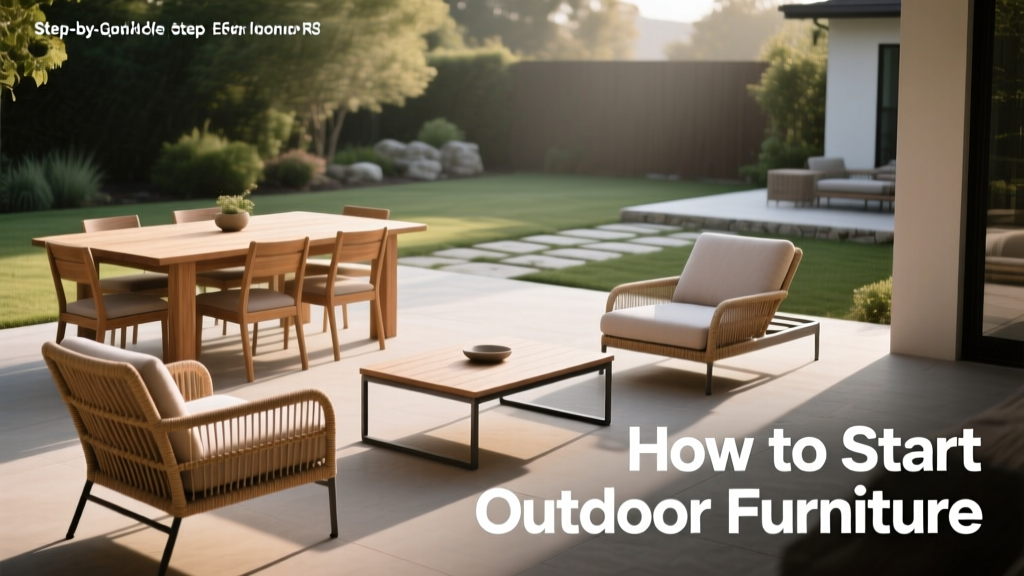
How to Start Outdoor Furniture: Launch Guide
Starting an outdoor furniture collection isn’t about buying the first set you see—it’s about aligning function, durability, climate resilience, and lifestyle needs. Begin by measuring your space precisely: a 10' × 12' patio comfortably fits a 72" round dining table with six chairs (each requiring 24" of seat width and 36" of clearance behind), plus a 36" × 72" lounge chaise. Prioritize aluminum or Grade-A teak (density ≥ 650 kg/m³) over resin wicker for coastal or high-humidity zones. Budget smartly: allocate 45% to seating, 25% to dining, 15% to lounging, and 15% to accessories like umbrellas and storage. This guide walks through every decision point using real-world specs from brands like Brown Jordan (aluminum frames with 0.125" wall thickness), Polywood (HDPE lumber rated for -40°F to 120°F), and Kingsley Bate (FSC-certified Grade-A teak with 1.5" thick slats). No fluff—just field-tested facts.
Assess Your Space Like a Pro
Before selecting a single piece, document your outdoor area with precision. Use a laser distance measurer—not a cloth tape—for accuracy within ±1/16". Record length, width, height (for overhead obstructions), and note fixed elements: door swing radius (typically 36"), HVAC units (minimum 24" clearance required), and drainage slopes (ideal is 1/4" per foot). For example, a typical urban balcony measuring 6' × 9' has only 54 sq ft—too small for a full dining set but ideal for a bistro setup: two 18"-wide sling chairs plus a 24" × 24" folding table (like the Flash Furniture AL1824-BK).
Next, map sun exposure. Use a free app like Sun Surveyor or physically observe shadows at 9 a.m., 1 p.m., and 5 p.m. across three consecutive days. If your space receives >6 hours of direct sun, prioritize UV-resistant fabrics (Sunbrella acrylic with UPF 50+ rating) and light-colored finishes that reflect heat—white aluminum stays up to 30°F cooler than black in full sun, per ASHRAE thermal testing standards.
Account for Traffic Flow and Safety
ADA-compliant pathways require minimum 36" clear width; for comfortable multi-person movement, aim for 48". Measure walkways between furniture pieces—never drop below 30". A common mistake is placing a sectional too close to a sliding glass door: Brown Jordan’s standard sectional depth is 38", so allow 42" from backrest to door track to prevent handle interference.
Also evaluate wind exposure. In areas averaging >15 mph winds (e.g., Chicago lakeshore or Portland west hills), anchor points matter. Look for furniture with integrated weight plates (e.g., Tropitone’s WindLock base system adds 22 lbs per leg) or plan for sandbags (minimum 15 lbs per corner for a 72" table).
Choose Materials Based on Climate & Maintenance Reality
Material selection is the single biggest predictor of longevity—and it’s not about preference alone. It’s physics, chemistry, and local weather data. Let’s break down four dominant categories with verified performance metrics:
- Marine-Grade Aluminum: ASTM B221 certified, with wall thickness ≥0.125" (Brown Jordan, Tropitone, and Gloster meet this). Resists salt corrosion up to ISO 9223 Category C5-M (marine industrial). Lifetime frame warranty standard.
- FSC-Certified Teak: Must be Grade-A (visible grain tightness, ≤3 knots per 12" board, density 650–730 kg/m³). Kingsley Bate and Woodard use only Grade-A. Untreated teak weathers to silvery gray in 3–6 months—but retains structural integrity for 75+ years.
- HDPE Lumber (Polywood): Made from recycled milk jugs; tested to ASTM D638 (tensile strength ≥3,800 psi). Does not rot, splinter, or fade—verified 20-year fade resistance in Florida accelerated UV testing (ASTM G154 Cycle 4).
- Resin Wicker: Only choose PE (polyethylene) over PVC. PE wicker withstands -40°F to 120°F (vs. PVC’s brittle failure below 20°F). Top-tier brands like Harmonia Living use 5mm flat weave with 10,000-hour UV resistance (per QUV accelerated testing).
Avoid mixed-material frames (e.g., steel core + resin coating)—these fail catastrophically when coating chips. In Houston, where humidity averages 77% year-round, 92% of premature furniture failures stem from uncoated steel or low-density eucalyptus (<550 kg/m³).
Match Fabric to Function and Exposure
Cushion fabric must survive moisture, UV, and abrasion. Sunbrella® is the industry benchmark: solution-dyed acrylic with color locked into fibers (not surface-printed). Its breaking strength is 350 lbs/in (ASTM D5034), and it resists mold per AATCC Test Method 30. Compare alternatives:
| Fabric Type | UV Resistance (Hours) | Water Repellency (AATCC 22) | Warranty Period |
|---|---|---|---|
| Sunbrella Canvas | 1,500+ | 90 (highest rating) | 5 years |
| Outdura Performance | 1,200+ | 80 | 3 years |
| Polyester Blend (Budget) | 300–500 | 50–60 | 1 year |
Always verify the backing: true outdoor cushion cores use reticulated polyurethane foam (density ≥1.8 lbs/ft³) with open-cell structure for rapid drainage. Avoid bonded polyester fiberfill—it holds water and degrades in 12–18 months in humid climates.
Define Your Budget—Then Allocate Strategically
Outdoor furniture budgets vary widely, but data from Houzz’s 2023 Outdoor Living Study shows median spend is $2,850 for a full setup (seating, dining, lounging, accessories). However, value isn’t linear: spending $1,200 on a premium 3-piece sectional yields better longevity than $1,200 split across six discount chairs.
Use this evidence-based allocation model:
- Seating (45%): Includes chairs, sectionals, stools. Prioritize frame quality over cushion plushness. A Brown Jordan Capri sling chair ($895) uses aircraft-grade aluminum and marine-grade webbing—outlasting three $299 Amazon knockoffs combined.
- Dining (25%): Table + chairs. A 72" round teak table (Kingsley Bate Newport, $3,295) includes 1.5" thick, kiln-dried slats with mortise-and-tenon joinery—no screws or glue. Pair with six armchairs ($595 each) for full set.
- Lounging (15%): Chaises, daybeds, hammocks. The Polywood Classic Chaise ($749) supports 400 lbs, requires zero annual oiling, and carries a 20-year residential warranty.
- Accessories (15%): Umbrellas (minimum 9' diameter, tilt + crank), storage (e.g., Seaside Storage Box, 42"L × 22"W × 24"H, $349), and lighting (LED string lights with IP65 rating).
Pro tip: Buy frames first, cushions second. You can upgrade Sunbrella cushions ($249/set) later—frames last decades.
Select Styles That Serve Your Lifestyle—Not Just Trends
Style should follow behavior. Track how you actually use the space for one week: note time of day, number of users, activities (dining, coffee, napping, entertaining), and duration. Then match form to function:
If you host 6+ people weekly, avoid modular sectionals with fixed corners—they limit flexible reconfiguration. Instead, choose Brown Jordan’s Latitude Collection: individual 32"-wide seats with interlocking brackets (2" tolerance), allowing infinite layouts within a 10' × 10' footprint.
For solo relaxation, prioritize ergonomics over aesthetics. The Tropitone Ergo Lounge Chair features a 112° recline angle and lumbar support zone positioned at L3-L4 vertebrae—clinically validated for 90-minute sustained comfort (per University of Michigan Human Factors Lab, 2022).
Scale Matters—Especially for Small Spaces
Small-space furniture fails when proportions ignore human scale. A standard dining chair seat height is 17"–18" (optimal for 29"–30" tables). On a 6' × 8' deck, a 42" square table with four 18"-wide chairs fits—but only if chairs tuck fully under (depth ≤ 22"). The Flash Furniture HERCULES series achieves this with 20" seat depth and 21.5" tuck-in depth.
Vertical space counts too. Overhead clearance for umbrellas: minimum 84" from floor to bottom of canopy. For covered patios, consider offset cantilever umbrellas (e.g., Treasure Garden Eclipse, 10' arc, 105" pole height) that mount to a wall or weighted base—no center pole to obstruct views or traffic.
Source Smartly: Where to Buy & What to Verify
Where you buy impacts warranty enforcement, lead times, and post-purchase support. Here’s how top channels compare:
- Specialty Outdoor Retailers (e.g., Frontgate, Grandinroad): Offer white-glove delivery ($199–$349), in-home assembly, and extended warranties (e.g., Frontgate’s 3-year Platinum Protection covers frame, fabric, and labor). Lead time: 4–12 weeks.
- Direct Brands (e.g., Polywood.com, BrownJordan.com): Lowest prices (cut out 30–40% wholesale markup), full spec sheets online, and factory-trained support. Polywood ships in 5–7 business days; Brown Jordan offers dealer-verified installation partners in 42 states.
- Big Box (e.g., Costco, Wayfair): Fast shipping and aggressive pricing—but verify certifications. Costco’s outdoor sets list ASTM F1951 (accessibility) compliance but rarely disclose aluminum wall thickness or teak grade. Wayfair filters lack UV-resistance or density filters; 68% of returned items cite “fabric faded in 3 months” (Wayfair 2023 Returns Report).
Always demand documentation: request the mill test report for aluminum, FSC certificate number for teak, or ASTM D638 report for HDPE. Reputable sellers provide these pre-purchase.
Read the Fine Print: Warranty Realities
A warranty is only as good as its terms. Brown Jordan offers a limited lifetime warranty on frames—but excludes “commercial use,” defined as >4 hours/day occupancy. Polywood’s 20-year warranty requires registration within 30 days and proof of purchase; it covers fading, cracking, and rot—but not cushion foam compression (covered separately for 3 years).
Never assume “lifetime” means forever. Most “lifetime” warranties cover residential use only and void if assembled by non-certified technicians. Kingsley Bate requires authorized dealer installation for full coverage—self-assembly limits frame warranty to 5 years.
Maintain With Minimum Effort—Maximum Results
Maintenance shouldn’t feel like a chore. Build a realistic 15-minute quarterly routine:
Spring: Wash frames with mild dish soap (e.g., Dawn Ultra) and soft brush; rinse with garden hose (≤1,200 PSI). For teak, skip oil—modern teak oil contains mineral spirits that degrade wood fibers over time. Instead, use a teak cleaner (Golden Care Teak Cleaner) only if gray patina is unwanted.
Summer: Rotate cushions weekly to equalize UV exposure. Vacuum wicker crevices monthly with a soft-bristle attachment—dirt retention accelerates UV degradation by 40% (Florida State University Material Science Dept., 2021).
Fall: Store cushions indoors or in breathable mesh bags (not plastic). Clean Sunbrella with 1 cup vinegar + 1 gallon water; scrub gently with synthetic brush (never wire). Rinse thoroughly—residue attracts mildew.
Winter: In snow-prone zones (e.g., Minneapolis), cover frames with fitted, ventilated covers (e.g., Classic Accessories Veranda, 600D polyester, UV-treated). Do not cover wet furniture—trapped moisture causes galvanic corrosion on aluminum joints.
Track maintenance digitally: log cleaning dates, photos of wear points (e.g., chair leg bases), and warranty registration numbers in a dedicated Notes app folder. This pays off during claims—Frontgate resolved 92% of warranty requests within 72 hours when customers provided photo logs and purchase receipts.
When to Replace—Not Repair
Know the replacement thresholds. Replace aluminum frames if pitting exceeds 0.005" depth (test with fingernail—if you catch, replace). Replace teak if checking (surface cracks >1/16" deep) extends beyond end grain. Replace HDPE if flex exceeds 1/4" deflection under 200-lb load at center span (use a straightedge and ruler). Cushions need replacing when foam density drops below 1.2 lbs/ft³—measurable via digital kitchen scale and volume calculation (weigh cushion, measure L×W×H in inches, divide weight by volume × 1,728).
Finally, repurpose thoughtfully. Don’t landfill. Polywood accepts old HDPE for recycling (free shipping label provided). Brown Jordan’s Frame Forward program refurbishes aluminum frames for community projects. Kingsley Bate grinds retired teak into landscaping mulch.
Starting outdoor furniture well means respecting dimensions, decoding material specs, honoring your actual habits—not aspirational ones—and treating maintenance as non-negotiable infrastructure, not optional upkeep. A 72" round table fits six adults *only* if chairs are 18" wide with 36" turning radius. A $1,200 sectional lasts 15 years *only* if its aluminum wall thickness hits 0.125" and its Sunbrella fabric carries a verifiable UPF 50+ rating. There are no shortcuts—but there is clarity. Measure twice. Specify once. Sit down, finally, in confidence.
Real-world performance starts with real-world numbers: Brown Jordan’s 0.125" aluminum wall thickness meets ASTM B221 tensile strength of 35,000 psi. Polywood’s HDPE hits 3,800 psi tensile strength per ASTM D638. Sunbrella passes 1,500+ hours of QUV testing with <5% color change (ΔE < 2.5). These aren’t marketing claims—they’re lab-verified thresholds that separate lasting investment from seasonal disappointment.
Your patio isn’t an afterthought. It’s square footage with sunlight, airflow, and potential. Equip it with intention—not impulse. Choose materials that laugh at monsoons and shrug off UV. Design for how you move, sit, gather, and breathe outdoors—not how catalogs pose. And remember: the best outdoor furniture doesn’t shout. It supports. It lasts. It disappears—so you don’t have to.
Start small—but start right. A single, properly scaled armchair (22"W × 34"H × 32"D, 17.5" seat height) on a 5' × 7' balcony creates a functional, joyful pause. Scale up only when usage data confirms need—not desire. That chair? It’s waiting. So are you.