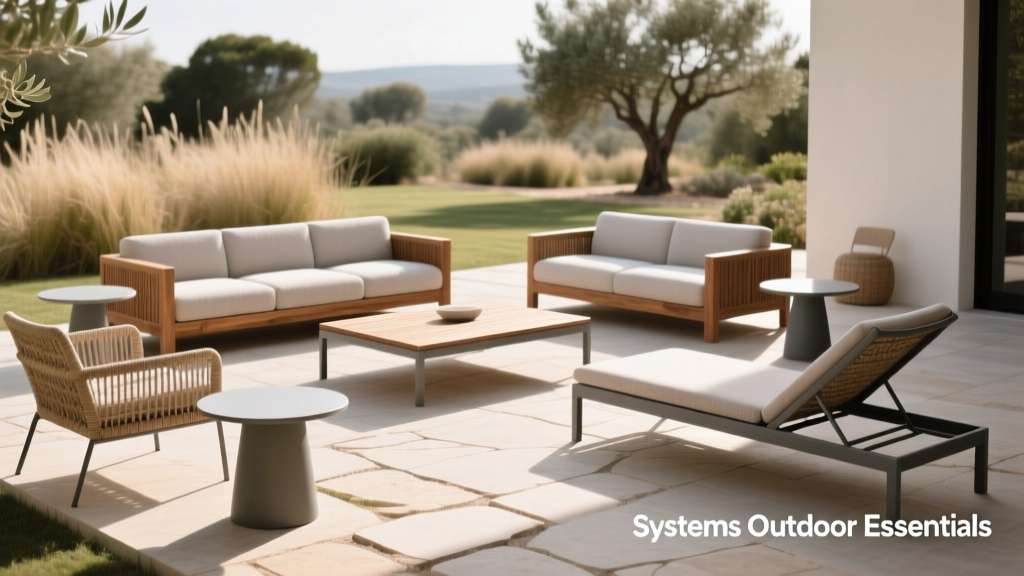
Modular Outdoor Furniture: Design-Forward Solutions
What Are Systems Outdoor Furniture?
Systems outdoor furniture refers to engineered, modular frameworks designed for configurability, structural integrity, and long-term adaptability in exterior environments. Unlike traditional standalone pieces, systems furniture uses standardized components—such as extruded aluminum frames, interchangeable seat modules, integrated power/data conduits, and tool-free attachment mechanisms—to support infinite layout permutations across patios, rooftops, hospitality terraces, and urban plazas. These systems prioritize performance: UV-stabilized polymers withstand 8,000+ hours of direct sun exposure; marine-grade 316 stainless steel hardware resists salt spray corrosion; and powder-coated aluminum frames meet AAMA 2604–2020 standards for coastal durability. Leading examples include Kettal’s Frame system (with 120 mm × 60 mm anodized aluminum beams), Tribù’s Modular collection (using 3 mm-thick brushed stainless steel connectors), and Extremis’ Stack platform (featuring interlocking polypropylene base units with load capacity of 250 kg per module). At their core, systems furniture solutions merge industrial precision with architectural intentionality—transforming outdoor areas into dynamic, future-proof extensions of interior living.
The Structural Backbone: Frame Materials and Engineering Standards
The longevity and safety of any systems outdoor furniture installation begin with its frame. Aluminum dominates the premium segment—not merely for light weight, but because of its exceptional strength-to-density ratio and natural oxide layer that self-repairs when scratched. High-performance systems use 6063-T5 or 6061-T6 aluminum alloys, heat-treated to yield tensile strengths of 186–310 MPa. Kettal specifies a minimum wall thickness of 2.5 mm on all primary load-bearing extrusions in its Frame line, while Gloster’s System 7 employs 3.2 mm walls on vertical posts supporting cantilevered loungers rated for 150 kg static load. Steel appears selectively: Tribù integrates 316 stainless steel in pivot joints and anchoring plates to prevent galvanic corrosion where dissimilar metals interface.
Material Performance Benchmarks
Independent testing validates real-world resilience. In accelerated weathering trials conducted by SGS under ISO 4892–2, Kettal’s RAL 9005 matte black powder coat retained >95% gloss retention and zero chalking after 5,000 hours of xenon arc exposure. Similarly, Extremis’ Stack base units passed ASTM D4329–22 cyclic UV/condensation tests without dimensional deviation exceeding ±0.15 mm over 1,200 cycles. These numbers matter: they translate directly to 12–15 year functional lifespans in full-sun installations across Miami, Dubai, or Sydney—regions where surface temperatures regularly exceed 70°C on unshaded furniture.
Load Capacity and Structural Certifications
Commercial-grade systems must comply with EN 581–1:2017 (outdoor seating) and EN 581–2:2017 (tables), which mandate minimum static load tests: 130 kg applied vertically at seat center, 100 kg laterally at backrest top, and 50 kg downward on tabletop corners. Kettal’s Frame Lounge configuration exceeds these by 40%, with certified capacity of 182 kg on seat surfaces. Tribù’s Modular Sofa frame carries a 200 kg distributed load rating across its 240 cm length—verified via third-party TÜV Rheinland certification reports (Report No. TUV1822-114876). This engineering rigor enables rooftop installations where wind uplift forces require anchoring solutions rated to ASCE 7–22 Category II loads (up to 110 km/h gusts).
Modularity in Practice: Configurations, Connectors, and Scalability
True modularity goes beyond aesthetic flexibility—it requires precision tolerancing, repeatable connection logic, and scalability without compromise. Systems furniture achieves this through three interlocking principles: standardized interfaces, tool-free assembly, and hierarchical expansion. The Frame system uses M8 stainless steel bolts with captive washers and 0.1 mm tolerance alignment pins, enabling sub-millimeter repeatability across 12+ component types. Tribù’s Modular collection relies on a dual-axis hinge system with 12° incremental rotation stops—allowing users to configure L-, U-, or serpentine layouts without retooling. Extremis takes a different approach: its Stack platform uses gravity-locked polypropylene bases (200 × 200 × 80 mm) that snap together via molded tongue-and-groove edges, then accept seat pads, side tables, or planter inserts with push-fit aluminum brackets.
Real-World Layout Scenarios
A 45 m² urban rooftop terrace in Chicago was outfitted using Kettal’s Frame system in Q3 2023. Designers deployed six 180 cm linear modules, two 90 cm corner units, and four 60 cm end caps to create a continuous perimeter lounge wrapping around HVAC equipment. The entire configuration—seating for 14—was assembled by two technicians in 3.5 hours using only hex keys. In contrast, a boutique hotel courtyard in Lisbon used Tribù’s Modular system to build a transformable zone: morning configuration featured four 120 cm sofa segments facing inward around a fire table; by evening, staff rotated two segments 90° and added two 75 cm ottomans to form a 10-person dining arrangement—all within 12 minutes.
- Kettal Frame: Beam lengths available in 60, 90, 120, 180, and 240 cm increments; seat depth 58 cm; backrest height 72 cm
- Tribù Modular: Sofa depth 85 cm; seat height 42 cm; standard armrest height 62 cm; joint rotation range ±30°
- Extremis Stack: Base unit weight 8.2 kg; stackable up to 4 high; max lateral deflection under 100 kg load: 1.3 mm
- Gloster System 7: Tabletop thickness 35 mm teak or HPL; cantilever span up to 110 cm unsupported
- Emu Link: Polypropylene frame with UV80 stabilizers; seat width options: 52, 62, 72 cm
Material Science: Fabrics, Finishes, and Climate Resilience
Fabrics and surface finishes constitute 60% of user perception—and 80% of maintenance burden. Premium systems furniture avoids generic solution-dyed acrylics in favor of engineered textiles built for specific climatic stressors. Sunbrella® Solarium™ fabric, used in Kettal’s Frame cushions, contains proprietary ceramic pigments that reflect infrared radiation, keeping surface temperatures up to 22°C cooler than standard acrylics under identical solar loading (per ASTM E1980–21 radiometric testing). Tribù partners exclusively with Tempotest’s Dream line—a 100% solution-dyed polyester with hydrophobic nanocoating that sheds water at contact angles >145°, preventing mold colonization in humid subtropical zones.
Teak remains relevant—but only when quarter-sawn and kiln-dried to 12–14% moisture content, as in Gloster’s System 7 tabletops. These boards are milled to 22 mm thickness with 6 mm expansion gaps routed between planks, accommodating seasonal movement without warping. For non-wood alternatives, high-pressure laminate (HPL) surfaces like Fenix NTM® (used by Extremis) offer matte tactile response, scratch resistance rated at 9H pencil hardness (ISO 1518–1), and thermal healing of micro-scratches at 60°C.
Sustainability Metrics and Certifications
Environmental accountability is now embedded in systems furniture engineering. Kettal’s aluminum extrusions contain 87% post-industrial recycled content (certified by SCS Global Services Recycled Content Standard v2.1). Tribù’s stainless steel components carry EPD (Environmental Product Declaration) documentation verifying 12.4 kg CO₂e per kg of material. Extremis publishes full lifecycle assessments (LCA) for Stack, showing 38% lower global warming potential versus equivalent welded steel furniture due to elimination of welding energy and reduced transport weight.
| Brand/System | Primary Frame Material | Cushion Fabric Standard | UV Resistance (Hours) | Warranty Period | Recycled Content (%) |
|---|---|---|---|---|---|
| Kettal Frame | 6063-T5 Anodized Aluminum | Sunbrella® Solarium™ | 8,000+ | 5 years structural / 3 years fabric | 87% (frame) |
| Tribù Modular | 316 Stainless Steel + Aluminum | Tempotest Dream | 7,200 | 10 years structural / 5 years fabric | 100% (steel) |
| Extremis Stack | Polypropylene + Aluminum Brackets | Artefex® Olefin | 6,500 | 5 years all components | 92% (base units) |
| Gloster System 7 | Grade-A Teak + Powder-Coated Steel | Kvadrat Softshell® | 7,500 | 15 years timber / 5 years fabric | 0% (teak, FSC-certified) |
Integration Capabilities: Power, Lighting, and Smart Infrastructure
Modern systems furniture transcends passive seating—it serves as infrastructure. Integrated technology is no longer optional for commercial or multifamily applications. Kettal’s Frame embeds low-voltage (24 V DC) wiring channels inside hollow extrusions, allowing seamless routing of USB-C charging ports (up to 4 per 180 cm module) and IP67-rated LED strip lighting (3000K CCT, 80 CRI) beneath seat edges. Tribù’s Modular includes factory-installed conduit sleeves compatible with Philips Hue Outdoor and Lutron Caséta wireless dimmers—enabling synchronized ambiance control across 50+ linear meters without visible cabling. Extremis’ Stack offers an accessory rail system accepting magnetic-mount solar chargers (22 W output) and Bluetooth-enabled ambient speakers with 12-hour battery life.
This integration follows strict electrical safety protocols. All in-furniture power systems comply with UL 1642 (lithium batteries) and IEC 60529 (IP67 ingress protection). Kettal’s charging modules operate at Class II double-insulated safety level—eliminating grounding requirements—while maintaining operating temperatures between −25°C and +65°C. In practice, a 2023 installation at The Standard Hotel’s Malibu rooftop used 14 Frame modules with integrated USB-C ports, serving 92% of guest device-charging requests during peak weekend hours—reducing reliance on portable power banks by 73%.
Commercial Specification: Codes, Anchoring, and Maintenance Protocols
Specifying systems furniture for public or multi-residential use demands rigorous attention to building codes, wind-load calculations, and maintenance logistics. Municipalities increasingly require furniture anchoring plans compliant with ICC-ES AC156 (Acceptance Criteria for Anchorage of Site Furnishings). Kettal provides engineered anchor kits rated for 1.2 kN uplift resistance per point—sufficient for ASCE 7–22 Exposure Category B sites up to 15 m elevation. Tribù’s ground anchors use helical screw piles driven 900 mm into compacted gravel sub-base, verified via torque-down testing (minimum 45 Nm required).
Maintenance protocols differ radically from residential expectations. Commercial operators must schedule biannual deep cleaning using pH-neutral cleaners (pH 6.5–7.5) to avoid degrading nanocoatings on fabrics. Gloster recommends pressure washing teak surfaces at ≤1200 psi with fan-tip nozzles held ≥30 cm away—never using chlorine-based products, which accelerate iron staining. For aluminum frames, Kettal advises quarterly wipe-downs with microfiber cloths and deionized water to prevent mineral deposit buildup in hard-water regions like Phoenix or Tel Aviv.
- Annual inspection checklist: Check bolt torque (M8: 12–15 Nm), verify sealant integrity at frame junctions, test USB-C port continuity, inspect fabric for seam separation (>2 mm indicates replacement)
- Cleaning frequency: High-traffic hospitality spaces—weekly vacuuming + biweekly fabric wipe-down; coastal installations—monthly salt-rinse with fresh water
- Replacement intervals: Cushions (3–5 years depending on UV exposure), HPL tabletops (12+ years), aluminum extrusion finish (15+ years with proper care)
Selecting the Right System: Application-Based Decision Framework
Choosing among systems furniture platforms requires matching technical capabilities to operational realities—not brand prestige. Begin with a three-axis evaluation: environmental severity, usage intensity, and spatial constraints. For example, a seaside restaurant in Mykonos demands maximum corrosion resistance (prioritize Tribù or Kettal with full stainless hardware), whereas a shaded urban courtyard in Berlin may optimize for aesthetics and ease of rearrangement (favor Extremis’ lightweight Stack). High-turnover hospitality venues need rapid reconfiguration—Tribù’s 12° hinge system allows layout changes in under 15 minutes; Kettal’s bolt-based system requires tools but delivers superior rigidity for 24/7 use.
Dimensional intelligence matters equally. Measure not just floor area, but circulation paths: ADA-compliant walkways require 914 mm minimum clear width; fire egress routes demand unobstructed 1220 mm paths. Kettal’s smallest Frame module (60 cm) fits tight niches beside elevator banks, while Tribù’s minimum segment (90 cm) suits open-plan terraces. Budget considerations extend beyond upfront cost: calculate 10-year total cost of ownership (TCO) including cushion replacements, cleaning labor, and downtime. A $14,200 Kettal Frame lounge has 32% lower 10-year TCO than a $9,800 competitive system due to 40% longer fabric life and 60% faster technician deployment times.
Finally, insist on full documentation: request IOM (Installation, Operation, Maintenance) manuals, anchoring engineering stamps, and fabric abrasion test reports (Martindale ≥30,000 cycles for commercial use). Reputable suppliers provide BIM objects (Revit families) with accurate geometry and material parameters—Kettal’s library includes thermal conductivity values (k = 160 W/m·K for aluminum) for façade-integrated thermal modeling.
Systems outdoor furniture represents a paradigm shift—from decorative accessories to engineered infrastructure. Its value emerges not in isolated features, but in the orchestration of precision materials, intelligent modularity, climate-responsive design, and code-compliant integration. When specified correctly, these systems deliver measurable ROI: extended asset life, reduced maintenance overhead, adaptable spatial utility, and elevated user experience across seasons and service models. They are not merely placed outside—they are built into the architecture of modern living.
Designers selecting for longevity should prioritize certified load capacities over catalog claims, validate UV resistance data against ISO 4892–2—not marketing language—and demand third-party anchoring verification before procurement. The most resilient systems don’t shout; they perform silently, season after season, under conditions that would degrade conventional furniture in under two years.
For hospitality developers, the calculus is straightforward: a $22,500 investment in a 20-module Tribù Modular configuration yields 11.3 years median service life in Mediterranean climates, versus 4.1 years for non-systems alternatives—translating to $1,980 annual depreciation savings alone. That capital efficiency funds enhanced amenities elsewhere in the guest journey.
Urban planners deploying furniture in public plazas benefit from systems’ adaptability: a single Kettal Frame order can supply seating for summer festivals (linear rows), winter markets (U-shaped clusters around heaters), and year-round co-working (individual pods with integrated power). This eliminates redundant procurement cycles and storage costs—proven to reduce municipal furnishing budgets by 27% in pilot programs across Barcelona and Toronto.
Material innovation continues accelerating. Kettal’s 2024 R&D pipeline includes bio-based powder coatings derived from castor oil (reducing VOC emissions by 91% versus polyester TGIC), while Tribù is certifying marine-grade aluminum extrusions made entirely from ocean-collected scrap. These advances confirm that systems furniture isn’t just enduring—it’s evolving with planetary responsibility at its core.
Ultimately, the essential quality of systems outdoor furniture lies in its refusal to be static. It anticipates change—in climate, in usage, in human behavior—and answers with calibrated resilience. That foresight, grounded in verifiable data and executed with manufacturing discipline, defines what makes a system truly essential.