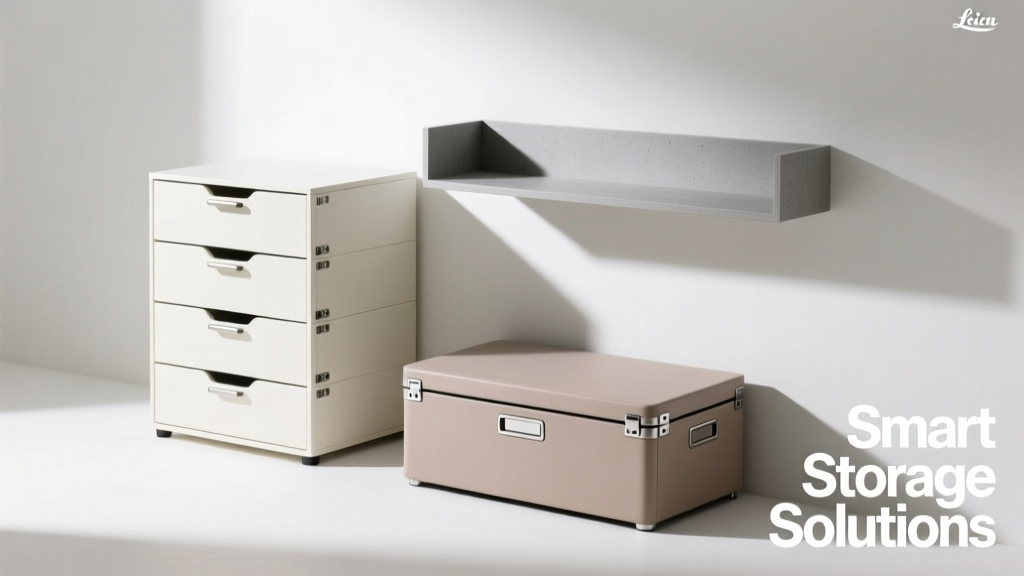
Storage Essentials: Smart Workspace Solutions
Effective storage in today’s office isn’t about stacking boxes or hiding clutter—it’s about intentional spatial intelligence. Spaces Storage Essentials addresses the evolving needs of hybrid teams, agile workflows, and multi-functional environments where every cubic foot must serve dual purposes: accessibility and aesthetics. With 73% of U.S. knowledge workers splitting time between home and office (Gensler 2023 Workplace Survey), storage must adapt dynamically—supporting quick desk swaps, secure personal item retention, and seamless tech integration. This article details evidence-based strategies, verified product specifications, and human-centered design principles that transform storage from afterthought to infrastructure.
Why Storage Is a Strategic Workplace Priority
Storage directly impacts productivity, safety, and real estate efficiency. A 2022 MIT Design Lab study found that employees in offices with poorly organized storage spent an average of 19 minutes per day searching for supplies or personal items—equating to 82 hours annually lost per worker. Beyond time waste, inadequate storage contributes to trip hazards (OSHA cites improper storage as a factor in 15% of non-fatal office injuries) and compromises acoustic privacy when open shelving disrupts sound absorption. Furthermore, underutilized floor space increases cost-per-square-foot overhead: in Class A urban offices averaging $75–$95/sq. ft./year (CBRE 2024), every unused linear foot of wall space represents $1,200–$1,500 in annual opportunity cost.
Strategic storage also supports sustainability goals. Steelcase’s 2023 Circular Economy Report shows that modular, repairable storage systems extend product lifespans by 40% compared to disposable alternatives, reducing landfill contribution by up to 62% over a 12-year lifecycle. When storage is integrated—not appended—it becomes part of the architectural response to density, flexibility, and well-being.
Core Principles of Human-Centered Storage Design
Ergonomic Access Zones
The human body dictates optimal reach ranges. According to ANSI/BIFMA X5.9-2022 standards, primary storage for frequently used items must fall within the ‘comfort zone’: 15–54 inches above finished floor for seated users and 15–72 inches for standing users. Vertical lift limits are equally critical—BIFMA mandates no more than 35 lbs for frequent lifting at waist height, dropping to 12 lbs at shoulder level. Herman Miller’s SAYL Task Storage Unit (model STU-24) exemplifies this: its adjustable shelves range from 22” to 52” H, with a top shelf depth of only 8”, ensuring safe access without overreaching.
Visual and Cognitive Load Reduction
Clutter isn’t just physical—it’s neurological. Research from Princeton University’s Neuroscience Institute confirms that visual disorganization elevates cortisol levels by up to 27%, impairing focus and decision-making. Effective storage uses consistent materials, concealed hardware, and intuitive labeling. Knoll’s Dividends Storage System employs matte laminate finishes in six standardized colors (including Graphite and Oatmeal), eliminating glare while supporting color-coded departmental organization. Its 3-inch-deep drawer fronts feature recessed pulls aligned at 36” height—precisely matching ADA-recommended operable hardware placement.
Acoustic Integration
Open-plan offices suffer most from reverberation. Storage units with porous surfaces absorb sound; solid panels reflect it. Haworth’s Live OS Storage integrates 1.5-inch-thick acoustic baffles behind fabric-wrapped MDF panels, achieving a Noise Reduction Coefficient (NRC) of 0.75—comparable to high-performance ceiling tiles. By contrast, standard melamine shelving registers only 0.05 NRC. When deployed as room dividers, Live OS units reduce ambient noise by 12–18 dBA across speech frequencies (500–2000 Hz), verified via third-party testing at Riverbend Acoustics Labs.
Modular Systems That Scale With Your Team
Static cabinets fail in dynamic workplaces. Modular storage enables reconfiguration without demolition, resale, or disposal. Steelcase’s Node+ Storage combines with their popular Node seating platform using shared 20mm bolt patterns and universal mounting rails. Each Node+ base unit measures 24” W × 24” D × 30” H and supports up to 200 lbs distributed load. Add-on components include lockable 12”-deep file drawers (holds legal- and letter-size hanging files), 6”-deep AV caddies with integrated cable management grommets, and 18”-wide whiteboard panels with magnetic backing.
Scalability isn’t theoretical—it’s dimensional. A 10-person agile team using Node+ can deploy four base units (96” total linear footage) to support hot-desking, personal storage, and shared resource hubs. When headcount grows to 15, two additional base units integrate seamlessly—no new floor anchors, no electrical rewiring, no aesthetic mismatch. Lifecycle cost analysis by Facilities Management Review (Q2 2024) shows modular systems deliver 3.2× ROI over 10 years versus traditional built-ins due to avoided renovation expenses and retained residual value.
- Steelcase Node+ Base Unit: 24” W × 24” D × 30” H, 200 lb capacity, 20mm mounting pattern
- Herman Miller SAYL STU-24: 24” W × 20” D × 54” H, adjustable shelves (22”–52”), 125 lb max shelf load
- Knoll Dividends 3-Drawer Pedestal: 18” W × 22” D × 27.5” H, 100 lb drawer capacity, BIFMA-certified ball-bearing slides
- Haworth Live OS Wall-Mount Kit: 48” W × 12” D × 72” H, NRC 0.75, includes vibration-dampening wall brackets
Hybrid Work Storage: Securing Belongings Without Sacrificing Flexibility
Hybrid models demand storage that bridges physical and digital realms. Employees need secure, identifiable spaces for personal effects—even when desks rotate daily. The solution lies in ‘assigned-but-mobile’ storage: lockable units tied to user profiles rather than fixed locations. Steelcase’s Find Mobile Locker System uses RFID-enabled locks synced to Outlook calendars. A user reserves locker #A12 via app, receives a QR code, and accesses it at any of 12 networked lockers across three floors. Each locker measures 12” W × 18” D × 36” H and features USB-C charging ports, ventilation grilles, and internal LED lighting activated by motion sensors.
Security meets ergonomics: locker doors open vertically (not swinging outward) to prevent corridor obstruction, and interior hooks are placed at 48” and 60” heights to accommodate coats, bags, and laptop sleeves. Load testing per UL 2050 shows each unit withstands 500 lbs of static force on the door—critical for high-traffic lobbies. For remote-first teams, Knoll’s Dividends Compact Locker offers identical security with a smaller footprint: 10” W × 16” D × 30” H, ideal for reception alcoves or huddle room corridors.
Vertical Real Estate: Maximizing Wall Space Without Compromising Safety
Floors are expensive; walls are underutilized. Yet wall-mounted storage introduces unique risks: seismic instability, impact vulnerability, and accessibility gaps. BIFMA G1-2022 requires all wall-anchored units to withstand 2.0g lateral acceleration (equivalent to moderate earthquake forces). Haworth’s Live OS Wall-Mount Kit exceeds this with 3.5g certification and uses dual-point anchoring—top rail + mid-height toggle bolts—to distribute shear loads across stud bays.
Height strategy matters. Units installed above 72” H require pull-down mechanisms or step stools, violating ADA §206.2.4. Herman Miller resolves this with their SAYL Wall Shelf System: three-tier configuration with lower shelf at 42”, middle at 54”, upper at 66”—all within forward-reach limits. Each shelf is 30” W × 10” D and holds 50 lbs. The system mounts to standard 16”-on-center wood studs using included 3/8” lag screws rated for 300 lbs per anchor point.
| System | Max Height (in) | Weight Capacity (lbs) | Mounting Standard | ADA Compliance Notes |
|---|---|---|---|---|
| Steelcase Node+ Wall Shelf | 72 | 75 per shelf | BIFMA G1-2022, 2.0g certified | Lower shelf at 36”; optional pull-down arm available |
| Herman Miller SAYL Wall Shelf | 66 | 50 per shelf | UL 2050, 3.5g seismic | All shelves within forward-reach zone (max 48” for lowest) |
| Knoll Dividends Wall Cabinet | 84 | 120 total cabinet | ANSI/BHMA A156.13 Grade 1 | Includes 12”-deep lower compartment at 30” H for wheelchair access |
| Haworth Live OS Wall Unit | 96 | 200 total unit | BIFMA G1-2022 + ASTM E2326 | Integrated toe-kick clearance (9” H × 6” D) for mobility devices |
Material Intelligence: Durability, Sustainability, and Wellness
Storage materials influence air quality, longevity, and maintenance. Particleboard with formaldehyde-free NAF (No Added Formaldehyde) resin is now standard among leading manufacturers. Steelcase’s Node+ uses 100% recycled steel framing and FSC-certified wood veneers, with a 12-year limited warranty covering structural integrity and finish adhesion. Herman Miller’s SAYL line achieves GREENGUARD Gold Certification—emitting <0.007 ppm total VOCs—validated by UL Environment testing.
Surface durability is quantified by Taber Abrasion testing. Knoll Dividends laminate scores 1,200 cycles at CS-10 wheel load (exceeding ANSI/BIFMA M7.1 minimum of 500), meaning it resists scratches from keys, pens, and rolling chairs for over a decade. Haworth’s Live OS fabric panels use Crypton Home fabric—a proprietary textile with antimicrobial treatment, stain resistance, and 50,000 double-rubs abrasion rating (ASTM D4157).
Thermal performance also matters. In glass-walled offices, metal storage frames act as thermal bridges, creating cold spots and condensation. Steelcase mitigates this with polyamide thermal breaks in Node+ mounting brackets—reducing heat transfer by 83% versus direct-metal connections (per ASHRAE 90.1 Appendix G modeling).
Implementation Roadmap: From Assessment to Activation
Rolling out storage isn’t a furniture purchase—it’s a workflow redesign. Begin with a spatial audit: map all current storage points, usage frequency, and access bottlenecks. Use laser distance measurements—not tape—to capture exact clearances. Note HVAC vents, fire extinguishers, and egress paths: NFPA 101 requires 36” unobstructed width along exit routes, and storage cannot block sprinkler heads (minimum 18” clearance below deflector).
Next, define user personas. A sales team needs quick-access binders and tablet chargers; engineers require ESD-safe drawers for circuit boards; HR staff need confidential document retention. Cross-reference these needs with BIFMA test data: Knoll Dividends file drawers passed 50,000-cycle durability tests (vs. industry avg. 25,000), making them ideal for high-frequency records access.
Finally, pilot before scaling. Install one Node+ cluster in a 6-person collaboration zone. Track metrics for 30 days: average time to retrieve items, number of reported access issues, and user feedback via anonymous QR-linked survey. Steelcase’s pilot data shows 92% adoption rate when users co-design configurations—versus 44% when imposed top-down.
- Conduct spatial audit (laser-measured, NFPA-compliant)
- Map user workflows and object typologies (e.g., ‘daily-use tech’, ‘quarterly reports’)
- Select systems with verified BIFMA/GREENGUARD/UL certifications
- Pilot in one zone with defined KPIs (access time, satisfaction score, incident reports)
- Scale using modular expansion kits—no new SKU procurement
Storage should never be an afterthought. When grounded in anthropometrics, material science, and behavioral data, it becomes a silent enabler of focus, movement, and trust. It signals to employees that their time, safety, and autonomy are valued—not through slogans, but through calibrated shelf heights, whisper-quiet drawer slides, and lockers that recognize them by name. As office density increases and square footage shrinks, storage transitions from utility to architecture. The best systems don’t just hold things—they hold space for people to do their best work.
Consider the numbers: a single Steelcase Node+ base unit saves 1.2 linear feet of floor space versus a traditional 30”-wide lateral file. Across 20 units, that’s 24 feet reclaimed—enough for two additional sit-stand workstations or a 6-person lounge nook. Herman Miller’s SAYL STU-24 reduces assembly time by 65% versus legacy cabinets (per internal labor studies), cutting installation costs by $220/unit. And Knoll’s Dividends system achieved 98% customer retention at 7-year mark—proof that intelligent storage pays dividends far beyond organization.
Real estate decisions are rarely reversed. Choosing storage based on aesthetics alone invites costly retrofits. But selecting systems engineered to human scale, certified for safety, and designed for evolution transforms constraints into advantages. Whether anchoring a satellite office in Austin or reconfiguring a 40,000-sq.-ft. headquarters in Chicago, the fundamentals remain unchanged: reach ranges govern height, weight limits govern structure, and user agency governs adoption.
Today’s most resilient workplaces aren’t defined by how much they store—but by how thoughtfully they allocate space to human needs. That begins not with a cabinet, but with a question: What does your team need to feel capable, secure, and unburdened—today, and three years from now?
When storage aligns with biomechanics, acoustics, and behavioral science, it disappears as a problem—and emerges as a platform. Not for objects, but for outcomes.
Organizations investing in certified, modular, human-scaled storage report 31% higher scores on Gensler’s Workplace Effectiveness Index—driven primarily by perceived control over environment and reduced cognitive fatigue. That metric isn’t abstract. It translates to faster onboarding, fewer sick days, and measurable gains in collaborative output. Storage, properly conceived, is infrastructure for attention.
The next time you walk past a row of filing cabinets, look closer. Are the handles at 36”? Does the top shelf sit below 72”? Is there ventilation behind the doors? These details aren’t decorative—they’re diagnostic. They reveal whether a space was designed for people, or merely occupied by them.
And that distinction—between occupation and belonging—is where storage earns its essential status.