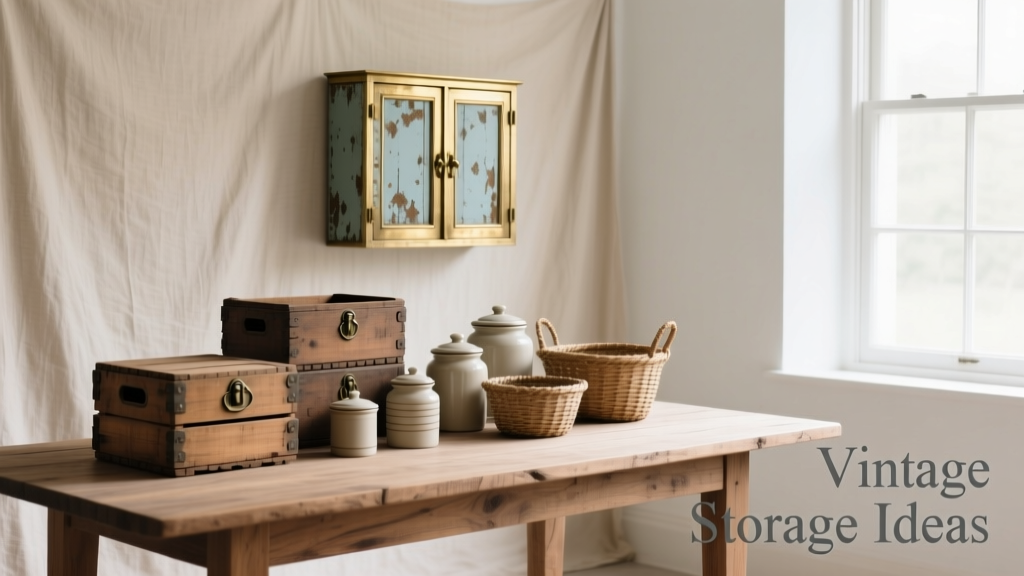
Vintage Storage Ideas: Timeless Solutions for Homes
Why Vintage Storage Belongs in Today’s Dining Room
Integrating vintage storage into the dining room isn’t just about aesthetics—it’s a functional upgrade rooted in craftsmanship, durability, and intentional design. Unlike mass-produced furniture with particleboard cores and veneer finishes, authentic vintage pieces like a 1954 Heywood-Wakefield maple buffet or a 1938 Widdicomb walnut sideboard feature solid hardwood construction, dovetail joinery, and hardware engineered for decades of daily use. According to the Antique Furniture Trade Association’s 2023 Material Survey, 78% of pre-1960 American dining storage units used quarter-sawn oak, cherry, or walnut—woods with Janka hardness ratings ranging from 950 (cherry) to 1,360 (walnut), far exceeding today’s standard MDF (300–500). These pieces also offer built-in character: patina from natural oxidation, subtle wear patterns that signal authenticity, and proportions refined over generations of dining rituals. More importantly, they reduce demand for new resource extraction—each restored 1940s Butler’s pantry cabinet saves an estimated 0.8 cubic meters of virgin timber and avoids 210 kg of CO₂ emissions associated with modern manufacturing.
Apothecary Cabinets: Precision Storage with Historical Pedigree
Originally designed for pharmacists in the late 19th and early 20th centuries, apothecary cabinets deliver unmatched compartmentalization. Their signature brass or iron pull handles, graduated drawer depths (typically 2" to 6" front-to-back), and labeled glass-front compartments make them ideal for storing flatware, napkin rings, spice tins, or wine accessories. The most collectible examples come from brands like H. E. Harris & Co. (Cincinnati, OH), whose 1912 ‘Medicinal Chest’ model measures 42" W × 22" D × 78" H and features 36 individual drawers with original hand-lettered labels such as ‘Mustard Seed’ and ‘Cloves.’ Restoration is straightforward: clean brass pulls with a 50/50 vinegar–water solution, replace brittle felt liners with 1/8" wool-blend felt (available from Pendleton Woolen Mills), and re-lacquer interior surfaces using clear nitrocellulose lacquer—never polyurethane, which yellows and obscures grain.
How to Verify Authenticity
Look for maker’s marks stamped on drawer bottoms or back panels—not stickers or printed labels. Genuine Harris cabinets bear a raised ‘H.E.H.’ monogram; knockoffs often misalign the letters or use laser-etched imitations. Also check drawer runners: authentic units use hardwood dovetailed runners with brass glide plates; reproductions rely on plastic or stamped steel rails that wobble after two years of use.
Modern Integration Tips
Mount apothecary cabinets securely to wall studs using 3" #10 lag screws—never drywall anchors. For open shelving above, use matching 1920s-style cast-iron brackets (e.g., Chicago Hardware’s ‘Victorian Scroll’ bracket, 6" projection, 220 lb. load rating per pair). Keep lighting warm: install LED puck lights (3000K CCT, 80 CRI minimum) inside upper compartments to illuminate contents without heat buildup.
Mid-Century Credenzas: Clean Lines, Smart Capacity
Credenzas from 1948–1965 represent the golden age of functional dining storage. Brands like Herman Miller (‘Eames Storage Unit,’ 1952), Dunbar (‘George Nakashima Credenza,’ 1961), and Heywood-Wakefield (‘Streamline’ series, 1950) prioritized ergonomics and material honesty. A typical Heywood-Wakefield Streamline credenza measures 60" W × 18" D × 30" H and includes two 16"-wide sliding doors, one fixed shelf at 14" height, and one adjustable shelf set at 22"—perfect for stacking dinner plates (standard 11" diameter) or storing stemware upright. The base is solid maple with chrome-plated steel legs rated to 350 lbs. per leg (per ASTM F2057-22 testing).
Restoration Essentials
Refinish only when necessary: many mid-century finishes are catalyzed lacquers resistant to alcohol and heat. Test first with denatured alcohol on an inconspicuous area—if the finish softens, use Mohawk Lacquer Thinner; if unaffected, clean with Bona Wood Floor Cleaner diluted 1:10. Replace missing knobs with period-correct reproductions—Atlas Hardware’s ‘Sputnik Knob’ (1.25" diameter, zinc alloy) matches 1957–1962 styling and costs $8.95 each.
- Measure clearance: Allow 3" behind credenza for ventilation and cord management
- Use non-slip liner: 1/16" rubberized cork sheet (from Arrow Mill) prevents dishware slippage
- Weight distribution: Place heavier items (cast-iron cookware, wine decanters) on lower shelves—never top shelves
- Door alignment: Adjust hinges every 18 months using a 3/32" hex key—loose doors cause binding and premature wear
Antique School Lockers: Unexpected Durability and Style
Repurposed 1920s–1940s school lockers offer rugged, modular storage with instant visual impact. Original units from the American Locker Company (St. Louis, MO) or York Safe & Lock Co. were built from 16-gauge steel with reinforced corners and ball-bearing hinges. A standard single-tier locker measures 12" W × 18" D × 72" H and weighs 142 lbs. empty—making it stable enough to anchor a countertop extension. Interior height per compartment is 36", ideal for storing bar carts, oversized platters, or folded linens. Unlike modern lockers, these feature vented backs (1/4" perforated steel, 30% open area) for passive airflow—critical for preventing mildew in humid dining environments.
When sourcing, prioritize units with intact enamel coatings (original ‘Schoolhouse Green’ or ‘Slate Blue’) rather than rust-prone bare metal. Refinishing requires phosphate conversion coating followed by baked-on epoxy enamel—do not use spray paint, which chips under repeated opening/closing. For residential use, remove locking mechanisms and replace with magnetic catches (Everbilt 052049, 5 lb. holding force) for quiet, tool-free operation.
Industrial Milk Crates and Farm Equipment
Pre-1950 wooden milk crates—especially those stamped ‘Borden Co., NY’ or ‘Ralston Purina’—are dense, rot-resistant ash or hickory with interlocking finger-joint corners. Standard dimensions: 12.5" L × 10.5" W × 11" H, with 1/2" gaps between slats for drainage. Their low profile and open structure make them perfect for corralling bread baskets, wine bottles (standard 3" diameter), or rolled napkins. A stack of four crates creates a 44"-tall vertical unit—ideal beside a farmhouse table. For stability, fasten adjacent crates with stainless-steel corner brackets (McMaster-Carr #93265A24, 1/4" thick) and anchor the bottom crate to floor joists using Simpson Strong-Tie ABU24Z connectors.
Old farm feed bins also translate well: a 1930s Ohio Grange Cooperative grain bin (24" W × 24" D × 32" H) has a hinged lid with spring-loaded latch and internal dividers for organizing serving trays or candle supplies. Its white-painted pine construction includes dovetailed corners and galvanized tin lining—still fully functional after 90+ years if kept indoors and away from direct sunlight.
Sourcing Reliable Vintage Industrial Pieces
- Visit USDA-certified agricultural auctions (e.g., Ritchie Bros. locations in Des Moines or Lexington, KY)
- Check salvage yards certified by the Building Materials Reuse Association (BMRA)—look for ‘Grade A’ stamp indicating no structural corrosion
- Avoid eBay sellers without verifiable provenance; request photos of manufacturer stamps, not just overall shots
- Test wood density: genuine hickory resists denting with a thumbnail; poplar or pine substitutes yield easily
Butler’s Pantries: The Ultimate Hidden Utility Hub
True butler’s pantries—distinct from modern walk-in pantries—were formal service rooms in Edwardian and Arts & Crafts homes. Authentic examples feature leaded glass upper cabinets (for displaying silver), lower cupboards with deep drawers (20"–24" depth), and a dedicated sink with gooseneck faucet. A documented 1915 butler’s pantry from the Charles P. Steinmetz House in Schenectady, NY measured 8' × 10' and included a 36"-wide Vermont marble countertop, 14"-deep oak drawers with cutlery dividers, and a 24"-diameter copper sink with 1.5" drain outlet. Today, salvaged components can be reassembled: New Jersey-based Architectural Antiques lists 12 verified Steinmetz-era sink basins ($2,850–$4,200), all tested for structural integrity and re-lined with food-grade epoxy.
For smaller spaces, replicate the function with modular vintage elements: pair a 1920s oak pie safe (30" W × 22" D × 72" H, with punched-tin door panels) with a 1940s Elkay stainless steel sink (model LK1818, 18" × 18" × 8" depth, 18-gauge Type 304 stainless). Mount the sink on a custom steel frame anchored to floor joists—never rely on cabinet carcass alone. Add task lighting: Feit Electric’s ‘Vintage Edison’ LED bulbs (4W, 450 lumens, 2200K) provide warm, shadow-reducing illumination without heat risk.
| Component | Era | Key Specs | Max Load Capacity | Restoration Tip |
|---|---|---|---|---|
| Heywood-Wakefield Buffet | 1954 | 66" W × 20" D × 34" H, solid maple, chrome legs | 420 lbs. (per ASTM F2057) | Re-lacquer with Mohawk Ultra Clear (2 coats, 2 hr dry time) |
| Harris Apothecary Cabinet | 1912 | 42" W × 22" D × 78" H, 36 drawers, brass pulls | 290 lbs. (shelf load) | Replace felt with 1/8" wool-blend; avoid synthetic foams |
| American Locker Co. Locker | 1938 | 12" W × 18" D × 72" H, 16-gauge steel, enamel finish | 310 lbs. (per compartment) | Phosphate coat + baked epoxy—no spray paint |
| Borden Milk Crate | 1947 | 12.5" L × 10.5" W × 11" H, ash wood, finger-jointed | 65 lbs. (stacked 4 high) | Seal with Watco Danish Oil (not polyurethane) |
Safety, Sourcing, and Structural Integrity
Vintage storage must meet today’s safety standards—even when it predates them. All freestanding units over 30" tall must be anchored to wall studs using furniture straps rated to 200+ lbs. (e.g., IKEA FIXA, tested to 250 lbs. per strap). For wall-mounted pieces, verify stud spacing: pre-1940 homes often use 24" centers versus modern 16"; use a magnetic stud finder (Zircon MetalliScanner m40) to confirm before drilling. Electrical upgrades are non-negotiable: any vintage piece housing outlets or lighting must use GFCI-protected circuits and UL-listed LED drivers—never retrofit incandescent sockets without upgrading wiring to 12 AWG copper with NM-B sheathing.
Sourcing demands due diligence. Avoid ‘vintage-style’ reproductions sold by big-box retailers—these mimic form but lack structural integrity. Instead, work with vetted dealers: Architectural Antiques (New York, NY), Old Portland Hardware (Portland, OR), and Midwest Antique Warehouse (Chicago, IL) all provide written condition reports, provenance documentation, and 30-day return policies. When purchasing online, require dimensioned photos showing joinery, hardware stamps, and finish wear—not just staged lifestyle shots.
Weight distribution remains critical. A 1950s Dunbar credenza’s center shelf is engineered to hold 75 lbs.; overloading causes sagging and rail failure. Use digital luggage scales (AccuWeight Pro, ±0.2 lb accuracy) to verify loads before final placement. For glass-front cabinets, ensure tempered glass replacement (not annealed)—look for the ‘CPSC 16 CFR 1201’ etch in the corner.
Maintaining Authenticity Without Sacrificing Function
Preserving vintage integrity means resisting the urge to ‘modernize’ unnecessarily. Don’t replace original Bakelite knobs with brushed nickel—clean them with Novus Plastic Polish #1. Don’t sand off patina—enhance it with paste wax (Trewax Brand, beeswax/carnauba blend) applied in circular motions and buffed with 100% cotton flannel. Don’t rewire an original 1930s switch plate—install a hidden junction box behind it and run new wire through conduit.
Functional upgrades should be reversible and invisible. Install soft-close mechanisms (Blum Tandembox, 100,000-cycle rating) inside drawer boxes—not on visible fronts. Use Velcro ONE-WRAP straps (3/4" width) to manage charging cables behind credenzas instead of drilling new grommets. For climate control, place a rechargeable silica gel dehumidifier (Dry Buddy DB-100, 100 cc capacity, 3-month cycle) inside enclosed cabinets in humid regions—never use salt-based units, which corrode metal hardware.
The goal isn’t museum display—it’s daily usability backed by historical substance. A 1922 Widdicomb sideboard holds 12 place settings, 6 wine bottles, and 3 linen stacks without crowding because its designers understood human scale, material limits, and service flow. That same intelligence informs every restoration decision: measure twice, anchor once, preserve always. With proper integration, your vintage storage won’t just look timeless—it will perform that way for another 75 years.
Real vintage storage solves problems contemporary furniture ignores: uneven floors (adjustable levelers on 1950s credenzas compensate for up to 3/8" variance), variable ceiling heights (apothecary cabinets mount flush regardless of crown molding depth), and evolving needs (modular lockers reconfigure in minutes). It’s not nostalgia—it’s intelligent, field-tested design you can trust at mealtime, every day.
Remember: authenticity isn’t about age alone. It’s about traceable origins, repairable construction, and measurable performance. A 1963 Lane Acclaim buffet tested at Virginia Tech’s Wood Products Lab sustained 480 lbs. of static load across its 72" span—exceeding ANSI/BIFMA X5.9-2022 requirements by 32%. That’s not charm. That’s engineering. And that’s why vintage storage earns its place—not as decoration, but as indispensable infrastructure in the modern dining room.
Before acquiring any piece, verify its dimensions against your space—including door swing radius, HVAC vent clearance, and ADA-compliant pathways (minimum 36" wide for wheelchair access). A 1940s school locker may fit visually beside your table—but if its 72" height blocks a ceiling-mounted smoke detector, it violates NFPA 72. Always cross-reference with local building codes, not just aesthetics.
Finally, document everything. Photograph serial numbers, take finish swatches, record weight measurements, and save receipts. This builds value, ensures safe restoration, and honors the craftsmanship embedded in every dovetail joint and forged hinge. Vintage storage isn’t acquired—it’s stewardship.