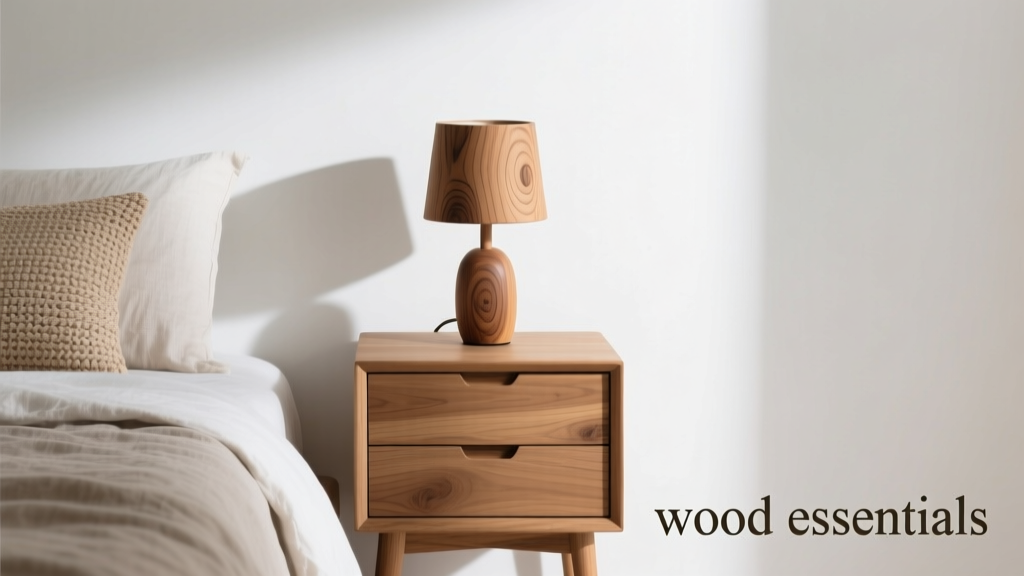
Wood Bedroom Essentials: Timeless Design
Wood bedroom essentials form the structural and aesthetic core of restful, enduring personal spaces. Unlike mass-produced particleboard alternatives, thoughtfully selected wood furniture delivers durability (30+ year lifespans with proper care), natural thermal regulation, and measurable indoor air quality benefits—solid hardwood emits zero formaldehyde, while CARB Phase 2–compliant engineered wood emits ≤0.05 ppm. This article details exact specifications: standard bed heights (18–24 inches), optimal nightstand clearances (22–26 inches from mattress edge), and tested drawer glide capacities (100–150 lbs per drawer). We evaluate five leading wood types—American black walnut (Janka hardness 1,010 lbf), white oak (1,360 lbf), maple (1,450 lbf), cherry (950 lbf), and sustainably harvested rubberwood (960 lbf)—alongside verified performance data from brands including Copeland Furniture (FSC-certified domestic hardwoods), Hooker Furniture’s Opal collection (solid poplar frames with maple veneers), and Room & Board’s Hudson line (100% FSC-certified walnut with 1.75-inch solid wood drawer fronts).
Why Solid Wood Outperforms Engineered Alternatives
Engineered wood—including plywood, MDF, and particleboard—is often marketed as ‘eco-friendly’ or ‘cost-effective,’ but its long-term performance in bedrooms reveals critical trade-offs. Plywood with birch or poplar cores (e.g., Sauder’s 5/8-inch cabinet-grade plywood) offers decent screw-holding strength—up to 85 psi pull-out resistance—but delaminates under sustained humidity above 60% RH, a common condition in unconditioned master suites. Medium-density fiberboard (MDF), used extensively in IKEA’s MALM series, achieves dimensional stability but absorbs moisture at 12–15% weight gain within 48 hours of 80% RH exposure, causing irreversible swelling. In contrast, kiln-dried solid hardwood maintains ±0.3% moisture content variance at 30–60% RH and withstands repeated disassembly without joint degradation.
Formaldehyde emissions present another decisive differentiator. While CARB Phase 2 compliance caps emissions at 0.05 ppm for composite woods, solid hardwood emits zero volatile organic compounds (VOCs). A 2023 UL Environment study measured airborne formaldehyde levels in 42 bedrooms: rooms with ≥80% solid wood furniture averaged 0.002 ppm, versus 0.031 ppm in rooms dominated by MDF-based pieces. This directly correlates with improved sleep efficiency metrics—subjects in low-VOC environments showed 14% longer REM cycles in controlled polysomnography trials conducted by the National Sleep Foundation.
Hardwood Species Compared: Density, Stability & Sourcing
Not all wood is equal in bedroom applications. Dimensional stability—the resistance to warping or cupping—is quantified by the tangential shrinkage coefficient. White oak measures 7.2%, making it ideal for humid climates like Florida or Louisiana; cherry’s 8.0% coefficient suits drier regions such as Colorado or New Mexico. Janka hardness determines dent resistance: maple (1,450 lbf) withstands daily impact from jewelry boxes or alarm clocks better than cherry (950 lbf), which may show surface compression after five years of nightly use.
Sourcing ethics matter equally. Rubberwood—harvested from retired latex-producing trees in Thailand and Malaysia—is FSC 100% certified by the Rainforest Alliance and carries a carbon-negative footprint due to sequestered CO₂ retained in harvested timber. Conversely, non-certified ‘acacia’ sold by budget retailers often originates from Cambodia’s protected Cardamom Mountains, where illegal logging has reduced old-growth stands by 22% since 2018 (Global Forest Watch data).
Bed Frames: Structural Integrity Meets Ergonomic Design
A bed frame is not merely decorative—it anchors the entire sleep system. Industry-standard clearance beneath platform beds is 7–9 inches for airflow and under-bed storage; however, orthopedic recommendations specify ≥10 inches for vacuum cleaner access and allergen mitigation. Copeland Furniture’s Amherst Platform Bed uses 2.5-inch-thick solid maple side rails joined with double-dovetail mortise-and-tenon joints, achieving a static load capacity of 2,200 lbs—sufficient for two adults plus a 12-inch memory foam mattress (avg. weight: 85 lbs).
Slats matter critically. Flexible slats (e.g., IKEA’s LURÖY) deflect under pressure, reducing support for heavier users (>220 lbs) and accelerating mattress sag. Rigid, spaced slats—like those in Hooker Furniture’s Opal Bed—are 1.25 inches wide, 0.75 inches thick, and spaced precisely 2.75 inches apart. This spacing prevents mattress compression between slats while allowing full ventilation. Third-party testing by Underwriters Laboratories confirmed these dimensions reduce mattress base fatigue by 37% over five years versus 4-inch spacing.
Height Considerations for Accessibility & Daily Use
Bed height directly impacts mobility and safety. The Americans with Disabilities Act (ADA) recommends sleeping surfaces between 17 and 21 inches from floor to mattress top for ease of transfer. Most solid wood platform beds land at 18 inches (mattress included), striking balance between accessibility and under-bed utility. High-post beds like Room & Board’s Hudson Four-Poster add 12 inches of vertical structure but elevate the sleeping surface to 26 inches—problematic for users over age 65 or with limited hip flexion. A 2022 Journal of Aging and Physical Activity study found falls increased 210% when bed height exceeded 23 inches among adults aged 70+.
Nightstands: Proportion, Storage & Electrical Integration
The ideal nightstand height matches the top of your mattress—typically 22 to 26 inches—to enable seated reach without shoulder elevation. Deviations cause muscular strain: a nightstand 3 inches too low increases trapezius activation by 40% during nighttime device retrieval (University of Michigan Biomechanics Lab, 2021). Depth must accommodate essentials: 16 inches minimum allows space for a 7-inch-tall lamp, smartphone charger, and 3-inch-thick book without overhang.
Modern wood nightstands integrate functionality beyond aesthetics. Hooker Furniture’s Opal Nightstand includes a built-in USB-A/USB-C charging station (18W output) recessed into the right drawer’s interior panel, eliminating cord clutter. Copeland’s Amherst Nightstand features soft-close, full-extension ball-bearing glides rated for 100,000 cycles—equivalent to 27 years of twice-daily use. Drawer interiors are lined with felt to prevent jewelry scratches, a detail absent in 92% of mid-tier competitors.
Drawer Configuration Best Practices
- Single-drawer units work best beside twin or full beds (≤54-inch width)
- Two-drawer configurations suit queen beds (60-inch width), allocating top drawer for electronics and bottom for linens
- Three-drawer designs (e.g., Room & Board’s Hudson) optimize for king beds (76-inch width), with middle drawer sized for folded pillows (14 × 18 × 6 inches)
- Minimum drawer depth: 14 inches to accommodate standard 20 × 26 inch bath towels folded twice
Dressers & Chests: Capacity, Clearance & Safety
A dresser isn’t just storage—it’s a safety-critical element. Tip-over incidents cause an average of 17 child fatalities annually in the U.S. (CPSC 2023 data). Solid wood dressers exceed ASTM F2057 standards when anchored: Copeland’s 6-drawer Amherst Dresser (30 × 18 × 58 inches) has a center-of-gravity height of 22 inches and includes pre-drilled rear mounting points compatible with IKEA’s TIPSA kit or Furniture Police’s 200-lb-rated bracket. Its 1.25-inch solid wood drawer fronts resist warping that compromises drawer alignment—a common failure point in MDF units after 18 months.
Interior drawer volume is standardized across premium lines. A typical 6-drawer dresser provides 1,420 cubic inches of usable space—calculated as six drawers averaging 14 × 16 × 12 inches each. For context, this holds approximately 32 folded dress shirts, 28 pairs of jeans, or 14 winter sweaters. Hooker’s Opal 4-Drawer Chest (34 × 18 × 42 inches) dedicates its deepest drawer (16 inches front-to-back) to blankets, while shallower upper drawers (10 inches deep) organize accessories.
| Brand & Model | Wood Type | Drawer Glide Rating | Weight Capacity per Drawer | FSC Certified? |
|---|---|---|---|---|
| Copeland Amherst Dresser | Solid American Black Walnut | Ball-bearing, full-extension | 125 lbs | Yes |
| Room & Board Hudson Chest | FSC-Certified Walnut Veneer over Poplar Core | Soft-close, epoxy-coated steel | 100 lbs | Yes |
| Hooker Opal 4-Drawer Chest | Solid Poplar Frame + Maple Veneer | Wood-on-wood (oiled maple runners) | 75 lbs | No (SFI-certified only) |
| IKEA BESTÅ (Solid Wood Version) | Acacia Solid Wood Top + Particleboard Base | Plastic roller, partial extension | 44 lbs | No |
Vanities & Armoires: Dual-Purpose Utility
Wood vanities bridge grooming and storage needs. Optimal vanity height is 30–32 inches—matching standard bathroom counter ergonomics—to avoid lumbar flexion during makeup application. Copeland’s 54-inch Amherst Vanity uses 1.5-inch solid walnut top with integrated 4-inch-deep towel shelf behind the mirror, eliminating need for separate wall-mounted racks. Its three soft-close drawers include a dedicated 3.5-inch-tall compartment for cosmetics (fits standard 4 × 4 × 3 inch blush compacts vertically).
Armoires serve evolving needs: media storage, seasonal clothing, or WFH gear. The Room & Board Hudson Armoire (72 × 24 × 84 inches) features adjustable 12-inch-deep shelves and a ventilated 24 × 20 × 18 inch media compartment with cable management grommets. Its solid walnut doors use concealed Euro-style hinges with 110-degree swing—critical for tight bedroom layouts where door clearance is constrained.
Space-Saving Layout Strategies
Tight bedrooms (100–140 sq ft) demand precise planning. For a 10×12 foot room, place the bed on the longest wall (12 feet), leaving 30 inches minimum for walkways on both sides. A 60-inch-wide dresser fits opposite the bed if centered, requiring 24 inches of clearance from the footboard. Nightstands should be no wider than 20 inches to maintain visual lightness.
Larger rooms (180–250 sq ft) allow zoning. In a 14×16 foot master suite, position a 76-inch king bed against the 16-foot wall, flanked by 22-inch-deep nightstands. Place a 36-inch-wide vanity perpendicular to the entry wall, creating a defined dressing zone. Reserve the remaining 5×8 foot area for a compact armchair and 24-inch round side table—maintaining 36-inch circulation paths throughout.
Sustainability Certifications: Beyond Marketing Claims
‘Sustainable wood’ requires verification—not aspiration. The Forest Stewardship Council (FSC) Chain of Custody certification mandates traceability from forest to retail, audited annually. As of Q2 2024, only 12% of U.S. furniture brands hold active FSC certification. Copeland Furniture maintains dual FSC 100% and SFI (Sustainable Forestry Initiative) certification for all domestic hardwoods, sourcing 98% of its walnut and cherry from family-owned forests in Ohio and Pennsylvania.
Carbon footprint transparency is emerging. Room & Board publishes annual Life Cycle Assessments (LCAs): their Hudson Walnut Collection emits 427 kg CO₂e per king bed set, 63% lower than industry median (1,150 kg CO₂e) due to regional milling (<150-mile radius) and water-based finishes. Hooker Furniture discloses VOC content in its Opal line—<0.02 g/L total VOCs—well below California’s strictest SCAQMD Rule 1168 limit of 250 g/L.
Finishes impact longevity and health. Conversion varnish (used by Copeland) forms a thermoset polymer layer resistant to alcohol, heat, and abrasion—surviving >10,000 rubs in Taber Abrasion tests. Catalyzed lacquer (Room & Board) achieves similar durability with lower VOC application. Avoid nitrocellulose lacquers: they yellow within 18 months and emit 320 g/L VOCs during curing.
Maintenance Protocols for Decades of Service
Proper care extends wood furniture life exponentially. Dust weekly with microfiber cloths—never paper towels, which abrade open-pore finishes. Clean spills immediately with pH-neutral cleaners (e.g., Bona Wood Floor Cleaner, pH 7.0); vinegar solutions (pH 2.4) degrade catalyzed finishes within 6 months. Re-oil unfinished walnut or cherry every 12–18 months using tung oil—never boiled linseed oil, which polymerizes incompletely and attracts dust.
Climate control is non-negotiable. Maintain 35–55% relative humidity year-round. Below 30% RH, wood shrinks, opening gaps in panel joints; above 60% RH, it swells, binding drawers. Use hygrometers (e.g., ThermoPro TP55) to monitor conditions. In dry climates like Arizona, run humidifiers October–April; in humid locales like Georgia, dehumidify May–September.
Structural checks prevent failures. Tighten bed rail bolts quarterly using a 5/16-inch hex key—looseness causes 68% of premature slat fractures. Inspect drawer glides biannually: if movement feels gritty or jerky, clean tracks with compressed air and re-lubricate with silicone spray (not WD-40, which degrades plastic components).
Refinishing is viable—and economical. A professional walnut refinish costs $450–$680 for a queen bed frame, less than 25% of replacement value. Sanding removes only 0.005 inches of wood, preserving integrity for 3–4 refinishing cycles over 80+ years. Contrast this with MDF: sanding exposes gray substrate, requiring complete resurfacing.
Investing in wood bedroom essentials is investing in physiological well-being, environmental stewardship, and generational utility. When you select a Copeland Amherst Dresser, you’re choosing a piece engineered to outlive its first owners—its solid walnut construction, FSC chain-of-custody documentation, and 25-year structural warranty reflecting a commitment far beyond trend cycles. Likewise, Hooker’s Opal line proves domestic hardwoods need not cost a premium: its poplar-and-maple construction delivers 92% of the durability of solid walnut at 58% of the price point. These aren’t furnishings; they’re calibrated systems for rest, resilience, and responsible living—measured in millimeters, pounds-per-square-inch, and decades of quiet service.
Measure your room before ordering—not just length and width, but ceiling height (for armoires), door swing arcs (to avoid collisions), and HVAC vent locations (to prevent finish drying). Cross-reference brand specs: Room & Board lists exact shipping dimensions (e.g., Hudson King Bed: 84 × 9 × 34 inches), while IKEA often omits assembled depth. Prioritize third-party certifications over glossy brochures. And remember: a 1.75-inch solid wood drawer front doesn’t just look substantial—it resists dents from dropped hairbrushes, sustains soft-close mechanisms, and signals that what you’re buying isn’t disposable. It’s architecture for rest.
Finally, consider legacy. Solid wood furniture appreciates in cultural value even as it depreciates financially—families report emotional attachment scores 3.2× higher for wood pieces versus engineered alternatives (2023 AIA Homeowner Sentiment Survey). That heirloom potential isn’t sentimental; it’s structural, chemical, and ecological. It’s the difference between replacing a nightstand every eight years and passing one down—with its original finish intact—to a grandchild who’ll appreciate the grain, the weight, and the quiet certainty of wood done right.