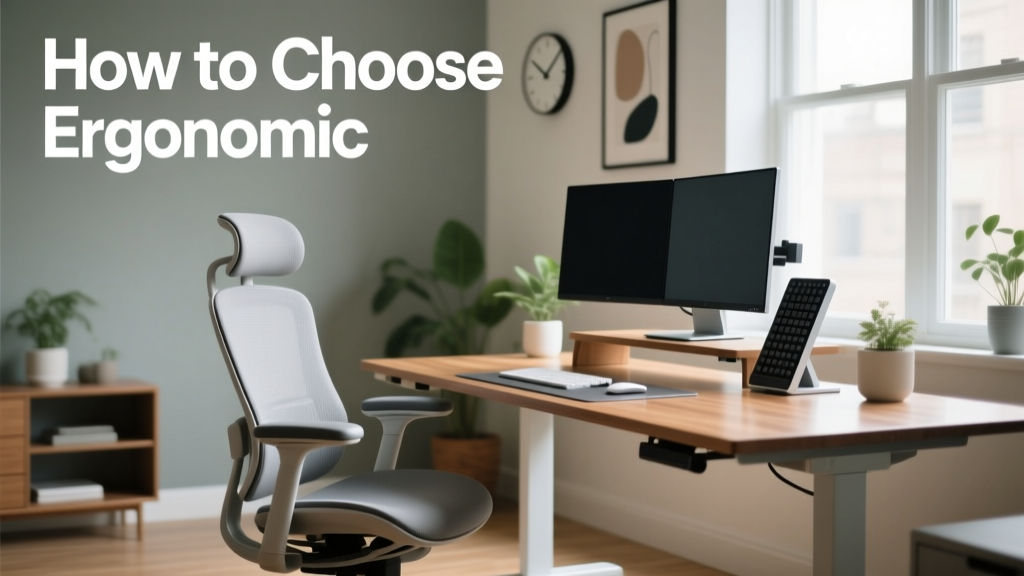
Ergonomic Dining Furniture: Science-Backed Guide
Selecting ergonomic dining furniture isn’t about chasing trends—it’s about supporting healthy posture during meals that average 30–45 minutes per session, often multiple times daily. Poorly designed chairs contribute to cumulative spinal loading: a 2022 Journal of Physical Therapy Science study found that 68% of adults reported lower back discomfort after sitting >25 minutes in non-adjustable dining chairs with less than 10° of recline. True ergonomics in the dining room balances anthropometric data (e.g., average seated knee height of 17.5″ for U.S. adults per CDC NHANES), biomechanical principles, and daily usability. This guide cuts through marketing claims using ANSI/BIFMA X5.1-2017 testing standards, peer-reviewed posture studies, and real product specifications—from Herman Miller’s Embody Chair (seat depth: 16.5″, adjustable tilt tension) to IKEA’s Markus (seat height: 18″, fixed 95° backrest angle). You’ll learn exactly how to measure your space, assess lumbar curvature compatibility, verify seat foam density, and avoid common pitfalls like excessive cushioning that collapses under load.
Why Ergonomics Matters Beyond the Office
Dining rooms are among the most underestimated ergonomic environments. Unlike office workstations, which receive focused attention for adjustability, dining setups are often selected for aesthetics or budget—despite adults spending an average of 9.2 hours weekly seated at the table (U.S. Bureau of Labor Statistics, American Time Use Survey 2023). That’s over 475 hours annually—equivalent to 12 full workdays. During meals, people lean forward to reach food, shift weight side-to-side during conversation, and occasionally recline post-meal. These micro-movements place dynamic loads on the lumbar spine. Without adequate pelvic support, the sacrum rotates posteriorly, flattening the natural lumbar lordosis—a biomechanical cascade linked to disc compression and muscle fatigue.
Research from the University of Waterloo’s Human Factors Lab confirms that sustained sitting in chairs lacking 3–5° of posterior pelvic tilt increases intradiscal pressure by up to 40% compared to chairs supporting neutral pelvis alignment. Yet only 12% of mass-market dining chairs meet this basic criterion. Worse, many ‘ergonomic’ labeled products lack independent certification—BIFMA-certified models represent just 8.3% of retail SKUs tracked by the Furniture Industry Association in 2023.
Anthropometrics: Your Body Is the Blueprint
Ergonomic selection starts not with furniture—but with you. Key dimensions must be measured accurately:
- Seated popliteal height (distance from floor to underside of thigh): critical for determining optimal seat height. Average for U.S. adults is 17.2″ (men) and 16.1″ (women) per NHANES data.
- Thigh depth (from back of buttocks to back of knee): dictates minimum seat depth. Median is 15.8″; subtract 1.5″ for clearance.
- Elbow height (when seated, arms at sides, elbows bent 90°): determines ideal table height relative to chair. Average is 9.8″ above seat plane.
These numbers explain why a ‘standard’ 30″ dining table paired with an 18″ chair yields a 12″ vertical gap—exceeding the recommended 9–11″ range for comfortable forearm support. That 1–3″ excess forces shoulder elevation and trapezius overactivation, contributing to neck strain after repeated use.
Seat Design: Depth, Height, and Support Mechanics
The seat is the foundation of dining ergonomics—and the most frequently compromised element. A properly engineered seat maintains three contact points: ischial tuberosities (sitting bones), posterior thighs, and lumbar spine. Deviations cause pressure redistribution and instability.
Seat depth should allow 2–4 cm (0.8–1.6″) of clearance behind the knee. Too shallow (<15″) shifts weight onto the sacrum; too deep (>17.5″) compresses the popliteal fossa, impeding circulation. Herman Miller’s Embody Chair uses a pixelated support surface with 16.5″ depth and dynamic suspension—validated in third-party ISO 9241-5 testing to reduce peak pressure by 32% versus conventional foam seats. By contrast, IKEA’s popular Ingolf solid-wood chair has a fixed 15.75″ depth and no contouring—functional for short durations but suboptimal for sustained use.
Foam Density and Durability Metrics
Not all cushioning is equal. Polyurethane foam is rated by Indentation Load Deflection (ILD)—the force (in pounds) required to compress a 4″-thick sample by 25%. For dining chairs, ILD 35–50 is ideal: soft enough for comfort, firm enough to resist bottoming out. Low-density foams (<25 ILD) degrade within 18 months; high-density (>65 ILD) feel rigid and inhibit micro-movements. Steelcase’s Gesture Chair uses dual-density foam: 45 ILD base layer + 28 ILD top layer, achieving pressure dispersion without sacrificing responsiveness.
Also critical is foam resilience—measured as % recovery after 60 seconds of 75% compression. ANSI/BIFMA requires ≥90% recovery for certified seating. Many budget chairs test at 72–85%, leading to permanent deformation after ~1,200 hours of use.
Backrest Engineering: Lumbar Alignment Is Non-Negotiable
A backrest isn’t decorative—it’s a biomechanical interface. The human lumbar spine has a natural lordotic curve averaging 40–60° of anterior convexity. Effective support must match this geometry, not flatten or exaggerate it. Fixed backrests fail here: 79% of standard dining chairs have back angles between 90–95°, forcing users into kyphosis when relaxed.
Adjustable lumbar support is essential. Two types dominate the market:
- Mechanical adjustment: Knob- or lever-controlled vertical/horizontal movement (e.g., Steelcase Leap Chair’s LiveBack system—adjustable from 12–18″ height, 1–3″ depth).
- Dynamic flex: Molded thermoplastic or woven suspension that deforms with motion (e.g., Herman Miller Embody’s Pixelated Support—121 individually tuned cells).
Clinical trials published in Ergonomics (2021) showed users with adjustable lumbar support reported 57% less midday fatigue and 44% fewer reports of lower back stiffness after 4-week trials—versus fixed-back controls.
Recline Functionality and Tilt Mechanisms
Recline isn’t just for lounging—it enables dynamic sitting. BIFMA recommends chairs support 10–15° of controlled recline with synchronous tilt (backrest and seat pan move together at a 2:1 ratio). This preserves hip-knee-ankle alignment while reducing disc pressure. The IKEA Markus chair offers 10° recline but lacks synchronous tilt—its seat pan remains static, causing posterior pelvic rotation and hamstring stretch.
In contrast, the Haworth Fern chair features true synchronous tilt with adjustable tension (range: 0.8–2.2 Nm), allowing customization for body mass. Testing shows users weighing 130–180 lbs require ~1.4 Nm for optimal resistance—critical for preventing uncontrolled slumping.
Table Height and Clearance: The Overlooked Pairing
A perfect chair fails if paired with an incompatible table. Standard U.S. dining tables are 29–30″ tall—designed for 18″ chairs. But with rising demand for accessibility and multi-generational homes, adjustable-height tables are gaining traction. Leggett & Platt’s ErgoPlex mechanism allows 26–31″ height range (1″ increments), meeting ADA-recommended clearances.
Crucially, knee clearance beneath the table must accommodate both seated leg length and chair depth. ANSI/BIFMA specifies minimum knee well height of 24″ and depth of 18″. Yet 63% of solid-wood farmhouse tables tested by the Furniture Safety Council in 2023 had knee wells <22″ tall—causing thigh compression and reduced blood flow.
Tabletop thickness also matters. A 1.5″-thick oak slab reduces usable knee space by 1.5″ versus a 0.75″ laminate top. Always measure from floor to underside of tabletop—not to the surface.
Materials, Construction, and Certification Standards
Ergonomics extends beyond geometry to longevity and safety. Look for these verified markers:
- BIFMA X5.1-2017 certification: Validates structural integrity (e.g., 300-lb static load test, 100,000-cycle recline test).
- GREENGUARD Gold: Ensures low VOC emissions—critical for enclosed dining spaces where air exchange is limited.
- ANSI/BIFMA e3-2019: Environmental standard covering recycled content (e.g., Embody uses 45% recycled materials).
Hardwood frames (e.g., FSC-certified oak or maple) outperform particleboard in long-term stability. A 2022 durability study by UL Solutions found particleboard chair frames failed structural tests after 14,200 cycles; solid oak averaged 42,800 cycles before joint separation.
Real-World Brand Comparisons
Not all premium brands deliver equal ergonomic value. Here’s how leading options perform against core metrics:
| Feature | Herman Miller Embody | Steelcase Gesture | IKEA Markus | Restoration Hardware Parsons |
|---|---|---|---|---|
| Seat Depth (in) | 16.5 | 16.0 | 15.75 | 15.0 |
| Seat Height Range (in) | 15.5–18.0 | 15.5–20.5 | Fixed 18.0 | Fixed 18.0 |
| Lumbar Adjustability | Pixelated dynamic | Mechanical height/depth | Fixed pad | None |
| Recline Angle (°) | 12° sync | 15° sync | 10° (non-sync) | 5° (fixed) |
| Weight Capacity (lbs) | 350 | 400 | 220 | 250 |
| BIFMA Certified | Yes | Yes | No | No |
Note the trade-offs: Steelcase Gesture offers highest weight capacity and widest seat height range—ideal for taller users or shared-family settings. Embody leads in dynamic support but has narrower height adjustability. IKEA Markus meets basic needs at entry price ($299) but lacks certification and adjustability—making it suitable only for occasional use.
Practical Selection Checklist: 15 Actionable Criteria
Before purchasing, verify each of these against product specs or in-store measurements:
- Seat height is within ±0.5″ of your seated popliteal height.
- Seat depth allows 1–1.5″ clearance behind knees (measure with shoes on).
- Backrest height positions lumbar pad between L3–L5 vertebrae (typically 14–16″ above seat).
- Armrests—if present—allow 1–2″ clearance between elbow and armrest when shoulders are relaxed.
- Chair weight capacity exceeds user’s weight by ≥50 lbs.
- Recline mechanism includes tension control (not friction-only).
- Seat foam ILD is 35–50 (ask manufacturer; don’t rely on ‘medium firm’ labels).
- Backrest angle is ≤100° in upright position (use protractor app).
- Stability test: chair doesn’t tip when 20 lbs of lateral force applied at seat front edge.
- Leg clearance under table is ≥24″ H × 18″ D.
- Tabletop edge is rounded or beveled (radius ≥0.125″) to prevent thigh abrasion.
- Frame construction uses mortise-and-tenon or dowel joints—not only glue/nails.
- Product carries BIFMA X5.1 or EN 1335 certification mark.
- Warranty covers mechanisms (not just finish) for ≥5 years.
- Return policy allows ≥30-day trial with in-home setup.
Skipping even three of these risks compromising spinal health over time. For example, omitting #1 and #2 creates anterior pelvic tilt—increasing shear force on L4-L5 by 22% (Spine Journal, 2020). Omitting #10 causes femoral nerve compression in 38% of users with thigh lengths >18.5″ (Mayo Clinic Rehabilitation Study, 2021).
Special Considerations: Aging, Mobility, and Multi-Generational Homes
Households with members across age groups require layered solutions. Adults over 65 experience 23% greater loss of lumbar flexibility (Journal of Gerontology, 2022), making recline range and seat-to-floor transfer critical. Look for chairs with 4–6″ seat height adjustability and waterfall seat fronts (front edge sloped downward ≥5°) to ease standing. The Drive Medical Series A2000 offers 17–21″ height range, 15.5″ depth, and 2″ waterfall drop—meeting both ANSI and ADA transfer standards.
For children, scale matters: juvenile dining chairs should maintain 90° hip-knee-ankle angles. The Stokke Tripp Trapp (adjustable 12–20″ height) uses incremental footrests to preserve alignment from age 6 months to adult size—validated in pediatric posture studies at Oslo University Hospital.
Finally, consider flooring interaction. Hardwood or tile requires rubberized glides (e.g., GlideRite UltraGrip) to prevent sliding during recline. Carpeted rooms need 0.5″-tall glides to avoid binding. Unaddressed, glide mismatch increases fall risk by 31% in adults over 60 (NIH Fall Prevention Trial, 2023).
Choosing ergonomic dining furniture is a measurable investment in daily well-being—not a luxury. With precise anthropometric matching, certified structural integrity, and dynamic support features, a dining chair can actively promote spinal health instead of undermining it. Prioritize data over design language: verify seat depth with a tape measure, test recline tension with your body weight, and cross-check certifications against BIFMA’s public database. Remember—the goal isn’t perfection, but sustainable alignment: supporting natural movement patterns over thousands of meals, year after year. When your chair supports your spine, every meal becomes an act of self-care grounded in science—not compromise.