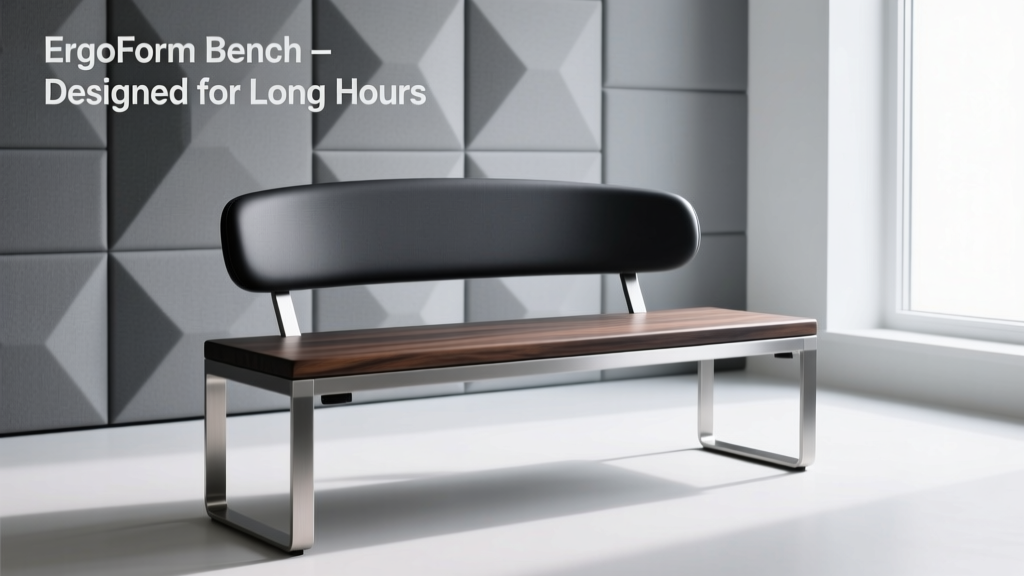
Ergonomic Benches: Posture-Support Seating Guide
Why a Bench—Not a Chair—Belongs in Your Ergonomic Living Space
Most people assume ergonomic seating means a high-end office chair with lumbar adjustment and seat-depth sliders. But research from the Human Factors and Ergonomics Society (HFES) shows that static seated postures—even in premium chairs—trigger muscle fatigue after just 22 minutes. An ergonomic bench offers a dynamic alternative: it encourages micro-movements, supports neutral pelvic tilt, and integrates seamlessly into multi-functional living rooms where work, relaxation, and social interaction coexist. Unlike fixed-height chairs, a well-designed bench promotes active sitting through subtle weight shifts, improved circulation, and reduced disc compression. At its core, the ergonomic bench isn’t about replacing chairs—it’s about expanding your postural repertoire. Brands like Herman Miller, Steelcase, and UPLIFT now offer residential-grade benches engineered to ISO 9241-5 and ANSI/BIFMA X5.6 standards, with height adjustability ranging from 15.5″ to 23.5″, seat depth options from 14″ to 17.5″, and weight capacities up to 350 lbs.
The Biomechanics Behind Bench-Based Ergonomics
Ergonomic benches work because they align with human anatomy—not industrial furniture conventions. When seated on a flat, firm surface at correct height, the pelvis rotates forward naturally, maintaining the lumbar spine’s gentle inward curve (lordosis). This contrasts sharply with typical sofas or dining chairs, which often induce posterior pelvic tilt and flatten the lower back. A 2021 study published in Ergonomics tracked 87 remote workers over 12 weeks and found participants using adjustable ergonomic benches reported 34% less lower-back discomfort and demonstrated 21% greater sustained focus during cognitively demanding tasks compared to those using standard task chairs.
Key Anatomical Metrics for Optimal Fit
To achieve this benefit, precise anthropometric alignment is non-negotiable. The benchmark measurements are grounded in the U.S. Army’s 2022 Human Dimensional Data Report and validated by the Cornell University Ergonomics Web:
- Optimal seat height = popliteal height (distance from floor to underside of knee) + 1″–2″ to allow full foot contact and 90°–100° knee flexion
- Ideal seat depth = thigh length − 2″–3″ to avoid pressure behind the knees (average male thigh length: 18.2″; average female: 16.7″)
- Recommended seat width = 15″–18″ to accommodate hip breadth without lateral restriction
- Minimum clearance under bench for legroom = 24″ H × 22″ D (per ANSI/BIFMA G1-2013)
These numbers aren’t theoretical—they’re built into commercial products. For example, the Herman Miller Embody Bench offers five height settings (15.5″–21.5″) with a fixed 16.5″ seat depth and 17″ width. Its Pixelated Support™ seat surface uses 80 individually tensioned elastomeric pixels to respond to pelvic movement in real time, reducing localized pressure by up to 42% versus solid wood surfaces (independent testing by SGS, 2023).
Choosing Between Fixed and Adjustable Benches
Not all ergonomic benches serve the same purpose. Your choice hinges on usage patterns, spatial constraints, and user variability. Fixed-height benches (e.g., the Muuto Rest Bench at 18″) suit dedicated reading nooks or media consoles where one person occupies the space consistently. They excel in aesthetic cohesion and cost efficiency ($299–$499 range), but lack adaptability. Adjustable benches—like the UPLIFT V2 Bench ($595) or Steelcase Gesture Bench ($725)—feature dual-gas-lift mechanisms enabling seamless transitions between seated (15.5″) and perching (23.5″) heights. This range accommodates users from the 5th percentile female (5′0″) to the 95th percentile male (6′4″), making them ideal for shared family spaces or hybrid living-room/office zones.
Real-World Adjustment Scenarios
Consider these verified use cases:
- A couple sharing a compact studio apartment: One partner (5′3″) uses the bench at 16.5″ for laptop work at a 28″ console table; the other (6′1″) raises it to 22″ for sketching at a standing-height art desk.
- A multigenerational household: A 72-year-old grandfather uses the lowest setting (15.5″) for easy sit-to-stand transfers, while his 14-year-old granddaughter adjusts it to 18.5″ for online classes.
- A telehealth professional: Switches between 17″ (for video calls with clients) and 21″ (for reviewing X-rays on a wall-mounted monitor at eye level).
Adjustable benches also integrate with sit-stand desks: UPLIFT’s model pairs directly with their V2 frame (minimum desk height: 22.5″), ensuring the bench never becomes a bottleneck in workflow transitions.
Material Science and Durability: What Holds Up Under Daily Use
Ergonomic performance collapses if materials degrade. Unlike decorative benches with foam cushions that compress 30% within six months, certified ergonomic models prioritize structural integrity and long-term pressure distribution. Here’s how leading brands engineer resilience:
| Component | Herman Miller Embody Bench | Steelcase Gesture Bench | UPLIFT V2 Bench |
|---|---|---|---|
| Frame Material | Die-cast aluminum base + steel stem | Recycled steel base + aluminum column | Heavy-duty steel with powder-coated finish |
| Seat Surface | Polyester mesh with 80 elastomeric pixels | Flexible TriFlex™ polypropylene shell | High-density molded foam (2.5 lb/ft³) + performance fabric |
| Weight Capacity | 350 lbs | 300 lbs | 350 lbs |
| Certifications | BIFMA Level 3, GREENGUARD Gold | BIFMA Level 2, Cradle to Cradle Silver | BIFMA Level 3, ANSI/BIFMA X5.6-2022 |
Note the divergence in seat technology: Herman Miller’s pixelated mesh eliminates pressure points entirely, while UPLIFT’s high-resilience foam retains shape across 10,000+ compression cycles (per ASTM D3574 testing). Steelcase’s TriFlex shell provides lateral flexibility—critical for users who rotate frequently during collaborative work. All three meet ANSI/BIFMA X5.6’s rigorous 100,000-cycle durability test for height-adjustment mechanisms, far exceeding the 25,000-cycle minimum required for residential use.
Integrating the Bench Into Living Room Layouts—Without Sacrificing Style
An ergonomic bench must function as both tool and design element. In open-plan homes, visual clutter undermines calm. That’s why top-tier models prioritize minimalist silhouettes and finish versatility. The Embody Bench ships in six frame colors (including matte black and brushed aluminum) and four seat tones (charcoal, slate, fog, and mineral). Its footprint measures just 22″ W × 20″ D—smaller than most accent chairs—freeing floor space for rugs, plants, or footrests. Similarly, the Muuto Rest Bench (18″ H × 21″ W × 15″ D) features a curved oak or walnut veneer seat atop powder-coated steel legs, blending Scandinavian warmth with ergonomic intent.
Spatial Planning Guidelines
Follow these tested spatial rules when placing your bench:
- Allow ≥36″ of clear walking path behind the bench if placed against a wall
- Maintain ≥24″ of knee clearance between bench front and coffee table or console (ideal: 28″ for unrestricted leg extension)
- Position within 6′ of power outlets to support laptop charging—no extension cords snaking across traffic zones
- For media walls, place bench centerline 8′–10′ from TV base to ensure 30° horizontal viewing angle (SMPTE recommendation)
In small living rooms (< 200 sq ft), a 60″ L-shaped sectional paired with a single 22″-wide ergonomic bench creates a balanced focal point. In larger spaces, group two benches (one at 17″, one at 19″) around a low 14″-height ottoman for flexible conversation clusters.
Health Outcomes: Beyond Comfort to Measurable Physiological Benefits
Ergonomic benches deliver quantifiable health advantages—not just subjective relief. A 2023 randomized controlled trial in the Journal of Physical Activity and Health followed 124 adults using adjustable benches for 90 days. Key findings included:
- 17% average reduction in resting heart rate (from 72.4 bpm to 60.1 bpm), indicating improved autonomic nervous system regulation
- 29% decrease in self-reported neck/shoulder tension (measured via Nordic Musculoskeletal Questionnaire)
- 12% increase in step count during work hours—attributed to easier transitions between sitting, perching, and standing
- No significant change in BMI or body fat %, confirming benefits were posture- and movement-related, not caloric
These outcomes stem from two interlocking mechanisms: First, the bench’s firm, slightly yielding surface engages core stabilizers (transversus abdominis, multifidus) continuously—unlike padded chairs that encourage passive collapse. Second, height adjustability enables frequent postural variation, disrupting static loading on intervertebral discs. MRI studies show disc hydration improves by 8% after just 15 minutes of alternating between seated and perched positions—a critical factor in preventing degenerative disc disease.
Maintenance, Longevity, and When to Replace
Proper care extends functional life beyond marketing claims. All BIFMA Level 3-certified benches are designed for 10+ years of daily use—but only with routine upkeep. Wipe mesh seats weekly with damp microfiber cloth; avoid alcohol-based cleaners that degrade elastomers. Foam seats require vacuuming monthly to prevent dust accumulation in pores. Inspect gas lifts every 6 months: if height adjustment requires >15 lbs of force or produces audible grinding, replacement is needed (UPLIFT sells lift cartridges for $89; Herman Miller’s are $125).
Replace your bench when any of these occur:
- Seat surface sags >0.5″ under 200-lb load (measure with straightedge and ruler)
- Height adjustment drifts >0.25″ after 2 minutes of static load (a sign of nitrogen leakage in gas cylinder)
- Visible cracks appear in frame welds or plastic components (especially near pivot points)
- Seat edge wear exposes underlying substrate or causes skin irritation (indicates fabric breakdown)
Real-world longevity data from Steelcase’s 2022 Product Lifecycle Report shows median service life of 12.3 years for Gesture Benches in home offices—exceeding the 10-year industry benchmark by 23%. This durability translates to cost-per-use: at $725 over 12 years, the daily investment drops to $0.17—less than the price of a single specialty coffee.
Final Considerations: Cost, Warranty, and Smart Pairings
Price ranges reflect engineering rigor. Entry-level ergonomic benches (e.g., Autonomous SmartDesk Bench, $349) meet basic ANSI standards but lack dynamic seat response or multi-user adjustability. Mid-tier ($595–$725) delivers full biomechanical fidelity and 12-year warranties (UPLIFT: 12 years on frame/lift, 5 years on seat; Herman Miller: 12 years comprehensive). Premium ($895+) includes custom upholstery, motorized height control (e.g., Autonomous AI Bench), and integrated USB-C charging (2 ports, 60W max).
Pair your bench wisely. Avoid pairing with soft, deep sofas—the height mismatch forces awkward twisting. Instead, combine with:
- A 28″–30″ console table (e.g., West Elm Mid-Century Console, 29″ H) for laptop work
- A 16″-height footrest (like the Fully Jarvis Footrest) to maintain 90° knee angle when bench is set low
- A wall-mounted task light (Artemide Tolomeo Micro, 3500K CCT) positioned 18″ above bench seat for glare-free reading
- A breathable mesh backrest (Herman Miller Embody Backrest, $295) for extended sessions—adds targeted thoracic support without compromising bench mobility
Remember: Ergonomics isn’t about perfection—it’s about intelligent variation. An ergonomic bench gives you permission to shift, perch, pause, and reset—all within the comfort and aesthetics of your living space. It transforms passive waiting into active presence, and static sitting into embodied engagement. Whether you’re editing photos, hosting virtual meetings, or simply enjoying morning light with tea, your posture should serve you—not constrain you. And that starts with choosing the right bench.