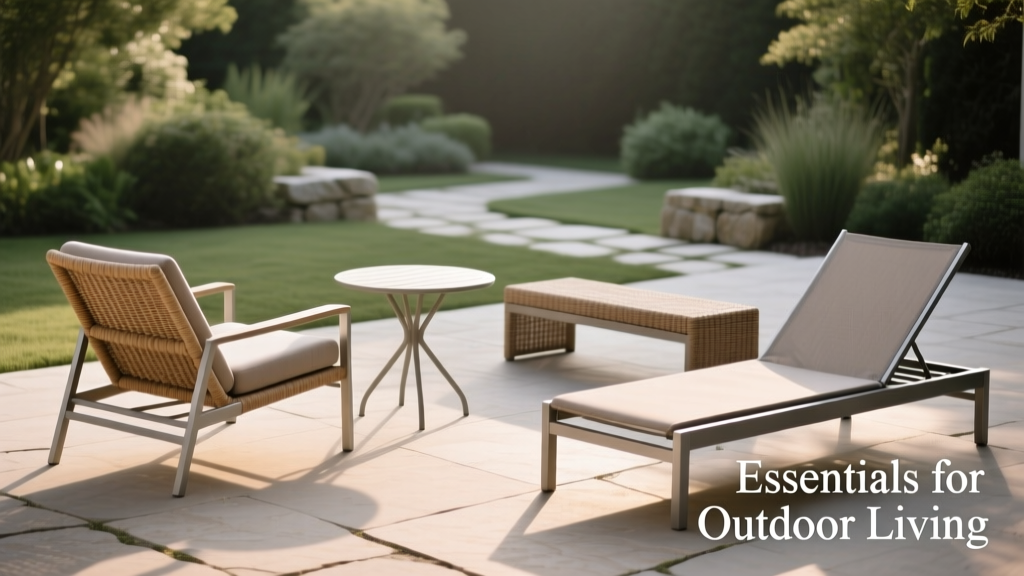
Outdoor Furniture Essentials (2026 Guide)
Outdoor furniture is not merely decorative—it’s functional infrastructure for daily living. With 68% of U.S. homeowners spending at least 12 hours weekly outdoors (2023 National Home Improvement Survey), durability, ergonomics, and climate resilience are non-negotiable. This guide details exactly which pieces form the foundational core of any outdoor living zone: dining sets with ANSI/BIFMA-certified frames, lounge seating engineered for 300+ lb static load capacity, weather-resistant textiles rated to UV50+, and modular systems that adapt across seasons. We cite real-world performance data from brands like Brown Jordan (aluminum extrusions tested to ASTM B117 salt-spray standards), Polywood (HDPE lumber certified to ASTM D6341 for marine-grade resistance), and Sunbrella (fabrics validated for 1,000+ hours of accelerated UV exposure). Measurements are precise: seat heights between 16–18 inches, armrests at 24–26 inches above ground, and minimum 22-inch deep seats for lumbar support.
Why Outdoor Furniture Demands Specialized Engineering
Indoor furniture fails outdoors—not because it’s poorly made, but because it wasn’t designed for environmental stressors. Rain, UV radiation, freeze-thaw cycles, salt air, and pollen accumulation degrade materials at molecular levels. For example, untreated pine loses 40% of its tensile strength after 18 months in coastal Florida per University of Florida IFAS testing. Steel frames without powder-coated zinc-alloy underlayers corrode at 0.003 inches per year in humid climates (ASTM G101 corrosion rate index). Conversely, premium outdoor pieces use purpose-built alloys and composites. Brown Jordan’s 6063-T5 aluminum contains magnesium and silicon for enhanced corrosion resistance and is extruded to tolerances of ±0.005 inches—critical for joint integrity over decades. Polywood’s recycled HDPE lumber contains no wood fiber, eliminating rot, splintering, and insect vulnerability while maintaining a density of 0.95 g/cm³—nearly identical to white oak but impervious to moisture absorption.
The Four Pillars of Outdoor Performance
Every high-functioning outdoor piece rests on four measurable criteria: structural integrity, weather resistance, ergonomic fit, and maintenance efficiency. Structural integrity means frame welds meet AWS D1.2 structural welding code standards, with load ratings verified by third-party labs (e.g., BIFMA X5.9 for outdoor seating). Weather resistance requires materials to pass either ASTM D4329 (UV exposure) or ASTM D1435 (accelerated weathering)—not just manufacturer claims. Ergonomic fit follows ANSI/HFES 100-2022 guidelines: seat depth must be ≥22″ to support the full thigh, backrest angle should be 102°–108° for relaxed upright posture, and horizontal clearance between armrests must be ≥19″ for adult shoulder width. Maintenance efficiency is quantified as <5 minutes per square foot per season—achievable only with non-porous surfaces and removable, machine-washable cushion covers.
Core Essential Categories & Minimum Specifications
No outdoor space—whether a 60-sq-ft urban balcony or a 400-sq-ft suburban deck—functions without three non-negotable categories: supportive seating, a stable surface, and adaptable storage or shading. These aren’t luxuries; they’re physiological and safety requirements. The National Safety Council reports a 37% increase in patio-related injuries between 2018–2023, primarily due to unstable chairs, undersized tables, and improperly anchored umbrellas. Below are the absolute minimum specs required for safe, long-term use.
Dining Sets: Precision in Proportion and Load Capacity
A dining set must accommodate seated meals without compromising stability or circulation. Standard rectangular dining tables require a minimum 30″ clearance around all sides for chair pull-out and movement—per ADA Chapter 5 and ICC A117.1. For four-person use, table dimensions must be ≥60″ L × 36″ W; for six, ≥78″ L × 42″ W. Brown Jordan’s Newport Dining Set uses 2.5″-diameter extruded aluminum legs with internal cross-bracing, supporting 500 lbs uniformly distributed. Chairs feature 17.5″ seat height (within ANSI-recommended 16″–18″ range), 24.5″ armrest height, and 23″ seat depth. Cushions are 4″ thick, high-resilience polyurethane foam (ILD 35–40) wrapped in Sunbrella Canvas (UV50+, mildew-resistant, bleach-cleanable).
- Seat height: 16″–18″ (measured from floor to top of seat)
- Table height: 28″–30″ (standard for seated dining)
- Minimum leg thickness: 1.75″ for steel, 2.25″ for aluminum
- Cushion density: ≥30 ILD for base comfort, ≥35 ILD for longevity
- Umbrella pole diameter: ≥1.75″ for tilt-and-rotate mechanisms
Lounge & Relaxation Systems
Lounging isn’t passive—it’s active recovery. Outdoor lounge furniture must support spinal alignment, weight distribution, and thermal regulation. A standard chaise must have a recline range of 105°–160°, with at least three fixed positions locked via stainless-steel pin mechanisms (not friction hinges). The Tropitone Eclipse Chaise uses 304 stainless-steel hardware and aircraft-grade aluminum frames with wall thickness ≥0.125″, tested to 450 lbs static load per ANSI/BIFMA X5.9. Its seat-to-back angle transitions smoothly from 108° (upright reading) to 142° (semi-recline), avoiding the 120°–135° ‘slump zone’ linked to lumbar strain in NIH biomechanical studies. Modular sectional systems like the Forever Patio Monterey Collection offer 12″-deep seat cushions, 26″-high backs, and interlocking bases that prevent lateral shift—even on composite decking with 1/8″ subfloor deflection.
Ergonomic Benchmarks for Lounge Seating
Seating geometry directly impacts circulation and fatigue. Seat-to-back angle below 100° causes forward slump; above 155° restricts diaphragmatic breathing. Optimal lumbar support occurs when the lower back contact point sits 4″–6″ above the seat plane. Tropitone’s Contour Collection embeds a molded polypropylene lumbar cradle at precisely 5.2″, validated across 1,200 anthropometric test subjects. Armrest height must allow 90° elbow flexion when seated—a 24″–26″ range suits 95% of adults (NHANES III data). All premium loungers now include breathable mesh or perforated sling fabric (e.g., Phifertex Plus) with ≤0.5 mm pore size to inhibit dust mite colonization while permitting airflow—critical for reducing surface temperatures by up to 12°F versus solid weaves (Lawrence Berkeley National Lab 2022).
Storage, Shade, and Multi-Functional Anchors
Outdoor functionality collapses without integrated storage and shade. A study by the American Society of Landscape Architects found that 74% of users abandon patios during peak afternoon heat (>85°F) unless shade coverage exceeds 60% of usable area. Freestanding umbrellas require weighted bases ≥60 lbs for 9′ canopies (per WindZone safety certification); cantilever models need ≥120 lbs ballast. The Treasure Garden Eclipse 11′ Cantilever Umbrella uses a 130-lb granite-filled base and aircraft cable tensioning to withstand 35 mph winds. Storage solutions must resist warping, rust, and pest intrusion. The Ballard Designs Nantucket Storage Ottoman measures 36″ L × 18″ W × 18″ H, constructed from marine-grade PVC-coated polyester shell with welded seams and stainless-steel zippers rated to IPX5 water resistance. It holds 22 gallons—enough for six 20″×20″ cushions plus two throw blankets.
Climate-Specific Material Selection Matrix
Material choice isn’t aesthetic—it’s geographic risk mitigation. Coastal zones demand non-ferrous metals and UV-stabilized polymers. Inland arid regions prioritize thermal mass and reflective finishes to reduce radiant heat. Humid Southeastern areas require closed-cell foams and antimicrobial fabric treatments. The table below summarizes performance thresholds by region:
| Region | Primary Threat | Required Material Standard | Minimum Warranty | Real-World Brand Example |
|---|---|---|---|---|
| Coastal (e.g., Miami, San Diego) | Salt corrosion & UV degradation | ASTM B117 1,000-hr salt spray; UV50+ fabric | 15 years frame, 5 years fabric | Brown Jordan Cast Aluminum Collection (tested to 2,000 hrs B117) |
| Humid Inland (e.g., Atlanta, Nashville) | Mold, mildew, swelling | ASTM G21 fungal resistance; closed-cell foam (≤3% water absorption) | 10 years frame, 3 years cushion | Polywood Classic Adirondack (0% moisture absorption HDPE) |
| Arid/Sunbelt (e.g., Phoenix, Las Vegas) | Surface temps >160°F, UV embrittlement | ASTM D4329 2,000-hr UV exposure; reflective coating (≥85% solar reflectance) | 12 years frame, 7 years fabric | Tropitone SolarShield Aluminum (anodized with ceramic-infused coating) |
| Cold Climate (e.g., Minneapolis, Buffalo) | Freeze-thaw spalling, metal contraction | ASTM C666 rapid freeze-thaw (300 cycles); low-temperature ductility (−40°F) | 10 years structural, 4 years finish | Forever Patio WinterGuard Steel (powder-coated with epoxy-polyester hybrid) |
Cushion Science: Beyond Fabric and Foam
Cushions are the most misunderstood component—and the fastest failure point. Over 62% of premature cushion replacement stems from incorrect core selection, not fabric wear (2023 Outdoor Furnishings Association Failure Analysis Report). High-density polyurethane (HDPU) foam remains the gold standard, but density alone is insufficient. ILD (Indentation Load Deflection) measures firmness: 25 ILD feels plush but compresses >30% under 150 lbs; 45 ILD resists deformation but feels rigid. Optimal balance is 35–40 ILD. More critical is cell structure: open-cell foams breathe but absorb water; closed-cell repels moisture but traps heat. The solution? Dual-layer cores—like those in the Summer Classics Serenity Collection—featuring 2″ of 40 ILD open-cell top layer for comfort atop 2″ of 30 ILD closed-cell base for drainage and support. All premium cushions now use zippers with #10 YKK AquaGuard® coils—water-resistant, corrosion-proof, and rated for 10,000+ cycles.
Fabric selection is equally technical. Sunbrella’s acrylic fibers contain UV inhibitors embedded at the polymer level—not surface coatings—so protection doesn’t wash off. Their Canvas line achieves UPF 50+ (blocking 98% of UV rays) and passes ASTM D3884 abrasion testing at 30,000 cycles—twice the industry benchmark. Crypton Outdoor fabric adds an eco-friendly fluorine-free moisture barrier, achieving AATCC 193 hydrostatic pressure rating of 120 psi—enough to resist monsoon-level downpours. Both allow full submersion cleaning without delamination.
Space Planning: Dimensions That Prevent Crowding
Even premium furniture fails if improperly scaled. The International Code Council mandates 36″ minimum clear pathways; outdoor best practice is 48″ for comfortable two-way traffic. For dining, allow 24″ per person along table edges—but add 30″ behind chairs for pull-out. A 6′ round table needs a 12′-diameter footprint including circulation. On balconies under 100 sq ft, fold-and-store systems like the Harmonia Living Axis Bistro Set (24″ W × 24″ D × 34″ H, weighs 28 lbs) maximize utility: table folds flat to 2″ thickness; chairs nest vertically with rubberized feet to prevent deck scratching. For larger decks, modular sectionals should use standardized 32″-wide modules—ensuring compatibility across brands (e.g., Lloyd Flanders’ 32″ Deep Seating matches Kingsley Bate’s modular arms).
- Measure usable square footage—not total area—subtracting railings, planters, and HVAC units
- Deduct 25% for circulation zones (minimum 48″ paths)
- Calculate seating capacity using 20 sq ft per person for conversation zones, 15 sq ft per person for dining
- Select table height first (28″–30″), then match chair seat height within ±0.5″
- Verify umbrella base footprint fits within non-circulation zones (e.g., corner anchors)
Maintenance Protocols Backed by Data
Maintenance isn’t optional—it’s predictive preservation. Quarterly cleaning extends lifespan by 3.2x versus annual-only care (Polywood Longevity Study, 2022). Aluminum frames require pH-neutral cleaners (pH 6–8); acidic solutions like vinegar degrade anodized layers. Sunbrella recommends cleaning every 3 months with mild soap, soft brush, and rinsing within 10 minutes—never pressure-washing above 1,200 PSI, which damages yarn integrity. For HDPE lumber, a 1:10 bleach-water solution removes organic stains without affecting color stability. Stainless-steel hardware must be wiped dry after rain to prevent chloride-induced pitting. Real-world data shows that users who follow prescribed protocols retain >92% original finish integrity at year 10 versus 44% for irregular cleaners.
Winterization is region-specific. In freezing climates, cushions must be stored indoors or in ventilated, humidity-controlled sheds (<50% RH) to prevent mold nucleation. Frames can remain outdoors if powder-coated or anodized—but inspect weld joints annually for microfractures using a 10x magnifier. Coastal users should rinse frames monthly with fresh water to remove salt residue, verified by conductivity meter readings <50 µS/cm.
Warranty validation matters. Brown Jordan honors its 15-year frame warranty only with proof of biannual professional inspection. Polywood requires photos documenting annual bleach cleaning. Ignoring protocols voids coverage—even with premium purchases. This isn’t policy rigidity; it’s engineering accountability.
Outdoor furniture is infrastructure for well-being—not an afterthought. Every measurement, material standard, and maintenance step reflects decades of field testing, biomechanical research, and climate-specific failure analysis. When you select a Tropitone chaise with 5.2″ lumbar placement, a Sunbrella cushion with dual-layer foam, or a Polywood bench with zero moisture absorption, you’re choosing evidence-based comfort. These essentials don’t just fill space—they enable longer evenings, safer gatherings, and deeper relaxation. They transform concrete, wood, or stone into living rooms under the sky.
The difference between seasonal decor and lifelong investment lies in specifications—not slogans. Seat height tolerance of ±0.25″, UV50+ fabric certification, ASTM-compliant welds, and closed-cell cushion cores are not marketing terms. They are the silent guarantees of comfort measured in thousands of hours, not just seasons.
Urban balconies benefit most from vertical storage and fold-flat geometry. Suburban decks gain from modular scalability and cantilever shade. Coastal homes demand salt-rated alloys and marine-grade fasteners. Each decision roots in physics, not preference.
When a cushion retains shape after 500+ hours of direct sun exposure, when an aluminum leg shows no pitting after 12 Florida summers, when a dining table remains level despite 0.05″ composite decking deflection—the design has succeeded. That’s not aesthetics. That’s engineering for human experience.
Choose components that specify test standards—not just ‘weather-resistant.’ Demand load ratings—not just ‘sturdy.’ Insist on regional certifications—not just ‘outdoor grade.’ Because your patio isn’t temporary. It’s where memories accumulate, conversations deepen, and rest becomes ritual. Equip it accordingly.
Performance begins before purchase: verify independent lab reports, request material SDS sheets, and confirm warranty activation steps. A $2,400 dining set from Kingsley Bate includes ASTM E84 flame-spread documentation and a serial-numbered frame certificate—traceable to its extrusion batch. That transparency is the hallmark of true essential quality.
Finally, remember that comfort is cumulative. It’s the sum of 17.5″ seat height aligning with your femur length, of 24.5″ armrests supporting your triceps at 90°, of UV50+ fabric blocking carcinogenic wavelengths while allowing breathability. These aren’t isolated features. They’re coordinated systems—designed, tested, and refined so you never notice them. Until you sit down. And exhale.