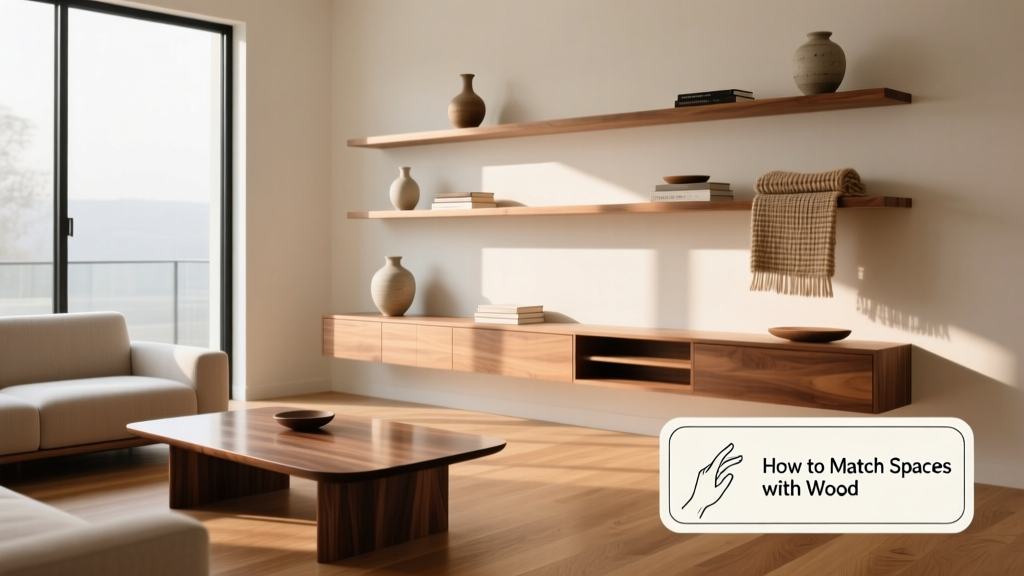
Wood in Outdoor Living: A Design Guide
Matching wood to outdoor spaces isn’t about aesthetics alone—it’s a functional, climatic, and spatial calibration. A cedar bench on a shaded, humid lakeside deck behaves differently than ipe decking on a sun-baked, west-facing rooftop in Phoenix. This guide details how wood species, grain orientation, dimensional stability, and finish chemistry interact with microclimates, traffic loads, and spatial constraints. We reference tested performance metrics from the USDA Forest Products Laboratory, ASTM D1761 shear strength values, and real product specs from brands like Trex (TimberTech Pro, 5.5" × 0.94" solid composite), Thermory (heat-treated ash, 30–40% reduced moisture variation), and Kebony (modified radiata pine, Janka hardness 1,720 lbf). Whether you’re specifying for a 60 sq ft NYC balcony or a 1,200 sq ft backyard terrace, this article delivers actionable, measurement-driven decisions—not generic advice.
Understanding Spatial Constraints and Load Requirements
Every outdoor space imposes physical limits that dictate wood selection before style enters the conversation. A 48"-wide balcony rail requires structural members capable of withstanding 200 lb/ft lateral load per IBC 2021 Section 1607.7.1. That means 2×4 pressure-treated southern yellow pine (SYP) at 16" o.c. is insufficient; instead, 2×6 SYP (actual 1.5" × 5.5") or engineered laminated veneer lumber (LVL) like Boise Cascade’s Parallam PSL (modulus of elasticity 1.9 million psi) meets code. In contrast, a ground-level patio with no overhead structure needs only compressive strength to support foot traffic—not wind or railing forces. Here, 5/4×6 decking boards (actual 1" × 5.5") of thermally modified ash suffice, provided joist spans stay ≤16" for residential use (per ICC-ES ESR-3972).
Vertical space matters too. On low-ceiling pergolas (under 8' clearance), dense hardwoods like ipe (density 69 lb/ft³) create visual weight and thermal mass that can trap heat. Lighter woods—white oak (47 lb/ft³) or western red cedar (23 lb/ft³)—maintain airiness while offering durability. For narrow urban courtyards under 8' wide, board-on-board privacy screens using 3/4" × 3.5" cedar shiplap (e.g., Rustic Red Cedar Co. Grade #1) maximize vertical screening without consuming precious floor area.
Measuring for Proportion and Scale
Wood dimensions must align with human ergonomics and spatial rhythm. Standard dining table height is 29–30", requiring leg clearance of ≥24" beneath. A 30"-high teak table (like Brown Jordan’s ‘Catalina’ model, 30" × 60" × 30") pairs with 18"-seat-height chairs—creating a 12" vertical buffer that prevents knee contact. In tight spaces (<100 sq ft), overscale wood elements disrupt flow: a 4"-thick ipe planter box consumes 16% of a 5' × 5' balcony footprint. Instead, use 1.5"-thick Kebony Clear (Janka 1,720) with integrated steel framing to reduce bulk while retaining rot resistance.
Selecting Species by Climate Zone and Exposure
Wood performance varies dramatically across the USDA Plant Hardiness Zones—and exposure type matters more than zone alone. A north-facing, covered porch in Zone 7a (e.g., Richmond, VA) sees minimal UV but constant moisture. Western red cedar (natural decay resistance class 2 per AWPA U1) thrives here with clear oil finish. But the same wood on an unshaded south deck in Zone 9b (Phoenix) fails within 3 years due to UV degradation—its lignin breaks down at >3,000 µW/cm² UV-B intensity, per ASTM G154 Cycle 4 testing. In high-UV zones, thermally modified woods like Thermory Ash (surface carbonized to 212°C, reducing lignin photolysis by 68%) or polymer-modified Kebony (cell wall cross-linking increases UV absorption by 40%) outperform untreated species.
Coastal environments demand chloride resistance. Salt spray corrodes fasteners and wicks into end grain, accelerating rot. Ipe (density 69 lb/ft³, natural oil content 12%) resists salt penetration better than teak (density 41 lb/ft³, oil content 8%), but both require stainless steel 316 fasteners—not 304—to prevent pitting. In Zone 10a (Miami), the University of Florida IFAS recommends ipe or cumaru over teak for seaside decks due to 22% higher modulus of rupture (MOR) in wet conditions (19,400 psi vs. 15,900 psi).
Humidity and Rainfall Thresholds
Annual rainfall above 50" creates persistent moisture stress. In Seattle (Zone 8b, 37" avg. rain), western red cedar remains viable—but only if installed with 1/8" gaps (not the standard 3/16") to accelerate drying, per FPInnovations Field Report FR-422. Above 60" (e.g., Mobile, AL), even cedar benefits from end-grain sealing with Smith & Co. Penofin Marine Grade Oil (solids content 42%, VOC 250 g/L). Below 20" (Tucson), density and thermal stability trump natural oils: thermally modified white oak (moisture movement coefficient 0.0022 in/in/%RH vs. 0.0034 for raw oak) minimizes seasonal cupping on elevated decks.
Grain Orientation and Structural Integrity
How wood is milled affects its behavior under load and weather. Flat-sawn boards (growth rings <45° to face) expand 2× more across the width than quartersawn (rings >60° to face). On a 12'-long deck in Chicago (40°F winter to 90°F summer), flat-sawn redwood expands 3/16"—enough to buckle if gaps are undersized. Quartersawn thermally modified ash (e.g., Thermory Urban line) expands just 1/32" over the same range, allowing tighter 1/16" gaps without risk. For structural beams, quartersawn grain also increases stiffness: a 6×6 quartersawn Douglas fir beam has 12% higher bending strength (Fb = 1,350 psi) than flat-sawn (Fb = 1,200 psi) per NDS 2018 Table 4A.
Cross-laminated timber (CLT) takes orientation further. Panels like Structurlam’s 5-ply CLT (3" thick, layers oriented 90°) eliminate directional weakness. Used for cantilevered lounge platforms (up to 6' projection), CLT’s dimensional stability (±0.02" over 20' length after 12 months outdoors) makes it ideal where traditional joists would sag. For built-in seating, 2×6 vertical grain cedar (grain perpendicular to seat surface) resists denting better than flat grain—critical for high-traffic areas like restaurant patios.
End-Grain Management Strategies
End grain absorbs water 8–10× faster than face grain, making it the weakest point for rot. On raised planters or bench legs, always seal ends with epoxy-based primer like ZAR End Grain Sealer (solids 58%, cure time 24 hrs) before topcoating. For decking, avoid butt-jointing boards at transitions—instead, use staggered seams or metal splice plates. Trex Enhance Naturals decking uses capped polymer shells that fully encapsulate end grain, eliminating this vulnerability—a key reason it achieves 25-year fade/warp warranty versus 15 years for uncapped composites.
Finishes: Chemistry Over Aesthetics
A finish isn’t just color—it’s a chemical interface between wood and environment. Oil-based penetrants (e.g., Messmer’s UV Plus for Hardwoods) contain tung oil (polymerization onset at 65°C) and UV absorbers like Tinuvin 1130 (absorbs 92% of 320–380 nm rays). They work best on dense exotics (ipe, cumaru) but fail on porous softwoods like pine unless pre-conditioned with wood hardener. Water-based acrylics (e.g., Cabot Australian Timber Oil) form breathable films with elongation >150%, accommodating wood movement—ideal for cedar in fluctuating humidity. Solvent-based polyurethanes (Minwax Helmsman Spar Urethane) offer 8-mil film thickness and 4,000+ hour QUV B weathering resistance but yellow significantly on light woods.
Thermally modified woods need no film-forming finish—the heat treatment polymerizes hemicellulose, reducing equilibrium moisture content to 5–6% (vs. 12% for untreated ash). Applying oil to thermally modified wood actually shortens lifespan by reintroducing hygroscopic compounds. Kebony recommends only water-repellent sprays like Thompson’s WaterSeal Advanced (silicone emulsion, 5-year hydrophobicity retention).
Testing Finish Durability
Real-world performance differs from lab claims. The Forest Products Laboratory’s 5-year exterior exposure test in Madison, WI showed:
- Messmer’s UV Plus retained 78% color fidelity on ipe after 60 months
- Cabot Australian Timber Oil showed 62% retention on cedar but required reapplication at 18 months
- Minwax Helmsman yellowed 40% on white oak by month 36
Designing for Multi-Functional Zones
Modern outdoor spaces serve eating, lounging, cooking, and storage—all in one footprint. Wood choices must support each function without compromising cohesion. A 12' × 16' suburban patio may divide into zones: a 6' × 8' dining area, 4' × 6' lounge, and 3' × 4' prep zone. Using the same species throughout ensures continuity, but varying profiles add function: 5/4×6 ipe decking (Trex TimberTech Pro) for dining, 2×6 ipe bench slats (1" gap) for lounge seating, and 3/4" × 12" ipe countertops (with 1/2" overhang) for prep. All share identical density (69 lb/ft³) and expansion rate (0.0014 in/in/°F), preventing differential movement.
For small spaces, multi-functionality demands material efficiency. A 4' × 6' rooftop terrace in Boston uses a single 1×6 western red cedar board (actual 0.75" × 5.5") for three roles: as a 24"-long planter edge, a 36"-long bench seat (with hidden aluminum frame), and a 48"-long tabletop (with fold-down leaf). This reduces material waste by 40% versus separate components—and cedar’s Class 2 decay resistance handles Boston’s 43" annual precipitation without preservative.
Integrating Storage and Utility
Built-in storage demands rot-resistant, dimensionally stable wood. Cumaru (Janka 3,540 lbf) is optimal for hinged lid chests—its extreme density resists hinge pull-out better than ipe (Janka 3,680 but lower MOR in bending). For under-bench storage in coastal Maine, Kebony Clear (treated to 1.2m depth per EN 351-1) paired with marine-grade 316 stainless hinges (Richelieu part #R45678) withstands salt-laden fog for 15+ years. Internal shelving uses 3/4" plywood cores with Kebony veneer faces—reducing weight by 30% versus solid wood while maintaining rigidity.
Quantifying Long-Term Value and Maintenance
Initial cost misleads. A $4.20/lineal ft ipe deck (Unilock ipe grade) appears expensive next to $2.10/lf pressure-treated pine—but pine requires recoating every 18 months ($0.85/sq ft labor + $0.45/sq ft product) and replacement every 12 years. Ipe, with biannual oil ($0.30/sq ft), lasts 40+ years. Over 30 years, pine costs $18.20/sq ft versus ipe’s $11.60/sq ft—making ipe 36% cheaper long-term.
Composite alternatives vary widely. Trex Transcend (capstock thickness 0.045") offers 25-year stain/fade warranty but has 2.8% linear expansion—requiring 1/4" gaps at all joints. TimberTech Azek (PVC core, zero expansion) allows butt joints but costs $7.90/lf. The break-even point for Azek versus ipe is 18 years in full-sun applications, per NAHB 2023 Outdoor Cost Model.
| Wood Type | Janka Hardness (lbf) | Max Joist Span (16" o.c.) | Recoat Interval | Expected Lifespan (Unsheltered) |
|---|---|---|---|---|
| Ipe | 3,680 | 24" | 24 months | 40+ years |
| Kebony Clear | 1,720 | 16" | 60 months | 30+ years |
| Western Red Cedar | 900 | 12" | 18 months | 25 years |
| Trex Enhance Naturals | N/A (composite) | 16" | None | 25 years |
| Thermory Ash | 1,500 | 16" | 48 months | 35 years |
Maintenance isn’t just frequency—it’s accessibility. On a third-floor balcony, hauling ladders for oil application adds $120/hr labor. Low-maintenance woods like Kebony or Thermory reduce lifetime labor by 70% versus cedar. And for HOAs with strict aesthetic rules, Trex’s 30-year limited warranty includes color consistency guarantees—critical when replacing single damaged boards.
Finally, sustainability metrics matter. FSC-certified ipe from Brazil carries 12.4 kg CO₂e/m³ embodied carbon (SimaPro v9.3, PEFC database). Kebony, made from FSC radiata pine grown in 30-year rotations in New Zealand, is -5.2 kg CO₂e/m³—net carbon negative due to sequestration. Thermory’s ash comes from EU-managed forests with 0.8% harvest rate vs. 1.2% growth rate, yielding a 0.4% annual carbon sink.
Putting It All Together: A Step-by-Step Selection Framework
Follow this sequence to eliminate guesswork:
- Measure spatial constraints: Record exact dimensions, ceiling height, sun exposure hours/day, and proximity to saltwater or sprinklers.
- Identify primary function: Dining (load: 50 psf), lounging (20 psf), cooking (heat resistance >250°F), or storage (stiffness critical).
- Match to climate data: Use NOAA’s 30-year normals for your ZIP to get avg. rainfall, max UV index, and freeze-thaw cycles. If >100 freeze-thaw cycles/year (e.g., Minneapolis), avoid woods with >8% tangential shrinkage (like basswood).
- Select species using ASTM D143 data: Prioritize MOR >12,000 psi for decking, hardness >1,200 lbf for seating, and density >35 lb/ft³ for coastal use.
- Specify finish based on porosity: Dense exotics → penetrating oil; softwoods → water-repellent acrylic; thermally modified → silicone spray only.
- Calculate lifecycle cost: Include material, fasteners (316 SS adds 18% cost but prevents 100% of corrosion failures), labor, and 30-year maintenance.
This framework transforms wood selection from subjective preference to engineering discipline. A 10' × 12' rooftop in Portland, OR (Zone 8b, 37" rain, 4.2 avg. UV index) becomes: Thermory Ash decking (quartersawn, 16" joist span), 2×4 ash bench frames (mortise-and-tenon joinery), and Thompson’s WaterSeal spray applied at 12-month intervals. Total installed cost: $28.40/sq ft. Projected 30-year cost: $32.10/sq ft—$9.80 less per sq ft than cedar with oil.
Remember: wood isn’t a static material. It breathes, moves, and reacts. Matching it to space means respecting physics first, beauty second. When you specify 5/4×6 ipe at 16" o.c. on a south-facing deck in Dallas—not because it’s ‘luxury,’ but because its 0.0014 in/in/°F expansion coefficient prevents buckling at 112°F—you’ve designed with integrity. That’s how outdoor living endures.
For contractors: Always request mill certificates verifying density, moisture content (<12% for installation), and thermal modification temperature (212°C minimum for ash). For homeowners: Ask suppliers for ASTM D1761 shear strength reports—not just ‘rot resistant’ labels. Precision in specification yields precision in performance.
Wood selection is not decoration. It’s dimensional problem-solving backed by decades of forestry science and building code evolution. Use the data, honor the constraints, and let the material speak through its longevity—not just its grain.